Must Know Vocabulary
| Word | العربية | Deutsch | Français | Русский |
|---|---|---|---|---|
| بستان | Obstgarten | verger | фруктовый сад | |
| تطعيم | Veredelung | greffage | прививка | |
| همس خافت | Flüstern | murmure | шелест | |
| ملتوي ومتقوس | knorrig | noueux | корявый | |
| ثمار متساقطة | Fallobst | fruits tombés | падалица | |
| كاتدرائية | Kathedrale | cathédrale | собор | |
| نزاع عائلي | Fehde | querelle | вражда | |
| دفتر حسابات | Hauptbuch | grand livre | бухгалтерская книга |
The Story
Edmund Thorne had worked the orchards of Thornfield Farm for forty-three years, ever since his father had pressed the worn leather of the grafting knife into his adolescent palm and pronounced him fit for the task. He knew every gnarled limb of the Bramley trees, every hollow where the robins nested, and every patch of earth where the roots ran shallow. What he did not know was why, on an evening in late October, the wind had begun to speak.
It started as nothing more than a murmur, a susurration beneath the rustle of falling leaves. Edmund had paused mid-harvest, a barrel of Cox's Orange Pippins balanced against his hip, and listened. At first, he dismissed it as the creaking of old wood, the settling of the wooden crates stacked along the northern wall. But then the breeze shifted, carrying with it something unmistakable: a human voice, thin and distant, drifting between the rows of trees like a ghost in moth-eaten clothing.
"You took what was not yours to take."
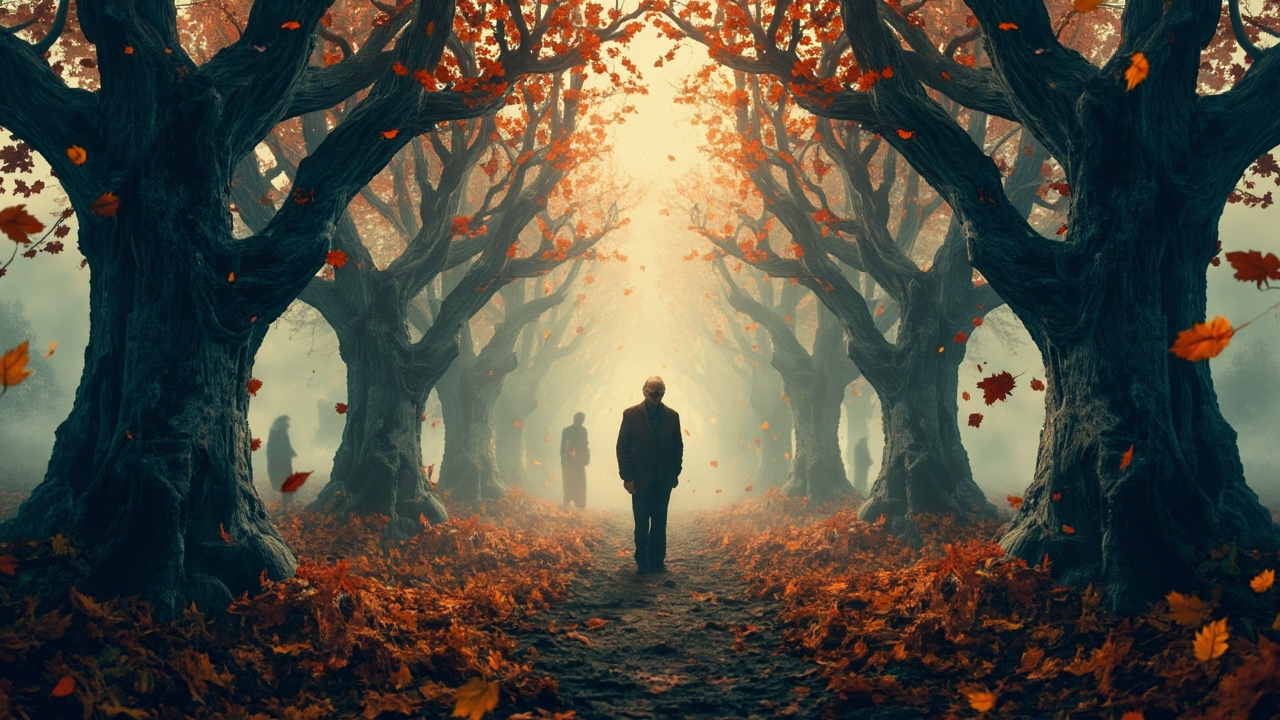
The words dissipated into the October air, leaving Edmund cold in a way that had nothing to do with the temperature. He set down the barrel and walked slowly toward the source of the sound, his brogues crunching on the windfall apples scattered across the grass. The orchard stretched before him, a cathedral of silver bark and copper leaves, and for a moment he thought he glimpsed figures moving between the trees—shadows without substance, forms without faces. Then the wind died, and they were gone.
That night, Edmund could not sleep. He lay in the narrow bed he had occupied since boyhood, staring at the ceiling where the moonlight cast prison-bar shadows through the window. His grandfather had slept in this same room, and his grandfather before that, and so on back through the generations. Thornfield had been in the Thorne family since 1847, when a man named Josiah Thorne had emigrated from the east and purchased twenty acres of what was then rough scrubland. The orchard, he had planted himself, and it had fed the Thornes through famines, wars, and the slow erosion of rural livelihood. Yet Edmund had always sensed a shadow hanging over the place—a weight in the silence, a question no one had ever dared to ask.
On the following morning, he found the box.
It was buried beneath the floorboards of the barn, beneath a loose oak plank that Edmund had known about since childhood but never thought to investigate. His father had called it a "sacrificial board," some old farmer's superstition about keeping the foundations stable. Edmund had humoured the notion without believing it. But the box was real, and when he pried it open with trembling hands, he discovered a sheaf of letters bound with twine, their paper yellowed and brittle as autumn twigs.
The handwriting was cramped, almost illegible, but Edmund pieced together the story over the course of three sleepless nights. In 1891, Josiah Thorne had entered into partnership with a man named Samuel Crane, a neighbouring farmer whose land bordered Thornfield to the west. Together they had cultivated the orchard, shared the harvest, and prospered. But then a woman named Eliza Hadley had come between them—a woman whom both men loved, and whom neither could have. When she chose Josiah, Samuel's fury knew no bounds. He accused Josiah of stealing not only his beloved but his share of the profits, of falsifying the accounts, of treachery and deceit. The feud that followed had torn the community apart. Samuel had died in poverty, cursing the Thornes with his final breath, and the two families had never spoken since.
But the letters told a different story.
Edmund found the proof hidden among the correspondence: a ledger, meticulously kept by Samuel himself, in which he had confessed to the very crimes he had accused Josiah of committing. Samuel had stolen from the partnership, had gambled away the money in the taverns of the nearest town, and had fabricated the accusations to save himself from ruin. Josiah had known the truth but had remained silent, allowing the community to believe the worst of his former friend rather than expose a dying man's shame. It was mercy of a kind, Edmund supposed, but it had come at a terrible cost—two families severed, a grudge festering across four generations, and a lie enshrined in the local memory like a saint's relic.
The wind spoke again on the fifth evening, but this time Edmund did not flinch. He walked into the orchard as the sun bled red across the horizon and stood beneath the oldest tree, the one Josiah had planted with his own hands in the year of the Great Exhibition. The voices were clearer now, and among them he could distinguish one—a woman's voice, gentle and sad, whispering words that seemed meant for him alone.
"Make it right," she breathed. "Before it is too late for rightness to matter."
Edmund had done some research in the intervening days. The Crane family still existed, or at least a branch of it did. A distant cousin, a woman named Margaret Crane who taught history at the secondary school in the nearest town, had answered his tentative letter with a reply that betrayed both suspicion and hope in equal measure. They had agreed to meet at the orchard's edge on the first of November, when the last of the apples would be gathered and the trees would stand stripped and silent, waiting for winter.
Margaret was older than Edmund had expected, her hair silver where his was grey, her eyes sharp as the knife he used for grafting. She listened to his account without interruption, her face unreadable as stone. When he handed her the ledger, she studied it for a long moment, and when she looked up, her eyes were wet.
"My father always said the Thornes were thieves," she said quietly. "He made me swear never to set foot on this land."
"Your father was wrong," Edmund replied. "As, it seems, was my great-grandfather—for different reasons."
They stood together in the orchard as the wind stirred the bare branches overhead, and for the first time in over a century, the voices fell silent. The grudge had been buried, the truth excavated, and the land could finally rest. Edmund offered Margaret the northern quarter of the orchard—land that had once belonged to Samuel Crane, returned at last—and she accepted with a handshake that sealed not only an agreement but a reconciliation.
That winter, they planted new trees together: twenty saplings of a variety neither family had ever grown before, a hybrid that would not fruit for years yet but would, in time, bear the name Crane-Thorne. And when the wind blew through the orchard in the seasons that followed, it carried no whispers of old grievances, only the patient silence of a story finally laid to rest.