Must Know Vocabulary
| Word | العربية | Deutsch | Français | Русский |
|---|---|---|---|---|
| مزائد | Auktionator | commissaire-priseur | аукционист | |
| سلالة | Herkunft | provenance | провенанс | |
| تزوير | Fälschung | faux | подделка | |
| حكم قضائي | einstweilige Verfügung | injonction | судебный запрет | |
| محام | Rechtsanwalt | avocat | юрист | |
| مدعي | Anspruchsteller | demandeur | истец | |
| منسوب | zugeschrieben | attribué | приписываемый | |
| نُهب | geplündert | pillé | разграблено | |
| قاعة المزاد | Auktionssaal | salle des ventes | зал аукциона | |
| فهرس شامل | Werkverzeichnis | catalogue raisonné | каталог-резерне |
The Story
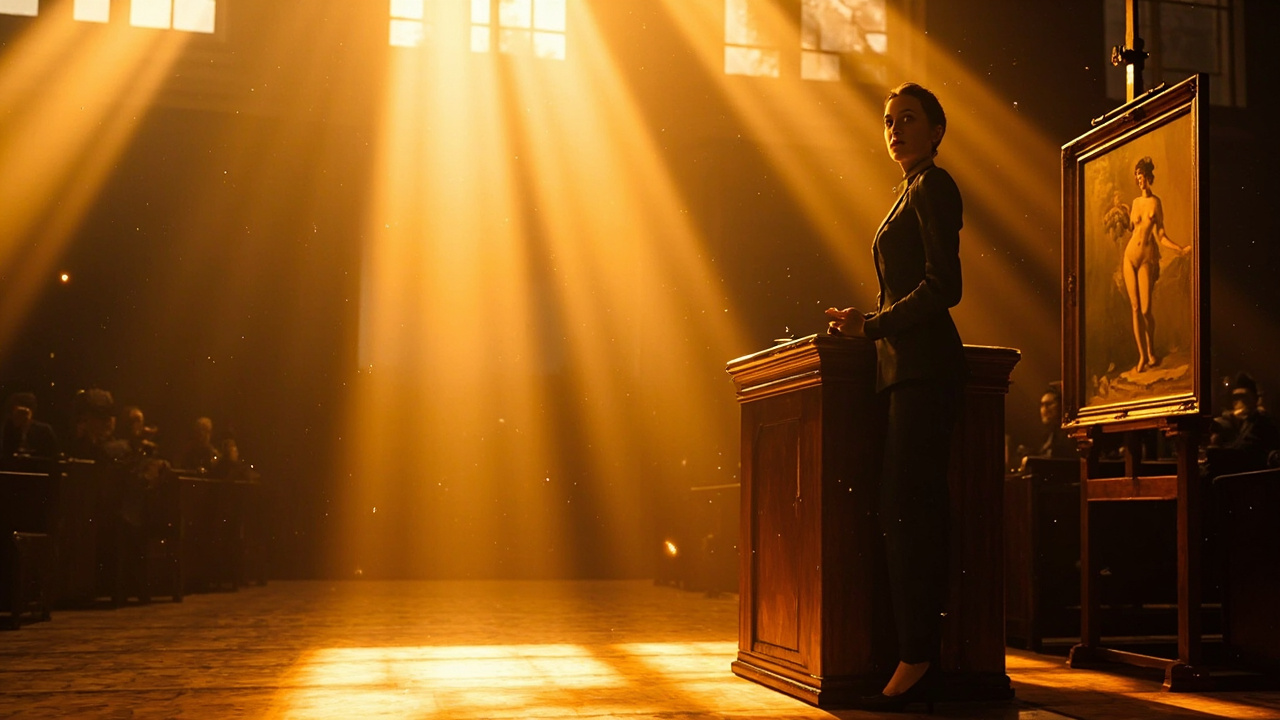
The morning light filtered through the tall windows of Whitmore & Sons Auction House, casting long shadows across the parquet floor of the saleroom. Victoria Ashworth, senior auctioneer and head of the Impressionist department, stood before the podium with an expression of carefully concealed unease. Before her lay the catalogue for the afternoon's star lot: Lot 47, a painting attributed to the studio of Eugène Delacroix, recently discovered in a Hampshire country house.
The painting itself was unremarkable—a half-nude figure in a languid classical pose, painted with the sort of confident brushwork that could have emanated from any number of mid-nineteenth century Parisian ateliers. What had made it the talk of every dealer's salon in London was not its aesthetic merit, but the provenance letter that had accompanied it: a yellowed manuscript suggesting the work had been part of a collection assembled by Sir Edmund Whitmore during his tenure as Governor of Bengal.
Beneath the surface of this apparent discovery, however, lay something altogether more corrosive.
The First Challenge
The morning's viewings had barely concluded when a solicitor's letter arrived by courier, demanding the immediate withdrawal of Lot 47. The claimant was one Dr Amara Osei, a senior lecturer in art history at SOAS, who maintained that the painting had been looted from her great-great-grandfather's compound in Kumasi during the British punitive expedition of 1874. She intended to seek a court injunction should Whitmore & Sons refuse compliance.
Victoria received this intelligence with the stoic demeanour expected of someone who had navigated the treacherous waters of contested estates for fifteen years. Yet as she set down the telephone receiver, she could not deny a creeping sense of dread. The Delacroix attribution had always struck her as somewhat convenient—a discovery emerging from the blue, accompanied by documentation that raised almost as many questions as it answered.
"We shall need to verify the provenance independently," she told her assistant, who had appeared at her elbow with the slightly glazed expression of someone who had spent too long contemplating other people's heirlooms. "Send a formal response to Dr Osei's solicitors. We require evidence of her claim before we consider withdrawal."
The Web Tightens
By the afternoon, two further complications had materialised. A letter from the British Museum arrived, suggesting that the painting bore stylistic affinities with works they had examined in 1967—works that had subsequently been declared forgeries. And a Mr Gerald Fairweather QC, acting on behalf of a charitable trust, had telephoned to insist that his family had owned the painting since 1923, having purchased it through Christie's at a sale where it had been described as a genuine Delacroix studio work.
Victoria found herself with three conflicting narratives and no clear path between them. The painting, it seemed, had acquired a far more complicated biography than anyone had anticipated. She began the painstaking work of untangling the threads—correspondence with Dr Osei's university, requests for documentation from the Fairweather trust, a careful examination of the Delacroix catalogue raisonné.
It was in the latter that she discovered the first significant discrepancy. The painting as described in the 1923 Christie's catalogue bore different dimensions from the work currently in her care. More troubling, the Christie's entry described the figure's pose as facing right; the Hampshire painting faced left.
The Truth Emerges
The revelation came not from archives but from the frame itself. During a routine examination, Victoria noticed the backing canvas was slightly newer than it should have been. Peeling back the tacks with careful fingers, she extracted a folded fragment of newspaper—poorly concealed, as though someone had stuffed it there in haste. The headline read: REWARD OFFERED FOR RETURN OF STOLEN PAINTING. The date was 1911. The description matched the Christie's entry, not the current work.
Victoria sat back on her heels, the full horror of the situation dawning on her. Somewhere between 1911 and 1923, the original painting had been stolen, replaced with a forgery, and sold through an auction house that had failed to detect the substitution. The Delacroix in Dr Osei's family had almost certainly been destroyed or lost. What remained was an elaborate deception, likely created to cover the theft.
Her subsequent investigation confirmed this theory. The forger—whoever he had been—had possessed considerable skill but had made the elementary mistake of reversing the composition. The pigments, examined under magnification, revealed traces of compounds not commercially available until the 1940s. The craquelure, so convincing to the untrained eye, had been artificially induced with careful application of heat and varnish.
A Measure of Justice
When Victoria contacted Dr Osei with her findings, the lecturer received the news with dignified restraint. "My family always suspected the painting's journey had not been straightforward," she said. "We shall pursue the matter through appropriate channels." The Fairweathers, it transpired, had been equally deceived—a family tradition of impeccable provenance had masked a century-old fraud.
The painting was quietly withdrawn from sale. Dr Osei began proceedings against the estate of Sir Geoffrey Fairweather's descendants, while the forger—if he had ever been identified—remained beyond the reach of any court. Victoria filed her report, recommending that Lot 47 be destroyed and the documentation preserved as a cautionary tale for future generations.
That evening, as she locked the saleroom doors, she permitted herself a moment of reflection. The world of fine art dealt in beauty and illusion in equal measure, she reflected. Her task was merely to distinguish between them. On this occasion, she had succeeded—though she suspected the full story of the Delacroix's disappearance would never be known. Some mysteries, she had learned, preferred to remain buried.