Must Know Vocabulary
| Word | العربية | Deutsch | Français | Русский |
|---|---|---|---|---|
| منفاخ الزجاج | Glasbläser | souffleur de verre | стеклодув | |
| فرن | Schmelzofen | four à verre | печь | |
| كريستال | Kristall | cristal | кристалл | |
| صيغة | Formel | formule | формула | |
| بوتقة | Schmelztiegel | creuset | тигель | |
| إرث | Erbe | héritage | наследство | |
| مُتوهِّج | leuchtend | lumineux | светящийся | |
| ورشة | Werkstatt | atelier | мастерская |
The Story
The ferry from Venice cut through the grey morning mist, carrying Marco Valentini toward an inheritance he had never sought. He stood at the bow, clutching the lawyer's letter, watching as the island of Murano materialised through the fog like a ghost from another century.
His grandfather's workshop had stood empty for thirty years. No one had set foot inside since Nonno Aurelio had been carted off to the hospital, raving about formulas and secret recipes that he claimed had been stolen from him. Marco had been seven years old at the time. He remembered the old man's wild eyes, the way his hands had trembled as he clutched young Marco's shoulders and whispered promises about a crystal that would 'set the world alight'.
The workshop was in an even worse state than Marco had feared. The furnace had long since gone cold, its brickwork crumbling. Venice's persistent damp had seeped through the wooden floorboards, and everywhere there was the unmistakable smell of abandonment—mildew, dust, and the ghost of wood smoke.
Marco spent the first three days simply clearing debris and cataloguing what remained. He had not intended to stay longer than a week, just long enough to sell the property and settle his grandfather's estate. But on the fourth day, while prising up a loose board near the cold furnace, his hands struck something unexpected—a false bottom, cleverly concealed with wax and ingenuity.
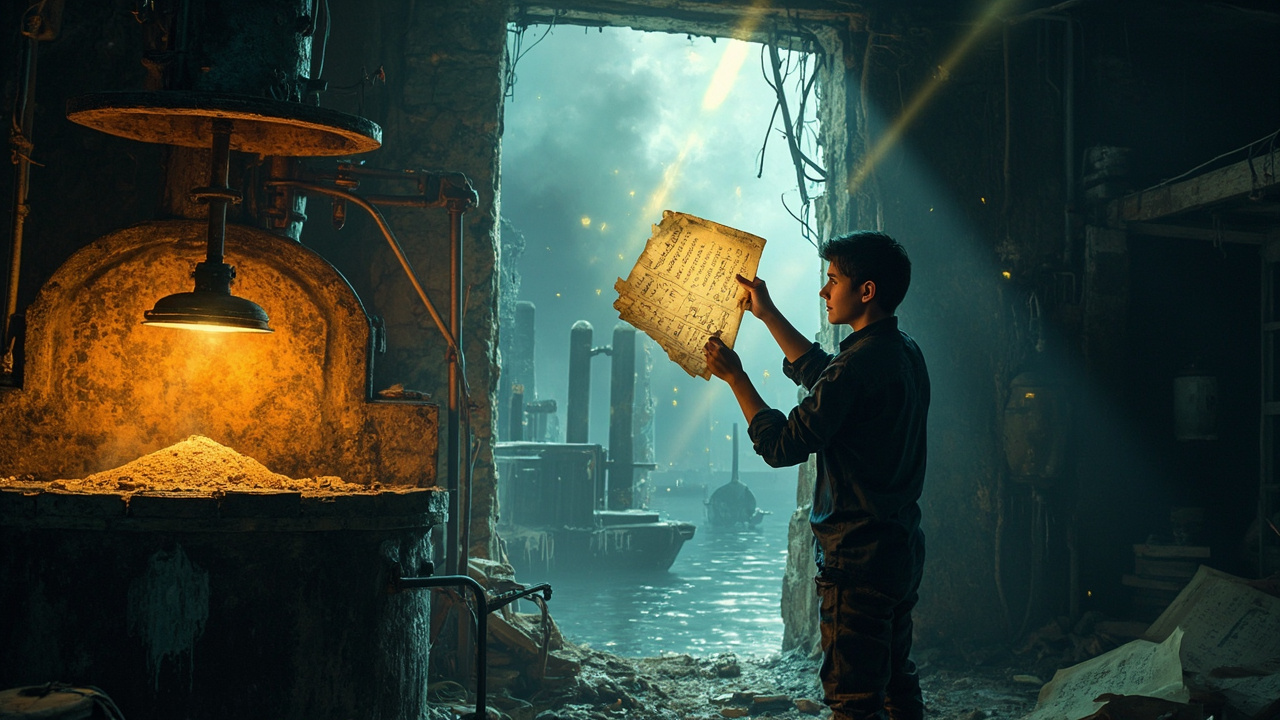
Beneath it lay a leather satchel, remarkably preserved in its hidden compartment. Marco carried it to the single window where the pale Venetian light filtered through, and carefully withdrew its contents: a sheaf of handwritten papers, yellowed with age, covered in his grandfather's distinctive cramped handwriting. Diagrams of furnace temperatures accompanied mathematical calculations, chemical formulae written in an archaic notation that took Marco hours to decipher. But it was the final page that made his breath catch in his throat—a title written in elaborate calligraphy: 'Formula for the Cristallo Celeste, as perfected by the Contarelli family, Anno Domini 1652.'
Marco knew his art history. The Contarelli family had been among Murano's most celebrated glassblowers during the seventeenth century, until their workshop had mysteriously burned to the ground in 1667. Their famous Cristallo Celeste—a crystal of such purity that it seemed to capture light itself—had vanished from the annals of glassmaking history, presumed lost forever. Scholars had written dissertations about what might have been, collectors had paid fortunes for fragments said to be from Contarelli pieces, and yet no one had ever managed to recreate the formula.
For two weeks, Marco lived and breathed those papers. He repaired the furnace brick by brick, sourced materials from suppliers in Padua and Verona, and began the painstaking process of experimentation. The formula was incomplete in places, requiring educated guesswork, intuition, and more than a few sleepless nights. But finally, on the fifteenth day, as molten glass swirled in his crucible and an unfamiliar compound worked its alchemy within, Marco saw it: a bubble of crystal so clear, so luminous, that it seemed to glow from within.
He held his breath as he shaped it. When it cooled and he examined it in the afternoon light, Marco felt tears prick his eyes. The Cristallo Celeste was real. His grandfather, in his madness or his wisdom, had preserved one of the greatest secrets of Venetian glassmaking.
The first visitor arrived that evening—a woman in expensive clothes who introduced herself as Dr Helena Voss, an art historian representing private collectors. She was charming, professional, and entirely too interested in the workshop's contents. Marco showed her nothing, but noticed how her eyes lingered on the furnace, how she photographed the papers he had left carelessly on the workbench.
The second visitor was less subtle. Three men arrived at midnight, their faces hidden, their intentions written in the speed with which they forced the door. Marco escaped through a back entrance he had noticed on his first day, clutching the satchel to his chest as he ran through the narrow streets of sleeping Murano.
By morning, he had made his decision. He would not sell the formula to the highest bidder, nor would he let it disappear again into hiding. He contacted the Museo del Vetro directly, arranged for the papers to be authenticated and displayed as a historical artefact, and donated the workshop itself to the city as a working studio for aspiring glassblowers.
On his final evening, Marco sat by the repaired furnace and watched the flames dance. The Cristallo Celeste would be studied, analysed, and its secrets eventually understood by those who came after him. It would never again belong to the shadows.
He thought of his grandfather then, not as the madman he had feared, but as a keeper of something precious—someone who had protected a legacy through decades of silence, waiting for the right hands to carry it forward. Marco smiled, feeling the warmth of the furnace on his face for the first time in weeks. Some inheritances, he realised, were worth far more than their weight in gold.