Must Know Vocabulary
| Word | العربية | Deutsch | Français | Русский |
|---|---|---|---|---|
| محطة قطار صغيرة | Haltestelle | halte | маленькая станция | |
| أُخليَ | evakuiert | évacué | эвакуированный | |
| شبح | Phantom | fantôme | призрак | |
| هوائي | pneumatisch | pneumatique | пневматический | |
| شارة | Abzeichen | insigne | эмблема | |
| ارتجف | zitterte | frémit | вздрогнул | |
| يتلاشى | sich auflösen | se dissoudre | растворяясь | |
| يلتف حلزونيا | sich drehen | tournoyer | закручиваясь |
The Story
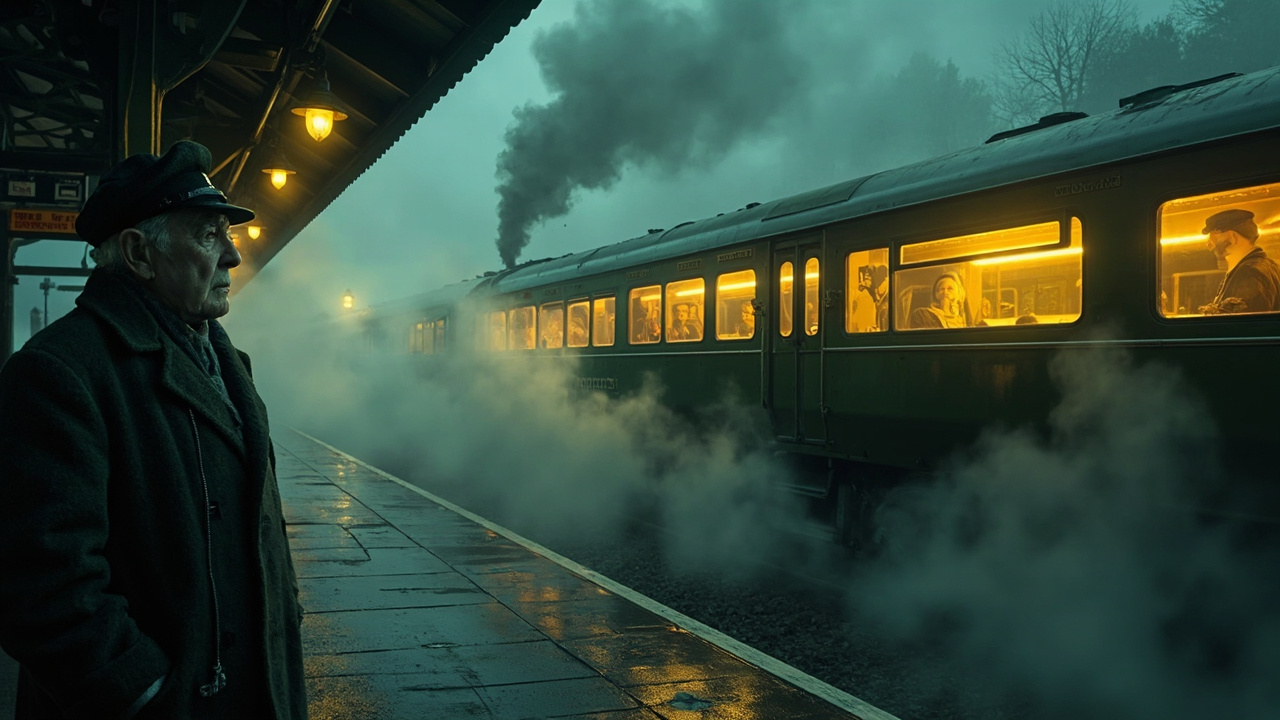
Marcus Thorne had grown accustomed to the silence. Three years on the night shift at Crowfield Halt had stripped away whatever appetite he'd once had for conversation. The station—a single platform, a ticket office no larger than a garden shed, and a waiting room that smelled perpetually of damp wool—was his entire universe between the hours of eleven and six. He made tea he didn't drink, completed logs no one would read, and listened to the wind moan through the empty car park as though mourning something it had lost long ago.
It was on the third night of November, when the fog had settled so thick over the Buckinghamshire countryside that the platform lights seemed to float in a sea of milk, that he first heard it: a distant rumble, like thunder rolling across the fields. Marcus glanced at the clock above his desk. Midnight exactly. The trains had ceased running hours ago—nothing was scheduled until the 5:47 to Marylebone. Yet there it was again, growing louder, accompanied now by the rhythmic clatter of wheels on track.
He rose from his chair, his old bones protesting, and made his way to the platform. The fog parted as though drawn aside by an invisible hand, and there—emerging from the mist like a phantom ship from grey waters—came a train.
It was not any locomotive Marcus had ever seen. The carriages were dark green, painted with the faded insignia of the Southern Railway, and the windows glowed with a warm amber light that seemed almost alive. The steam rising from the engine curled in shapes that defied the wind, spiralling upward before dissolving into nothing. A brass nameplate on the lead carriage caught the dim platform lights: The Aylesbury Express.
The train shuddered to a halt, and the doors slid open with a pneumatic hiss that didn't belong to any era Marcus knew.
They came in a steady stream—men in flat caps and work-worn coats, women clutching carpet bags and crying children, teenagers with gas mask cases slung across their bodies. Their clothes were those of 1943: utility coats, knitted jumpers, hand-me-down trousers patched at the knees. Some wore the hollow, frightened expression of people who had already said their goodbyes. They walked down the platform steps, their feet making no sound against the concrete, their eyes fixed on some distant point Marcus could not see.
"Excuse me," he called out, his voice emerging rougher than intended. "Can I help you? Is there something wrong with your journey?"
A woman turned to face him. She was perhaps thirty, with dark hair pinned beneath a headscarf and a child balanced on her hip. The child was pale, too pale, with eyes that seemed to look through Marcus rather than at him. The woman's gaze was not unkind, merely distant.
"We've been travelling a very long time," she said. Her voice carried the faint music of an East London accent. "Longer than we should have. The children are tired, and I'm afraid we've lost our way."
Marcus felt the hair rise on the back of his neck. He was not a superstitious man—had not been since his wife's funeral seven years prior, when he'd shouted at God and received only silence in return—but he understood, with the bone-deep certainty that sometimes replaces rational thought, that he was not speaking to the living.
"Lost your way," he repeated quietly.
"We were evacuated in September of forty-three," the woman continued. "Two hundred and fourteen children from Bethnal Green. The train was supposed to take us to the country—to safety. But there was an accident, you see. The bridge at Denham collapsed. The train fell into the river. We never arrived. We never..." Her voice faltered. "We've been trying to reach Aylesbury ever since. But the track keeps changing, and the fog never lifts, and the children don't understand why we can't go home."
Marcus thought of his daughter, whom he had not seen in fifteen years. He thought of all the ways we fail to reach the places we intend to go, the destinations that remain forever out of reach. He thought of the silence that had been his companion for so long, and how it had taught him, perhaps, to finally listen.
"Aylesbury," he said slowly. "The station at Aylesbury—you're trying to reach it?"
The woman nodded. Tears glistened on her cheeks but did not fall.
Marcus reached into his pocket and withdrew the old brass pocket watch his father had given him—the one that had stopped at 11:43 the morning of his wife's death. He did not know why he did it. He only knew that some gestures transcend explanation.
"I think perhaps," he said gently, "that Aylesbury isn't your destination anymore. I think perhaps you've been holding on because you never got to say goodbye. But the people waiting for you—they've made their peace. They're ready for you to rest now."
The woman stared at him for a long moment. Then, slowly, she smiled—a smile of such profound relief that it seemed to illuminate her entire face.
"Thank you," she whispered.
She turned and walked back to the train, gathering her child closer. One by one, the passengers followed—filing up the steps, taking their seats, as the amber light within the carriages grew warmer and brighter. The engine whistle blew, a sound that was somehow not mournful but hopeful, and the train began to move, gliding silently through the fog until it faded into the darkness beyond the platform.
Marcus stood alone on the empty platform, the pocket watch still warm in his hand. The fog had lifted. Above him, through a break in the clouds, a single star shone with uncommon brightness.
He remained there until the 5:47 arrived, its modern electric hum a stark contrast to the phantom silence of the midnight train. When the conductor asked why he looked so rested, so unexpectedly at peace, Marcus could only smile and shake his head.
Some journeys, he had learned, were never meant to end at a station.