Must Know Vocabulary
| Word | العربية | Deutsch | Français | Русский |
|---|---|---|---|---|
| شبكة | Gitter | réseau | решётка | |
| المواد فائقة التركيب | Metamaterialien | métamatériaux | метаматериалы | |
| كوارك | Quark | quark | кварк | |
| بلوري | kristallin | cristallin | кристаллический | |
| فتحة | Blende | ouverture | апертура | |
| استقطاب | Polarisation | polarisation | поляризация | |
| ما وراء الطبيعة | Metaphysik | métaphysique | метафизика | |
| ناشئ | entstehend | émergent | эмерджентный | |
| احتمالي | probabilistisch | probabiliste | вероятностный |
The Story
The first time Dr. Eleanor Vance looked through the Lattice Lens, she forgot to breathe.
Three years of sleepless nights, of funding rejections and colleagues' barely concealed pity, had led to this moment in a basement laboratory at the Cavendish. The lens itself was unremarkable to look upon—a disc of layered metamaterials, precisely etched to bend electromagnetic radiation in ways that conventional physics insisted were impossible. What mattered was not its appearance but its capability: it achieved a numerical aperture that, according to every peer-reviewed calculation, should have required a lens the size of a cathedral.
Eleanor had not built a cathedral. She had built something far stranger.
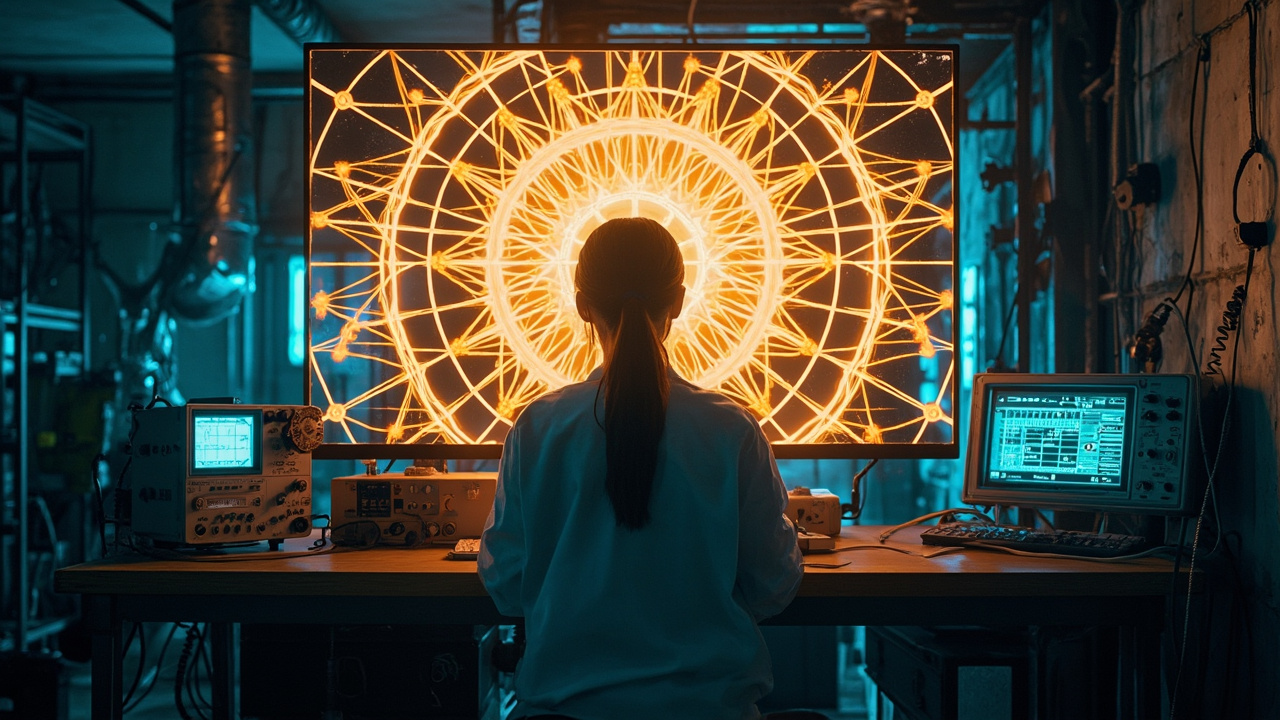
She adjusted the focus with trembling fingers. The display before her showed a field of view approximately one femtometre across—small enough to resolve individual quarks within a proton. She had requested leave from the university for this test, had told no one what she intended to observe. The knowledge felt dangerous, though she could not have explained why.
What she saw was not the probabilistic foam that quantum chromodynamics predicted.
It was a lattice.
The image rendered on her screen showed perfect geometric regularity: a crystalline structure of unfathomable precision, extending in all directions beyond the limits of her instrument's range. Each node of the lattice pulsed with what she can only describe as awareness—a soft, rhythmic emanation that seemed to respond to her observation. When she looked away, the pulses slowed. When she returned her gaze, they quickened, as though the structure itself was conscious of being watched.
Eleanor sat back in her chair. Her hands, usually steady enough to calibrate instruments measuring in nanometres, were shaking.
The Standard Model of particle physics described the fundamental constituents of matter and their interactions with elegant mathematical precision. It had predicted the Higgs boson, the top quark, the precise values of coupling constants. It had never, in any of its formulations, suggested that space itself possessed an intrinsic structure. And yet here it was: undeniable, geometric, and seemingly purposeful.
She ran the observation seventeen times over the following week, varying the wavelength of incident radiation, changing the angle of incidence, adjusting the polarisation. The lattice remained constant. It was not an artefact of her equipment—she had spent her career eliminating such artefacts. It was not a property of the particles she observed; the structure persisted whether she watched protons, electrons, or neutrons. It was a property of space itself, of the void through which all matter moved, and it had been hiding from every instrument humanity had ever pointed at the quantum world.
On the eighth day, she invited Professor James Hartley to observe. He was seventy-three years old, a theoretical physicist whose work on quantum field theory had helped shape the modern understanding of fundamental forces. He arrived at her laboratory with the slightly condescending air of a man who had seen countless promising results dissolve into experimental error.
He left four hours later with tears in his eyes.
"If this is what we have seen," he said, standing in the corridor with his coat half-fastened, "then the Standard Model is not wrong. It is incomplete in a way we did not imagine. We have been describing the furniture on the stage without noticing the stage itself has architecture."
The implications unfolded over the following months with the inexorable logic of a mathematical proof. If space possessed intrinsic structure, then the apparent randomness of quantum mechanics might not be fundamental but emergent—a statistical averaging over the deterministic behaviour of the lattice. If the lattice responded to observation, then consciousness and physics were not separate domains but intimately connected in ways that would require an entirely new metaphysics. If the lattice extended throughout the universe, then the apparent expansion of space might be better understood as a transformation of the lattice itself, its geometry evolving across cosmic time.
The discovery did not overturn the Standard Model so much as reveal that the model had been built upon foundations it did not understand. Eleanor's lens showed humanity a new floor beneath the basement they thought they knew.
She published her results in a paper with seventeen co-authors, each a sceptic converted by direct observation. The Nobel Committee awarded her physics prize the following year, but she accepted it with the quiet melancholy of someone who has seen too far and cannot return. The universe was stranger than the Standard Model had suggested, stranger than anyone had dared to imagine. It had architecture. It had purpose. And for the first time in human history, humanity had glimpsed the blueprint.
In the years that followed, others would build upon her work. They would map the lattice's geometry, decipher its language of pulses and nodes, begin the slow process of understanding what consciousness meant to a universe that seemed, in some profound sense, to be conscious itself. The Standard Model would evolve, as all models must, incorporating the lattice into its equations and emerging stronger for its humility.
But Eleanor Vance, who had stood first at the window into the infinite, would sometimes return to her laboratory late at night, when the building was empty and silent. She would look through the Lattice Lens one more time, watching the ancient structure pulse with its quiet, patient rhythm. She never knew if she was observing the universe or if the universe was, in some sense she could not articulate, observing her.
Perhaps, she came to think, there was no longer any meaningful distinction between the two.