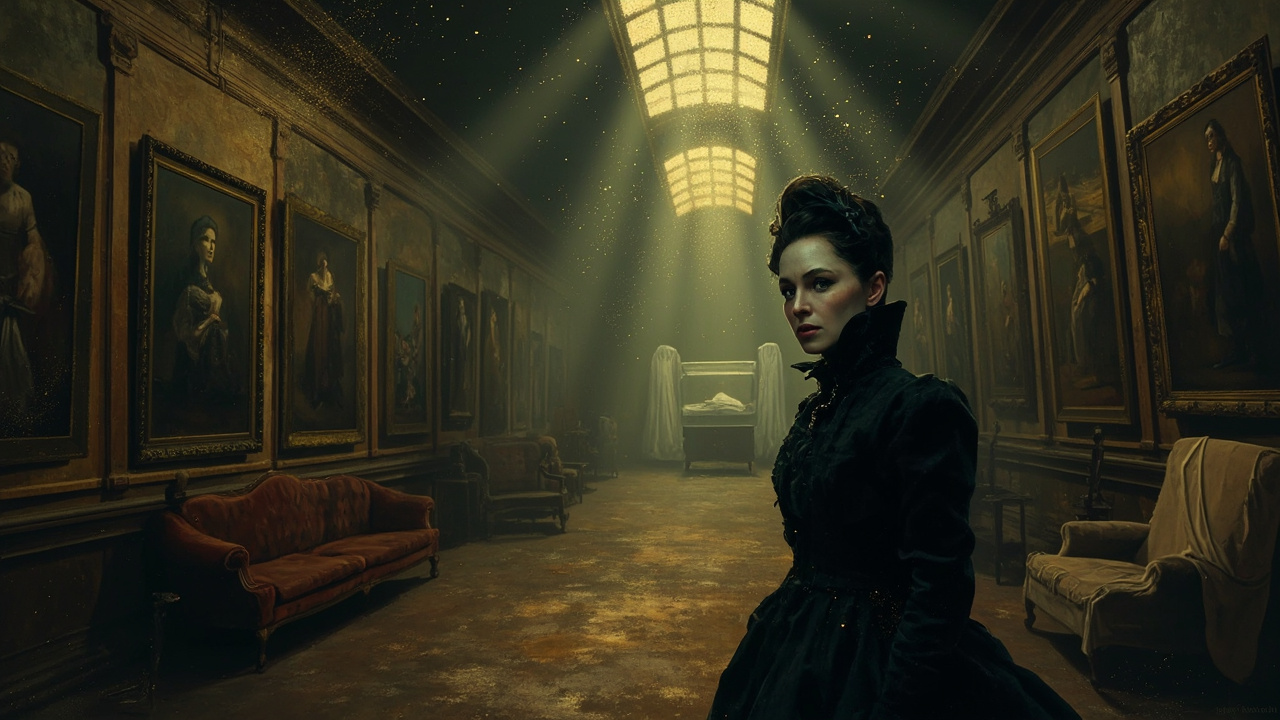
قاعة الأسماء المنسية
عملت إلينور مارش في متحف ألدرتون لمدة أحد عشر عامًا قبل أن تعثر على الباب. كان مخبأً خلف عرض لخزف ستافوردشاير من القرن الثامن عشر، غير مرئي إلا إذا كان أحد يعرف بالضبط أين يبحث — أو إذا كان قد أمضى عقدًا في حفظ كل ممر، كل ركن، كل زاوية منسية من الهندسة الم labyrinthية للمبنى.
كانت تبحث عن غرفة تخزين مذكورة في سجل الاقتناء لعام 1952. بدا عرض الخزف موقعًا غير محتمل، لكن السجل كان مصرًا. ما وجدته بدلاً من ذلك كان باب حريق، بإطار مختوم بختم شمع يحمل شعار المتحف قبل الحرب — قبل الحرب، قبل القصف، قبل إعادة الهيكلة التي محت كثيرًا من الذاكرة الجماعية للمؤسسة.
تنحى الباب لمفتاحها الرئيسي بصوت متذمر متردد، كأنه انتظر سنوات ليُزعج.
وراءه امتدت صالة طويلة لم ترها من قبل. كان الهواء باردًا وساكنًا، يحمل رائحة معدنية خافتة للقماش القديم والخشب المعتق. تسرب ضوء شفق شاحب عبر نوافذ عالية، زجاجهاثخين بسنوات من الأوساخ المتراكمة. وفي كل مكان — على الجدران، تحت أغطية الغبار، في حالات لم تُفتح قط — وقفت أدلة مجموعة لم تستطع تسميتها فورًا.
أول شيء لاحظته إلينور كان الغياب. لا لافتات. لا ملصقات. لا بطاقات صغيرة مكتوبة بآلة كاتبة تعرض المصدر أو الفنان أو التاريخ. مررت أصابعها عبر إطار لوحة، بورتريه لامرأة في أسود قاسٍ مقابل خلفية رمادية غامضة، فلم تجد سوى خشب عارٍ ورنيش قديم.
عملت بمفردها، كما كانت دائمًا تفعل. يفضل كبار أمناء المتحف تفويض المهام؛ أما الصغار فقد تعلموا منذ وقت طويل عدم التشكيك في رحلاتها المنفردة إلى أعماق المتحف. لذا عندما عادت إلى مكتبها تلك الليلة، كان ذلك بدون مظاهر أو تقرير، حاملةً فقط بضع صور التقطتها بهاتفها وشعورًا متزايدًا بالقلق.
راقتها المرأة في البورتريه. كان هناك شيء في تلك العيون المطلية — ليس تحديًا بالضبط، بل إصرارًا هادئًا، مطلبًا بأن تُشهد. بحثت في الأرشيف الرقمي للمتحف فلم تجد شيئًا. وشارفت التواريخ والأنماط والقرن المحتمل، فاكتشفت فجوات حيث يجب أن تكون السجلات. عقود كاملة غائبة ببساطة، كأن التاريخ قد عُدّل بيد مهملة.
في الأسابيع التالية، عادت إلينور إلى الصالة المخفية مرة بعد مرة. وثققت كل شيء.Interviewed retired staff members, most of whom had no knowledge the wing existed. One elderly conservator, now in his nineties and resident in a care home in Kent, grew quiet when she described the sealed door.
"They told us it was structural damage," he said, his voice thin and uncertain. "The bombing had weakened that section. Too dangerous to enter. We were forbidden to speak of it."
"Forbidden by whom?"
He shook his head. "The director. The board. I can't remember now. It was a different time."
It was a different time. That phrase became a refrain, a warning bell that rang through Eleanor's waking hours. A different time when artists could be erased. When names could be made to disappear from exhibition catalogues and auction records and the great encyclopaedias of art history. When the wrong associations, the wrong politics, the wrong bloodline could render a lifetime's work invisible.
The objects began to speak to her, each in its own voice. A landscape by the Vistula, painted with such tenderness that it seemed to ache. A series of lithographs depicting factory workers, their bodies rendered with an anatomical precision that owed debts to both Renaissance mastery and Marxist ideology. A marble bust of a composer, his expression caught mid-thought, forever about to speak. An embroidered textile from the Carpathian tradition, its symbols encoding a language of resistance that had been systematically dismantled.
She traced their origins. She requested access to sealed archives, submitted formal queries, filed reports with the museum's governing board. Most requests vanished into bureaucratic silence. One letter, however, arrived with a handwritten annotation in red ink: Cease this inquiry immediately.
She did not cease.
What she discovered was a lineage—not of families, but of artistic influence, passed from mentor to student across four generations. Names that had been familiar once, now obscure. Works that had hung in galleries across Europe, now scattered or destroyed. The trail led eastward, into territories that had changed hands repeatedly, whose borders had been redrawn by conquerors and commissars alike. Each regime had found its own reasons to condemn these artists: too bourgeois, too revolutionary, too Jewish, too Polish, too foreign. The reasons varied. The result was always the same.
Eleanor spent months reconstructing the story. She wrote letters to surviving relatives in Warsaw and Lviv and Vienna. She pieced together fragments from estate sales and private collections and the diaries of collectors who had managed to smuggle works west before the walls closed in. Slowly, impossibly, the lineage emerged from the void—Viktor Kaminsky, whose landscapes had been deemed decadent by Soviet critics in 1937. His student, Marta Żuk, whose prints had been confiscated by the Nazis and later by the People's Republic alike. Her daughter, Katya, whose musical portraits had survived only as photographs. And the marble composer, rendered by an unknown student whose name had been scratched from every record.
When Eleanor finally brought her findings to the board, she expected resistance. Instead, she received a single sheet of paper: a memorandum from 1962, stamped CONFIDENTIAL, which revealed that the sealed wing had been established precisely to contain these works. A burial, not a preservation. Evidence of complicity that ran deeper than any individual administrator's prejudice.
"What do you intend to do with this?" asked the board chair, his voice neutral, his eyes unreadable.
Eleanor looked at the portrait of the woman in severe black. She thought of Viktor Kaminsky's aching Vistula landscapes. She thought of Marta Żuk's confiscated prints. She thought of the unknown student's nameless composer.
"I intend to remember them," she said.
Der Saal der vergessenen Namen
Eleanor Marsh hatte elf Jahre lang im Alderton-Museum gearbeitet, bevor sie die Tür entdeckte. Sie war hinter einer Ausstellung von eighteenth-century Staffordshire-Porzellan versteckt, unsichtbar, es sei denn, man wusste genau, wo man suchen musste — oder man hatte ein Jahrzehnt damit verbracht, jeden Gang, jede Nische, jede vergessene Ecke der labyrinthartigen Architektur des Gebäudes auswendig zu lernen.
Sie hatte nach einem Lagerraum gesucht, der in einem Ankaufsregister von 1952 erwähnt wurde. Der Porzellan-Display schien ein unwahrscheinlicher Ort zu sein, doch das Register war hartnäckig. Was sie stattdessen fand, war eine Feiertür, ihr Rahmen mit einem Wachsstempel versiegelt, der das Vorkriegs-Wappen des Museums trug — vor dem Krieg, vor den Bombenangriffen, vor der Umstrukturierung, die so viel aus dem kollektiven Gedächtnis der Institution gelöscht hatte.
Die Tür gab unter ihrem Master-Schlüssel mit einem widerwilligen Ächzen nach, als hätte sie jahrelang darauf gewartet, gestört zu werden.
Dahinter lag eine lange Galerie, die sie noch nie gesehen hatte. Die Luft war kühl und still, trug den schwachen mineralischen Geruch alter Leinwand und gealterten Holzes. Blasses Nachmittagslicht filterte durch hohe Fenster, ihr Glas dick mit jahrzehntelangem Schmutz. Und überall — an den Wänden, unter Staubplanen, in Vitrinen, die nie geöffnet worden waren — standen die Beweise einer Sammlung, die sie nicht sofort benennen konnte.
Das Erste, was Eleanor bemerkte, war die Abwesenheit. Keine Schilder. Keine Etiketten. Keine kleinen getippte Karten mit Provenienz, Künstler oder Datum. Sie ließ ihre Finger über den Rahmen eines Gemäldes gleiten, ein Porträt einer Frau in strengem Schwarz vor einem unbestimmten grauen Hintergrund, und fand nichts als nacktes Holz und alten Firnis.
Sie arbeitete allein, wie immer. Die leitenden Kustoden zogen es vor zu delegieren; die jüngeren hatten längst gelernt, ihre einsamen Expeditionen in die Tiefen des Museums nicht zu hinterfragen. Also als sie an diesem Abend in ihr Büro zurückkehrte, war es ohne Aufhebens oder Bericht, nur mit einer Handvoll Fotos, die sie mit ihrem Telefon gemacht hatte, und einem wachsenden Gefühl der Unruhe.
Die Frau im Porträt verfolgte sie. Es war etwas in diesen gemalten Augen — nicht genau Trotz, sondern eine stille Beharrlichkeit, eine Forderung, gesehen zu werden. Sie durchsuchte das digitale Archiv des Museums und fand nichts. Sie verglich die Daten, den Stil, das wahrscheinliche Jahrhundert und entdeckte Lücken, wo Aufzeichnungen hätten sein sollen. Ganze Jahrzehnte fehlten einfach, als wäre die Geschichte von einer nachlässigen Hand redigiert worden.
In den folgenden Wochen kehrte Eleanor immer wieder in die verborgene Galerie zurück. Sie dokumentierte alles. Sie interviewte pensionierte Mitarbeiter, von denen die meisten keine Kenntnis davon hatten, dass dieser Flügel existierte. Ein älterer Restaurator, jetzt in den Neunzigern und in einem Pflegeheim in Kent lebend, wurde still, als sie die versiegelte Tür beschrieb.
"Man sagte uns, es seien strukturelle Schäden," sagte er, seine Stimme dünn und unsicher. "Die Bombenangriffe hatten diesen Abschnitt geschwächt. Zu gefährlich zu betreten. Wir durften nicht darüber sprechen."
"Verboten von wem?"
Er schüttelte den Kopf. "Der Direktor. Der Vorstand. Ich erinnere mich nicht mehr. Es war eine andere Zeit."
Es war eine andere Zeit. Dieser Satz wurde zu einem Refrain, einer Warnglocke, die durch Eleanors wache Stunden hallte. Eine andere Zeit, in der Künstler ausgelöscht werden konnten. In der Namen aus Ausstellungskatalogen und Auktionsaufzeichnungen und den großen Enzyklopädien der Kunstgeschichte verschwinden konnten. Als die falschen Verbindungen, die falsche Politik, die falsche Blutlinie das Lebenswerk unsichtbar machen konnten.
Die Objekte begannen zu ihr zu sprechen, jedes in seiner eigenen Stimme. Eine Landschaft an der Weichsel, gemalt mit einer solche Zärtlichkeit, dass sie zu schmerzen schien. Eine Serie von Lithographien, die Fabrikarbeiter darstellten, ihre Körper mit einer anatomischen Präzision dargestellt, die sowohl der Renaissance-Meisterschaft als auch der marxistischen Ideologie verpflichtet war. Eine Marmorbüste eines Komponisten, sein Ausdruck im Gedanken festgehalten, für immer im Begriff zu sprechen. Ein besticktes Textil aus der karpatischen Tradition, seine Symbole kodierten eine Sprache des Widerstands, die systematisch demontiert worden war.
Sie verfolgte ihre Ursprünge. Sie beantragte Zugang zu versiegelten Archiven, reichte formelle Anfragen ein, erstattete Berichte beim Vorstand des Museums. Die meisten Anfragen verschwanden in bürokratischem Schweigen. Ein Brief kam jedoch mit einer handschriftlichen Anmerkung in roter Tinte: Stellen Sie diese Untersuchung sofort ein.
Sie stellte nicht ein.
Was sie entdeckte, war eine Abstammungslinie — nicht von Familien, sondern künstlerischen Einflusses, von Mentor zu Schüler über vier Generationen weitergegeben. Namen, die einst vertraut waren, jetzt vergessen. Werke, die in Galerien in ganz Europa gehangen hatten, jetzt verstreut oder zerstört. Die Spur führte nach Osten, in Gebiete, die wiederholt die Hände gewechselt hatten, deren Grenzen von Eroberern und Kommissaren neu gezogen worden waren. Jedes Regime fand seine eigenen Gründe, diese Künstler zu verdammen: zu bourgeois, zu revolutionär, zu jüdisch, zu polnisch, zu fremd. Die Gründe variierten. Das Ergebnis war immer das gleiche.
Eleanor verbrachte Monate damit, die Geschichte zu rekonstruieren. Sie schrieb Briefe an überlebende Verwandte in Warschau, Lwiw und Wien. Sie fügte Fragmente aus Nachlassverkäufen und Privatsammlungen und den Tagebüchern von Sammlern zusammen, die es geschafft hatten, Werke nach Westen zu schmuggeln, bevor die Mauern sich schlossen. Langsam, unmöglich, tauchte die Abstammungslinie aus der Leere auf — Viktor Kaminsky, dessen Landschaften 1937 von sowjetischen Kritikern als dekadent bezeichnet worden waren. Seine Schülerin Marta Żuk, deren Drucke von den Nazis und später von der Volksrepublik konfisziert worden waren. Ihre Tochter Katya, deren musikalische Porträts nur als Fotografien überlebt hatten. Und der Marmor-Komponist, geschaffen von einem unbekannten Schüler, dessen Name aus jeder Aufzeichnung gekratzt worden war.
Als Eleanor ihre Ergebnisse schließlich dem Vorstand vorlegte, erwartete sie Widerstand. Stattdessen erhielt sie ein einzelnes Blatt Papier: ein Memorandum von 1962, gestempelt VERTRAULICH, das enthüllte, dass der versiegelte Flügel genau zu dem Zweck eingerichtet worden war, diese Werke zu enthalten. Ein Begräbnis, keine Bewahrung. Beweis für Mittäterschaft, die tiefer reichte als die Vorurteile jedes einzelnen Administrators.
"Was beabsichtigen Sie mit diesem zu tun?" fragte der Vorstandsvorsitzende, seine Stimme neutral, seine Augen unlesbar.
Eleanor blickte auf das Porträt der Frau in strengem Schwarz. Sie dachte an Viktor Kaminskys schmerzende Weichsellandschaften. Sie dachte an Marta Żuks konfiszierte Drucke. Sie dachte an den namenlosen Komponisten des unbekannten Schülers.
"Ich beabsichtige, mich an sie zu erinnern," sagte sie.
La Sala de los Nombres Olvidados
Eleanor Marsh había trabajado en el Museo Alderton durante once años antes de encontrar la puerta. Estaba oculta detrás de una exposición de cerámica Staffordshire del siglo dieciocho, invisible a menos que uno supiera exactamente dónde mirar — o a menos que uno hubiera pasado una década memorizando cada pasillo, cada rincón, cada rincón olvidado de la arquitectura laberíntica del edificio.
Había estado buscando un armario de almacenamiento mencionado en un libro de adquisiciones de 1952. La exposición de cerámica parecía una ubicación improbable, sin embargo el libro era insistente. Lo que encontró en su lugar fue una puerta cortafuegos, su marco sellado con un sello de cera que llevaba el escudo del museo de antes de la guerra — antes de la guerra, antes de los bombardeos, antes de la reestructuración que había borrado tanto de la memoria colectiva de la institución.
La puerta cedió a su llave maestra con un gemido reacio, como si hubiera esperado años a ser perturbada.
Más allá yacía una larga galería que nunca había visto. El aire era fresco y quieto, llevando el leve aroma mineral de lienzo viejo y madera añeja. Pálida luz de la tarde se filtraba a través de ventanas altas, sus cristales gruesos con décadas de mugre acumulada. Y en todas partes — a lo largo de las paredes, bajo sábanas anti-polvo, en vitrinas que nunca habían sido abiertas — estaba la evidencia de una colección que no podía nombrar inmediatamente.
Lo primero que Eleanor notó fue la ausencia. Sin letreros. Sin etiquetas. Sin pequeñas tarjetas mecanografiadas ofreciendo procedencia, artista o fecha. Pasó los dedos por el marco de una pintura, un retrato de una mujer en negro severo contra un fondo gris ambiguo, y no encontró nada más que madera desnuda y barniz antiguo.
Trabajaba sola, como siempre hacía. Los conservadores principales preferían delegar; los junior habían aprendido hace mucho tiempo a no cuestionar sus expediciones solitarias a las profundidades del museo. Así que cuando regresó a su oficina esa tarde, fue sin fanfarrias ni informes, llevando solo un puñado de fotografías que había tomado con su teléfono y una creciente sensación de inquietud.
La mujer del retrato la perseguía. Había algo en esos ojos pintados — no exactamente desafío, sino una tranquila insistencia, una demanda de ser presenciada. Buscó en el archivo digital del museo y no encontró nada. Cruzó las fechas, el estilo, el probable siglo, y descubrió lagunas donde deberían haber estado los registros. Décadas enteras simplemente ausentes, como si la historia hubiera sido editada por una mano descuidada.
En las semanas siguientes, Eleanor regresó a la galería oculta una y otra vez. Documentó todo. Entrevistó a miembros del personal jubilado, la mayoría de los cuales no tenían conocimiento de que el ala existiera. Un antiguo conservador, ahora en sus noventa y residiendo en un hogar de cuidado en Kent, se quedó callado cuando ella describió la puerta sellada.
"Nos dijeron que era daño estructural," dijo, su voz delgada e incierta. "Los bombardeos habían debilitado esa sección. Demasiado peligroso para entrar. Se nos prohibió hablar de ello."
"¿Prohibido por quién?"
Él negó con la cabeza. "El director. La junta. No puedo recordar ahora. Era una época diferente."
Era una época diferente. Esa frase se convirtió en un estribillo, una campana de advertencia que resonaba a través de las horas de vigilia de Eleanor. Una época diferente cuando los artistas podían ser borrados. Cuando los nombres podían desaparecer de los catálogos de exposiciones y registros de subastas y las grandes enciclopedias de historia del arte. Cuando las asociaciones equivocadas, la política equivocada, el linaje equivocado podían hacer invisible el trabajo de toda una vida.
Los objetos comenzaron a hablarle, cada uno con su propia voz. Un paisaje junto al Vístula, pintado con tal ternura que parecía doler. Una serie de litografías que representaban trabajadores de fábrica, sus cuerpos representados con una precisión anatómica que debía deudas tanto a la maestría del Renacimiento como a la ideología marxista. Un busto de mármol de un compositor, su expresión capturada a medio pensamiento, para siempre a punto de hablar. Un textile bordado de la tradición carpática, sus símbolos codificando un lenguaje de resistencia que había sido sistemáticamente desmantelado.
Rastreó sus orígenes. Solicitó acceso a archivos sellados, presentó consultas formales, presentó informes a la junta directiva del museo. La mayoría de las solicitudes desaparecieron en silencio burocrático. Sin embargo, una carta llegó con una anotación escrita a mano en tinta roja: Cesen esta investigación inmediatamente.
Ella no cesó.
Lo que descubrió fue un linaje — no de familias, sino de influencia artística, pasada de mentor a estudiante a través de cuatro generaciones. Nombres que habían sido familiares una vez, ahora oscuros. Obras que habían colgando en galerías de toda Europa, ahora dispersas o destruidas. El rastro llevaba hacia el este, hacia territorios que habían cambiado de manos repetidamente, cuyas fronteras habían sido trazadas de nuevo por conquistadores y comisarios alike. Cada régimen había encontrado sus propias razones para condenar a estos artistas: demasiado burgués, demasiado revolucionario, demasiado judío, demasiado polaco, demasiado extranjero. Las razones variaban. El resultado siempre era el mismo.
Eleanor pasó meses reconstruyendo la historia. Escribió cartas a familiares sobrevivientes en Varsovia y Leópolis y Viena. Ensambló fragmentos de ventas de propiedades y colecciones privadas y los diarios de coleccionistas que habían logrado contrabandear obras al oeste antes de que las paredes se cerraran. Lentamente, imposiblemente, el linaje emergió del vacío — Viktor Kaminsky, cuyos paisajes habían sido considerados decadentes por los críticos soviéticos en 1937. Su estudiante, Marta Żuk, cuyas impresiones habían sido confiscadas por los nazis y posteriormente por la República Popular alike. Su hija, Katya, cuyos retratos musicales habían sobrevivido solo como fotografías. Y el compositor de mármol, renderizado por un estudiante desconocido cuyo nombre había sido borrado de cada registro.
Cuando Eleanor finalmente llevó sus hallazgos a la junta, esperaba resistencia. En cambio, recibió una sola hoja de papel: un memorándum de 1962, sellado CONFIDENCIAL, que revelaba que el ala sellada había sido establecida precisamente para contener estas obras. Un entierro, no una preservación. Evidencia de complicidad que corría más profunda que cualquier perjuicio de un administrador individual.
"¿Qué piensa hacer con esto?" preguntó el presidente de la junta, su voz neutral, sus ojos ilegibles.
Eleanor miró el retrato de la mujer en negro severo. Pensó en los paisajes del Vístula de Viktor Kaminsky. Pensó en las impresiones confiscadas de Marta Żuk. Pensó en el compositor sin nombre del estudiante desconocido.
"Pienso recordarlos," dijo ella.
La Salle des Noms Oubliés
Eleanor Marsh avait travaillé au musée Alderton pendant onze ans avant de découvrir la porte. Elle était dissimulée derrière une vitrine de pottery Staffordshire du dix-huitième siècle, invisible sauf si l'on savait précisément où chercher — ou si l'on avait passé une décennie à mémoriser chaque corridor, chaque alcôve, chaque recoin oublié de l'architecture labyrinthique du bâtiment.
Elle cherchait un placard de rangement mentionné dans un registre d'acquisition de 1952. La vitrine de pottery semblait un endroit improbable, pourtant le registre insistait. Ce qu'elle trouva à la place était une porte coupe-feu, son cadre scellé d'un cachet de cire portant l'emblème d'avant-guerre du musée — avant la guerre, avant les bombardements, avant la restructuration qui avait effacé tant de choses de la mémoire collective de l'institution.
La porte céda à sa clé maîtresse avec un gémissement réticent, comme si elle avait attendu des années qu'on la dérange.
Au-delà s'étendait une longue galerie qu'elle n'avait jamais vue. L'air était frais et immobile, portant la faible odeur minérale de vieilles toiles et de bois vieilli. Une pâle lumière d'après-midi filtrait à travers de hautes fenêtres, leurs vitres épaisses de décennies de saleté accumulée. Et partout — le long des murs, sous des housses anti-poussière, dans des vitrines jamais ouvertes — se tenait l'évidence d'une collection qu'elle ne pouvait pas immédiatement nommer.
La première chose qu'Eleanor remarqua fut l'absence. Pas de pancartes. Pas d'étiquettes. Pas de petites cartes tapées à la machine offrant provenance, artiste ou date. Elle fit glisser ses doigts sur le cadre d'un tableau, un portrait de femme en noir austère sur fond gris ambigu, et ne trouva rien d'autre que du bois nu et du vernis ancien.
Elle travaillait seule, comme toujours. Les conservateurs seniors préféraient déléguer ; les juniors avaient depuis longtemps appris à ne pas questionner ses expéditions solitaires dans les profondeurs du musée. Donc quand elle rentra dans son bureau ce soir-là, ce fut sans cérémonie ni rapport, ne portant que quelques photographies qu'elle avait prises avec son téléphone et un sentiment croissant d'inquiétude.
La femme du portrait la hantait. Il y avait quelque chose dans ces yeux peints — pas vraiment du défi, mais une insistance tranquille, une exigence d'être témoin. Elle chercha dans les archives numériques du musée et ne trouva rien. Elle croisa les dates, le style, le siècle probable, et découvrit des lacunes là où des enregistrements auraient dû exister. Des décennies entières simplement absentes, comme si l'histoire avait été éditée par une main négligente.
Au cours des semaines suivantes, Eleanor revint à la galerie cachée encore et encore. Elle documenta tout. Elle interrogea d'anciens membres du personnel, dont la plupart ne savaient pas que cette aile existait. Un vieux restaurateur, maintenant nonagénaire résidant dans une maison de retraite dans le Kent, devint silencieux quand elle décrivit la porte scellée.
« On nous a dit que c'était des dommages structurels, » dit-il, sa voix mince et incertaine. « Les bombardements avaient affaibli cette section. Trop dangereux d'y entrer. On nous avait interdit d'en parler. »
« Interdit par qui ? »
Il secoua la tête. « Le directeur. Le conseil d'administration. Je ne me souviens plus. C'était une autre époque. »
C'était une autre époque. Cette phrase devint un refrain, une cloche d'alarme qui résonnait à travers les heures d'éveil d'Eleanor. Une autre époque où les artistes pouvaient être effacés. Où les noms pouvaient disparaître des catalogues d'exposition et des records d'enchères et des grandes encyclopédies de l'histoire de l'art. Quand les mauvaises associations, la mauvaise politique, le mauvais lignage pouvaient rendre invisible le travail d'une vie entière.
Les objets commencèrent à lui parler, chacun de sa propre voix. Un paysage de la Vistule, peint avec une telle tendresse qu'il semblait douloureux. Une série de lithographies représentant des ouvriers d'usine, leurs corps rendus avec une précision anatomique qui devait des dettes à la fois à la maîtrise de la Renaissance et à l'idéologie marxiste. Un buste en marbre d'un compositeur, son expression prise à mi-pensée, éternellement sur le point de parler. Un textile brodé de la tradition carpatique, ses symboles codant un langage de résistance qui avait été systématiquement démonté.
Elle remonta leurs origines. Elle demanda l'accès aux archives scellées, soumit des requêtes formelles, déposa des rapports auprès du conseil d'administration du musée. La plupart des demandes disparurent dans un silence bureaucratique. Une lettre, cependant, arriva avec une annotation manuscrite à l'encre rouge : Cessez immédiatement cette enquête.
Elle ne cessa pas.
Ce qu'elle découvrit fut une lignée — non pas de familles, mais d'influence artistique, transmise de mentor à étudiant à travers quatre générations. Des noms qui avaient été familiers une fois, maintenant obscurs. Des œuvres qui avaient exposé dans des galeries à travers l'Europe, maintenant dispersées ou détruites. La piste menait vers l'est, dans des territoires qui avaient changé de mains à plusieurs reprises, dont les frontières avaient été redessinées par des conquérants et des commissaires alike. Chaque régime avait trouvé ses propres raisons de condamner ces artistes : trop bourgeois, trop révolutionnaire, trop Juif, trop Polonais, trop étranger. Les raisons variaient. Le résultat était toujours le même.
Eleanor passa des mois à reconstruire l'histoire. Elle écrivit des lettres à des parents survivants à Varsovie, Lviv et Vienne. Elle rassembla des fragments de ventes de successions et de collections privées et des journaux de collectionneurs qui avaient réussi à passer des œuvres à l'ouest avant que les murs ne se ferment. Lentement, impossibly, la lignée émergea du néant — Viktor Kaminsky, dont les paysages avaient été jugés décadents par les critiques soviétiques en 1937. Son étudiant, Marta Żuk, dont les estampes avaient été confisquées par les nazis puis par la République populaire alike. Sa fille, Katya, dont les portraits musicaux n'avaient survécu que sous forme de photographies. Et le compositeur de marbre, rendu par un étudiant inconnu dont le nom avait été rayé de chaque enregistrement.
Quand Eleanor amena finalement ses découvertes au conseil, elle s'attendait à de la résistance. Au lieu de cela, elle reçut une seule feuille de papier : un mémorandum de 1962, tamponné CONFIDENTIEL, qui révélait que l'aile scellée avait été établie précisément pour contenir ces œuvres. Un enterrement, pas une préservation. Preuve de complicité qui dépassait les préjugés de tout administrateur individuel.
« Qu'avez-vous l'intention de faire avec cela ? » demanda le président du conseil, sa voix neutre, ses yeux illisibles.
Eleanor regarda le portrait de la femme en noir austère. Elle pensa aux paysages douloureux de la Vistule de Viktor Kaminsky. Elle pensa aux estampes confisquées de Marta Żuk. Elle pensa au compositeur sans nom de l'étudiant inconnu.
« J'ai l'intention de me souvenir d'eux, » dit-elle.
La Sala dei Nomi Dimenticati
Eleanor Marsh aveva lavorato al Museo Alderton per undici anni prima di trovare la porta. Era nascosta dietro una mostra di ceramiche Staffordshire del diciottesimo secolo, invisibile a meno che non si sapesse esattamente dove guardare — o a meno che non si fosse trascorso un decennio a memorizzare ogni corridoio, ogni nicchia, ogni angolo dimenticato dell'architettura labirintica dell'edificio.
Stava cercando un ripostiglio menzionato in un registro di acquisizione del 1952. La mostra di ceramiche sembrava una posizione improbabile, eppure il registro era insistente. Quello che trovò invece fu una porta tagliafuoco, la sua cornice sigillata con un timbro di cera recante il crest del museo pre-guerra — prima della guerra, prima dei bombardamenti, prima della ristrutturazione che aveva cancellato così tanto dalla memoria collettiva dell'istituzione.
La porta cedette alla sua chiave master con un riluttante gemito, come se avesse aspettato anni di essere disturbata.
Oltre giaceva una lunga galleria che non aveva mai visto. L'aria era fresca e immobile, portando il debole odore minerale di vecchia tela e legno invecchiato. Una pallida luce pomeridiana filtrava attraverso alte finestre, i loro vetri spessi di decenni di sporcizia accumulata. E ovunque — lungo le pareti, sotto teli antipolvere, in teche che non erano mai state aperte — stava l'evidenza di una collezione che non poteva immediatamente nominare.
La prima cosa che Eleanor notò fu l'assenza. Nessun cartello. Nessuna etichetta. Nessuna piccola scheda dattiloscritta che offrisse provenienza, artista o data. Fece scorrere le dita sulla cornice di un dipinto, un ritratto di una donna in severo nero contro uno sfondo grigio ambiguo, e non trovò nulla se non legno nudo e vernice antica.
Lavorava da sola, come sempre faceva. I curatori senior preferivano delegare; quelli junior avevano da tempo imparato a non mettere in discussione le sue spedizioni solitarie nelle profondità del museo. Così quando tornò nel suo ufficio quella sera, fu senza fanfare o rapporti, portando solo una manciata di fotografie che aveva scattato con il telefono e un crescente senso di disagio.
La donna nel ritratto la perseguitava. C'era qualcosa in quegli occhi dipinti — non esattamente sfida, ma una quieta insistenza, una richiesta di essere testimoniata. Cercò nell'archivio digitale del museo e non trovò nulla. Controllò le date, lo stile, il probabile secolo, e scoprì lacune dove avrebbero dovuto esserci registrazioni. Interi decenni semplicemente assenti, come se la storia fosse stata modificata da una mano negligente.
Nelle settimane successive, Eleanor tornò nella galleria nascosta ancora e ancora. Documentò tutto. Intervistò membri del personale in pensione, la maggior parte dei quali non aveva conoscenza dell'esistenza dell'ala. Un anziano restauratore, ora novantenne e residente in una casa di cura nel Kent, divenne silenzioso quando descrisse la porta sigillata.
"Ci hanno detto che erano danni strutturali," disse, la sua voce sottile e incerta. "I bombardamenti avevano indebolito quella sezione. Troppo pericoloso entrare. Ci era proibito parlarne."
"Proibito da chi?"
Lui scosse la testa. "Il direttore. Il consiglio. Non ricordo più. Era un'altra epoca."
Era un'altra epoca. Questa frase divenne un ritornello, un campanello d'allarme che risuonava attraverso le ore veglianti di Eleanor. Un'altra epoca in cui gli artisti potevano essere cancellati. Quando i nomi potevano scomparire dai cataloghi delle mostre e dai registri d'asta e dalle grandi enciclopedie di storia dell'arte. Quando le associazioni sbagliate, la politica sbagliata, il lignaggio sbagliato potevano rendere invisibile il lavoro di una vita.
Gli oggetti iniziarono a parlarle, ciascuno con la propria voce. Un paesaggio lungo la Vistola, dipinto con una tale tenerezza che sembrava dolere. Una serie di litografie che ritraevano operai di fabbrica, i loro corpi resi con una precisione anatomica che doveva debiti sia alla maestria rinascimentale che all'ideologia marxista. Un busto di marmo di un compositore, la sua espressione colta a metà pensiero, per sempre sul punto di parlare. Un tessuto ricamato della tradizione carpazziana, i suoi simboli che codificavano un linguaggio di resistenza che era stato sistematicamente smantellato.
Tracciò le loro origini. Richiese accesso agli archivi sigillati, presentò query formali, presentò rapporti al consiglio di amministrazione del museo. La maggior parte delle richieste scomparve nel silenzio burocratico. Una lettera, tuttavia, arrivò con un'annotazione scritta a mano in inchiostro rosso: Cessate immediatamente questa indagine.
Lei non cessò.
Ciò che scoprì fu una stirpe — non di famiglie, ma di influenza artistica, trasmessa da mentore a studente attraverso quattro generazioni. Nomi che erano stati familiari una volta, ora oscuri. Opere che erano appese in gallerie in tutta Europa, ora sparse o distrutte. La traccia portava verso est, in territori che avevano cambiato mani ripetutamente, i cui confini erano stati ridisegnati da conquistatori e commissari alike. Ogni regime aveva trovato le proprie ragioni per condannare questi artisti: troppo borghese, troppo rivoluzionario, troppo ebreo, troppo polacco, troppo straniero. Le ragioni variavano. Il risultato era sempre lo stesso.
Eleanor trascorse mesi a ricostruire la storia. Scrisse lettere a parenti sopravvissuti a Varsavia e Leopoli e Vienna. Ricompose frammenti da vendite di case d'asta e collezioni private e dai diari di collezionisti che erano riusciti a far passare opere a ovest prima che le mura si chiudessero. Lentamente, impossibilmente, la stirpe emerse dal vuoto — Viktor Kaminsky, i cui paesaggi erano stati giudicati decadenti dai critici sovietici nel 1937. La sua studentessa, Marta Żuk, le cui stampe erano state confiscate dai nazisti e successivamente dalla Repubblica Popolare alike. Sua figlia, Katya, i cui ritratti musicali erano sopravvissuti solo come fotografie. E il compositore di marmo, reso da uno studente sconosciuto il cui nome era stato graffiato da ogni registro.
Quando Eleanor portò finalmente le sue scoperte al consiglio, si aspettava resistenza. Invece, ricevette un singolo foglio di carta: un memorandum del 1962, timbrato CONFIDENZIALE, che rivelava che l'ala sigillata era stata istituita proprio per contenere queste opere. Una sepoltura, non una preservazione. Evidenza di complicità che correva più profonda di qualsiasi pregiudizio di un singolo amministratore.
"Cosa intende fare con questo?" chiese il presidente del consiglio, la sua voce neutrale, i suoi occhi indecifrabili.
Eleanor guardò il ritratto della donna in severo nero. Pensò ai paesaggi della Vistola doloranti di Viktor Kaminsky. Pensò alle stampe confiscate di Marta Żuk. Pensò al compositore senza nome dello studente sconosciuto.
"Intendo ricordarli," disse lei.