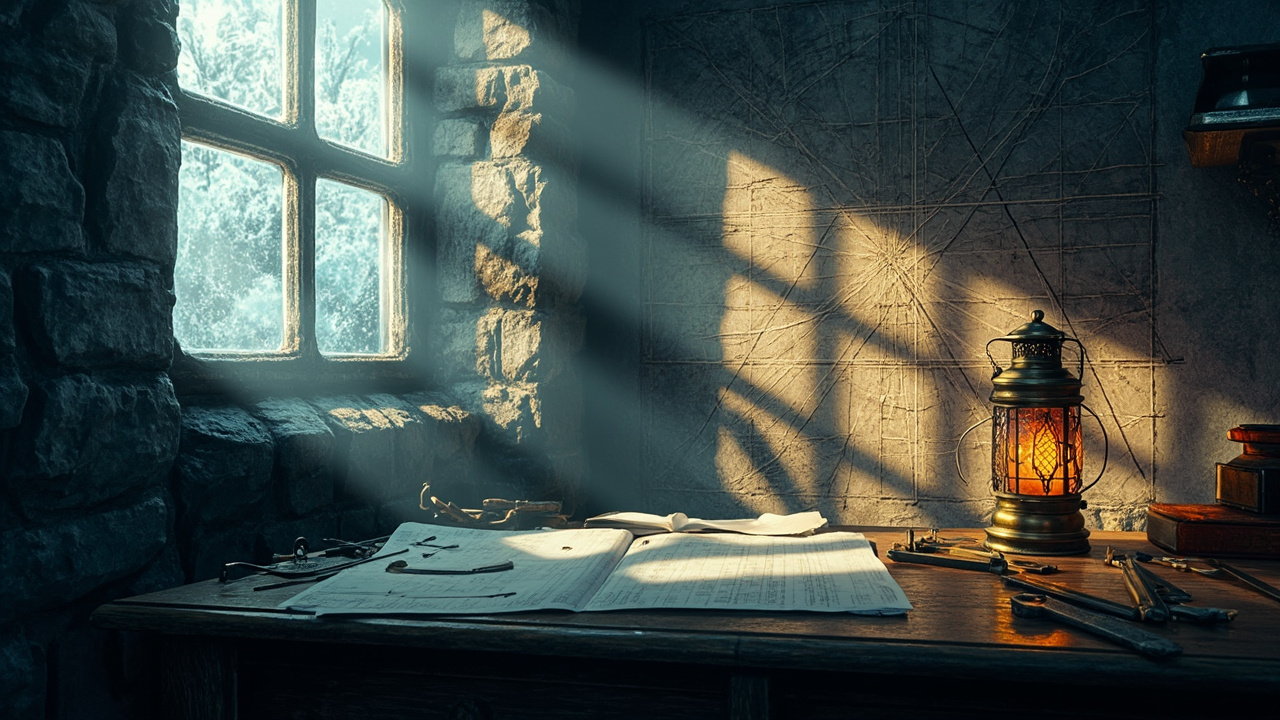
الشبكة الظلالية
قضت الدكتورة إلينور أشوورث أحد عشر عامًا في فك رموز رسائل لا يعرف معظم الناس بوجودها. كانت تعمل في مكتب قاعدي تحت مبنى وزارة الخارجية، محاطة بآلات طُرحت من الخدمة منذ زمن بعيد ومستندات سبقت الحربين العالميتين. كانت حياتها المهنية قائمة بالكامل على الأنماط—إيجادها، وكسرها، وأحيانًا، كما في حالة الليلة هذه، اكتشافها في أماكن غير متوقعة على الإطلاق. وصلت الفوانيس النادرة دون تفسير. صُنعت من خشب وأُوصلت يدويًا على يد رجل يرتدي معطفًا رماديًا لم يُعرّف عن نفسه ولم يقبل إيصالًا. عندما撬ت الغطاء، وجدت فانوسًا نحاسيًا بتصميم غير عادي، إطاره مُنسوج بشكل معقد يجعله يُلقي ظلالًا أكثر مما ينبغي. وضعته على مكتبها ونسيته ليومين. ثم، في عصر اليوم الثالث، اخترق shaft من ضوء الشمس الشتوي النافذة المُثلّجة وأضاء الحديد عند الزاوية الصحيحة تمامًا. سقطت الظلال على جدارها في نمط جعلها تتجمد في منتصف رشفة شايها. قضت الأسبوع التالي في تصويرها. مئات الصور، اُلتقطت في ساعات مختلفة، وإضاءات مختلفة، ومن زوايا مختلفة. ثبّتها على جدارها ودرستها حتى بدأت الأنماط تسبح أمام عينيها. ثم، في اليوم الثامن، رأت الأمر. لم تكن الظلال عشوائية. لم تكن كذلك أبدًا. في لحظات معينة، عندما يضرب الضوء بزوايا خاصة، تتجمع الأشكال المظلمة المتفرقة على جدارها في شيء يتحدى التصديق: كانت تشكل خطوطًا. خطوطًا متصلة. مخططًا Extraordinary التعقيد، يُصوَّر في لا شيء سوى غياب الضوء. جلست إلينور ساكنة لفترة طويلة بعد هذا الإدراك. شعر مكتبها فجأة أصغر، ضغط المبنى فوقها بنوع من العدائية غير المألوفة. كانت مُحلِّلة شفرات، ليس خرائطية. الخرائط ليست مجالها. ومع ذلك، فإن الدليل كان لا يُنكر—هذه الظلال كانت تصف جغرافيا. إحداثيات. موقعًا. يداها اهتزتا قليلاً وهي تمد يدها نحو مسطرتها ومُنقلة ورق الرسم البياني. بدأت تنسخ النمط، تُحدد زوايا الظلال والضوء، تحسب النسب بينهما. استغرق الأمر ثلاثة أسابيع، تعمل خلال الليالي وعطلات نهاية الأسبوع، تأكل الساندويتشات على مكتبها بينما يلقي الحديد تصميمه الغامض على الجص. ثلاثة أسابيع لرسم ما كان الفانوس يقوله. عندما وضعت أخيرًا حساباتها على خريطة المسح الميداني لمدينة لندن، فإن البرد الذي اجتاحها لم يكن له علاقة ببرودة القبو الدائمة. تلتقي الخطوط عند نقطة واحدة: مكان تحت وايتهول، عميقًا في متاهة الممرات والغرف التي تُشكّل المستويات المنسية السفلية للمبنى. مكان لا يوجد، وفقًا لكل السجلات الرسمية. أغمضت إلينور عينيها وفتحتهما، كما لو أن الخريطة قد ترتبت في شيء أكثر منطقية. لم يحدث ذلك. كانت تنظر إلى مخطط لفضاء لا ينبغي أن يكون موجودًا—ومع ذلك، بطريقة ما، كان موجودًا. أجرت تحقيقات، بالطبع. كانت محترفة أكثر من اللازم ألا تفعل ذلك. تحدثت إلى قسم السجلات في المكتب، historians الذين يحافظون على أرشيفات وايتهول، طاقم الصيانة الذين يعرفون كل أنبوب وكل سلك في عظام المبنى. لا أحد يستطيع مساعدتها. تحدثت السجلات عن أقبية طُوِّقت، وأنفاق أُغلقت، وممرات اختفت ببساطة من الخطط كما لو أنها لم تكن موجودة أبدًا. ومع ذلك فإن الظلال على جدارها رواية مختلفة. كان هناك شخص واحد فقط يمكنها التفكير في الاتصال به. بارثولوميو رين، الحارس المسن للأرشيف المعماري، الذي قضى خمسين عامًا في الحفاظ على الآثار الورقية لكل مبنى في لندن. كان رجلاً يصعب الوصول إليه ورجلاً يستحيل تجاهله. عندما ذكرت الفانوس، الحديد، نمط الظلال، صمت لفترة طويلة بما يكفي اعتقدت أن الخط قد انقطع. 'من أين قلت إنه وصل؟' سأل أخيرًا، صوته بالكاد أعلى من الهمس. 'لم يأتِ من أي مكان،' قالت. 'وصل. بدون عنوان عودة.' صمت طويل آخر. ثم: 'دمره.' 'عذرًا؟' 'دمر الفانوس، يا دكتورة أشوورث. اكسره، ادفنه، ألقه في نهر التيمز. مهما فعلت، لا تنظر إليه مرة أخرى. هل تفهمينني؟ هناك أشياء في هذا العالم لم تُقصد أن توجد.' لم تكن قد دمرته. لم تستطع أن تشرح السبب، حتى لنفسها—إلا أن النمط قد تشبث بشيء عميق، جزء منها عرف الفانوس ليس كشيء بل كمفتاح. مفتاح لباب يعلم قلة قليلة جدًا بوجوده. والآن، متأخرًا في الليل، بينما باقي المبنى فارغ وصامت، نشرت خرائطها على الأرض وتتبعت خطوط الظل بأطراف أصابعها. الأنفاق تحت وايتهول حقيقية. كانت حقيقية دائمًا. كانت أقدم من القصر، أقدم من المدينة، أقدم ربما من ذكرى الجزيرة نفسها. بنى الرومان فوقها، وال نورمان بنوا فوق الرومان، وكل عصر منذ ذلك الحين أضاف طبقته الخاصة من الحجر والأسرار. كان الفانوس ينتظرها. ليسها تحديدًا—أي شخص يستطيع قراءته. مفتاح passed down عبر القرون، يجد طريقه في النهاية إلى أيدي شخص يستطيع فهم رسالته. شعرت إلينور بوزن تلك المسؤولية يستقر على كتفيها كعباءة. عرفت الآن ما يكمن تحت المباني التي تعمل فيها كل يوم. عرفت أن الظلال التي يلقيها ذلك الحديد الغريب ليست مجرد ظلال على الإطلاق، بل خريطة رسمتها أيدٍ تحولت إلى تراب منذ زمن بعيد جدًا. وعرفت، بيقين أرّق عظامها، أن الأنفاق ليست فارغة. طوت الخرائط بعناية وأدخلتها في الدرج بجانب الفانوس. بعض المعرفة لم تُقصد مشاركتها—ليس بعد، ليس حتى تفهم المزيد. في الوقت الحالي، ستحفظ السر. ستستمر في عملها في القبو، محاطة بالآلات القديمة والمستندات التي سبقت الحربين العالميتين، محاطة بكل الأنماط التي لم يُكتشف حلها بعد. وفي الليل، عندما ينزل الظلام وتستقر الظلال على جدرانها، ستسمع أحيانًا—أو ستتخيل أنها تسمع—أصواتًا خافتة آتية من الأسفل، من تلك الأنفاق القديمة التي لا تظهر على أي خريطة. وربما، في تلك اللحظات، ستتساءل عما إذا كان الفانوس يراقبها أيضًا.
Das Schattennetz
Dr. Eleanor Ashworth hatte elf Jahre damit verbracht, Botschaften zu entschlüsseln, von deren Existenz die meisten Menschen nichts wussten. Sie arbeitete in einem Kellerbüro unter dem Außenministerium, umgeben von längst stillgelegten Maschinen und Dokumenten, die noch vor beiden Weltkriegen stammten. Es war eine Karriere, die ganz auf Mustern aufgebaut war—sie zu finden, sie zu knacken, und gelegentlich, wie in diesem Fall heute Nacht, sie an den unerwartetsten Orten zu entdecken. Die antike Laterne war ohne Erklärung angekommen. Eine Holzkiste, persönlich geliefert von einem Mann in einem grauen Mantel, der keinen Namen genannt und keinen Empfangsschein akzeptiert hatte. Als Eleanor den Deckel aufbrach, fand sie eine Messinglaterne von ungewöhnlichem Design, deren Rahmen mit einem kunstvollen Eisengitter durchwirkt war, das mehr Schatten zu werfen schien, als es sollte. Sie stellte sie auf ihren Schreibtisch und vergaß sie für zwei Tage. Dann, am dritten Nachmittag, brach ein Strahl winterlichen Sonnenlichts durch das vereiste Fenster und beleuchtete das Eisengitter unter genau dem richtigen Winkel. Die Schatten fielen auf ihre Wand in einem Muster, das sie mitten im Schluck ihrer Teetasse erstarren ließ. Sie verbrachte die nächste Woche mit Fotografieren. Hunderte von Fotos, zu verschiedenen Stunden aufgenommen, bei unterschiedlichem Licht, aus verschiedenen Winkeln. Sie heftete sie an ihre Wand und studierte sie, bis die Muster vor ihren Augen zu verschwimmen begannen. Und dann, am achten Tag, sah sie es. Die Schatten waren nicht zufällig. Das waren sie nie gewesen. Zu bestimmten Momenten, wenn das Licht in besonderen Winkeln auftrat, fügten sich die verstreuten dunklen Formen an ihrer Wand zu etwas zusammen, das jeden Glauben überstieg: Sie bildeten Linien. Verbundene Linien. Ein Diagramm von außerordentlicher Komplexität, dargestellt durch nichts anderes als Abwesenheit von Licht. Eleanor saß lange sehr still nach dieser Erkenntnis. Ihr Büro fühlte sich plötzlich kleiner an, das Gewicht des Gebäudes über ihr drückte mit ungewohnter Feindseligkeit herab. Sie war Kryptographin, keine Kartographin. Karten waren nicht ihr Fachgebiet. Und doch war der Beweis unbestreitbar—diese Schatten beschrieben Geographie. Koordinaten. Einen Ort. Ihre Hände zitterten leicht, als sie nach ihrem Lineal, ihrem Winkelmesser, ihrem Millimeterpapier griff. Sie begann das Muster zu übertragen, die Winkel von Schatten und Licht zu markieren, die Verhältnisse zwischen ihnen zu berechnen. Es dauerte drei Wochen, mit Nacht- und Wochenendarbeit, Sandwiches am Schreibtisch essend, während das Eisengitter sein rätselhaftes Netz auf den Putz warf. Drei Wochen, um zu kartieren, was die Laterne sagte. Als sie ihre Berechnungen schließlich auf eine Ordnance-Survey-Karte von Zentral-London legte, hatte die Kälte, die durch sie hindurchging, nichts mit der dauerhaften Kälte des Kellers zu tun. Die Linien konvergierten an einem einzigen Punkt: einer Stelle unter Whitehall, tief im Labyrinth der Korridore und Kammern, die die vergessenen unteren Ebenen des Gebäudes bildeten. Eine Stelle, die laut jeder offiziellen Aufzeichnung nicht existierte. Eleanor schloss die Augen und öffnete sie wieder, als könnte die Karte sich in etwas Vernünftigeres neu angeordnet haben. Das hatte sie nicht. Sie betrachtete einen Bauplan für einen Raum, der nicht sein sollte—und doch, irgendwie, war. Sie machte natürlich Nachforschungen. Sie war zu professionell, um es nicht zu tun. Sie sprach mit der Aktenabteilung des Büros, den Historikern, die Whiteshalls Archive pflegten, dem Wartungspersonal, das jede Röhre und jeden Draht in den Eingeweiden des Gebäudes kannte. Niemand konnte ihr helfen. Die Aufzeichnungen sprachen von Kellern, die versiegelt worden waren, von Tunneln, die verfüllt worden waren, von Gängen, die einfach aus den Plänen verschwunden waren, als hätten sie nie existiert. Und doch erzählten die Schatten an ihrer Wand eine andere Geschichte. Es gab nur eine Person, an die sie denken konnte zu appellieren. Bartholomew Wren, der betagte Hüter der Architektonischen Archive, der fünfzig Jahre damit verbracht hatte, die Papierspur jedes Gebäudes in London zu bewahren. Er war ein schwer erreichbarer Mann und ein unmöglicher Mann zu ignorieren. Als sie die Laterne erwähnte, das Eisengitter, das Schattenmuster, schwieg er so lange, dass sie dachte, die Leitung wäre unterbrochen. «Woher sagten Sie, kam das?» fragte er schließlich, seine Stimme kaum mehr als ein Flüstern. «Es kam von nirgendwo», sagte sie. «Es arrived. Ohne Rückadresse.» Eine weitere lange Pause. Dann: «Vernichten Sie es.» «Ich bitte um Verzeihung?» «Vernichten Sie die Laterne, Dr. Ashworth. Zerbrechen Sie sie, vergraben Sie sie, werfen Sie sie in die Themse. Was auch immer Sie tun, schauen Sie sie nicht wieder an. Verstehen Sie mich? Es gibt Dinge in dieser Welt, die nicht dazu bestimmt wurden, gefunden zu werden.» Sie hatte sie nicht vernichtet. Sie konnte nicht erklären warum, nicht einmal sich selbst—nur dass das Muster sich in etwas Tiefes gehakt hatte, einen Teil von ihr, der die Laterne nicht als Objekt erkannte, sondern als Schlüssel. Ein Schlüssel zu einer Tür, die nur sehr wenige Menschen überhaupt wussten, dass sie existierte. Und nun, spät in der Nacht, mit dem Rest des Gebäudes leer und still, breitete sie ihre Karten auf dem Boden aus und verfolgte die Schattenlinien mit ihren Fingerspitzen. Die Tunnel unter Whitehall waren real. Sie waren immer real gewesen. Sie waren älter als der Palast, älter als die Stadt, älter vielleicht als die Erinnerung an die Insel selbst. Die Römer hatten darüber gebaut, die Normannen hatten über den Römern gebaut, und jedes Zeitalter seitdem hatte seine eigene Schicht aus Stein und Geheimnissen hinzugefügt. Die Laterne hatte auf sie gewartet. Nicht auf sie specifically—jeder, der sie lesen konnte. Ein Schlüssel, der durch die Jahrhunderte weitergegeben wurde, der schließlich seinen Weg in die Hände von jemandem fand, der seine Botschaft verstehen konnte. Eleanor spürte das Gewicht dieser Verantwortung, das sich wie ein Mantel auf ihre Schultern legte. Sie wusste jetzt, was unter den Gebäuden lag, in denen sie jeden Tag arbeitete. Sie wusste, dass die Schatten, die dieses seltsame Eisengitter warf, nicht bloß Schatten waren, sondern eine Karte, gezeichnet von Händen, die vor sehr langer Zeit zu Staub geworden waren. Und sie wusste, mit einer Gewissheit, die sie bis ins Mark erschütterte, dass die Tunnel nicht leer waren. Sie faltete die Karten sorgfältig zusammen und schob sie in die Schublade neben der Laterne. Manche Wissens war nicht dazu bestimmt, geteilt zu werden—noch nicht, nicht bevor sie mehr verstand. vorerst würde sie das Geheimnis bewahren. Sie würde ihre Arbeit im Keller fortsetzen, umgeben von stillgelegten Maschinen und Dokumenten, die noch vor den Weltkriegen stammten, umgeben von all den ungelösten Mustern, die darauf warteten, entschlüsselt zu werden. Und nachts, wenn die Dunkelheit fiel und die Schatten sich über ihre Wände延长eten, hörte sie manchmal—oder bildete sich ein zu hören—leise Geräusche, die von unten heraufkamen, aus jenen alten Tunneln, die auf keiner Karte verzeichnet waren. Und vielleicht, in diesen Momenten, fragte sie sich, ob die Laterne auch sie beobachtete.
La Rejilla de Sombras
La doctora Eleanor Ashworth había pasado once años descifrando mensajes que la mayoría de las personas nunca sabrían que existían. Trabajaba en una oficina en el sótano bajo el Ministerio de Asuntos Exteriores, rodeada de máquinas que llevaban mucho tiempo fuera de servicio y documentos que precedían a ambas guerras mundiales. Era una carrera construida enteramente sobre patrones—encontrarlos, descifrarlos, y ocasionalmente, como en el caso de esta noche, descubrirlos en los lugares más inesperados. La linterna antigua había llegado sin explicación. Una caja de madera, entregada en mano por un hombre con un abrigo gris que no había dado ningún nombre y no había aceptado ningún recibo. Cuando Eleanor había hecho palanca en la tapa, había encontrado una linterna de latón de diseño inusual, su marco entrelazado con una compleja red de hierro forjado que parecía proyectar más sombras de las que debería. La había puesto en su escritorio y la había olvidado durante dos días. Luego, en la tarde del tercer día, un rayo de luz solar invernal había atravesado la ventana escarchada e iluminado el hierro forjado en el ángulo exacto. Las sombras cayeron sobre su pared en un patrón que la hizo quedarse helada a mitad de un sorbo de té. Pasó la siguiente semana fotografiándolas. Cientos de fotografías, tomadas a diferentes horas, con diferentes luces, desde diferentes ángulos. Las clavó en su pared y las estudió hasta que los patrones comenzaron a nadar frente a sus ojos. Y luego, en el octavo día, lo vio. Las sombras no eran aleatorias. Nunca lo habían sido. En ciertos momentos, cuando la luz golpeaba en ángulos particulares, las formas oscuras dispersas en su pared se resolvían en algo que desafiaba la creencia: formaban líneas. Líneas conectadas. Un diagrama de extraordinaria complejidad,renderizado en nada más que ausencia de luz. Eleanor se quedó muy quieta durante mucho tiempo después de esta realización. Su oficina se sintió de repente más pequeña, el peso del edificio sobre ella presionando con una hostilidad unfamiliar. Era una criptógrafa, no una cartógrafa. Los mapas no eran su dominio. Y sin embargo la evidencia era innegable—esas sombras estaban describiendo geografía. Coordenadas. Una ubicación. Sus manos temblaron ligeramente mientras extendía la mano hacia su regla, su transportador, su papel cuadriculado. Comenzó a transcribir el patrón, marcando los ángulos de sombra y luz, calculando las proporciones entre ellos. Le tomó tres semanas, trabajando a través de noches y fines de semana, comiendo sándwiches en su escritorio mientras el hierro forjado proyectaba su críptica rejilla sobre el yeso. Tres semanas para mapear lo que la linterna estaba diciendo. Cuando finalmente superpuso sus cálculos sobre un mapa del Ordnance Survey del centro de Londres, el frío que la recorrió no tenía nada que ver con el frío perpetuo del sótano. Las líneas convergían en un único punto: un lugar bajo Whitehall, en lo profundo del laberinto de pasillos y cámaras que formaban los niveles inferiores olvidados del edificio. Un lugar que, según cada registro oficial, no existía. Eleanor cerró los ojos y los abrió de nuevo, como si el mapa pudiera haberse reorganizado en algo más sensato. No había sido así. Estaba mirando un plano para un espacio que no debería ser—y sin embargo, de alguna manera, era. Hizo consultas, por supuesto. Era demasiado profesional para no hacerlo. Habló con el departamento de registros de la oficina, los historiadores que mantenían los archivos de Whitehall, el personal de mantenimiento que conocía cada tubería y cada cable en los huesos del edificio. Nadie podía ayudarla. Los registros hablaban de sótanos que habían sido sellados, de túneles que habían sido rellenados, de pasos que simplemente habían desaparecido de los planos como si nunca hubieran existido. Y sin embargo las sombras en su pared contaban una historia diferente. Solo había una persona a la que podía pensar en llamar. Bartholomew Wren, el anciano guardián de los Archivos de Arquitectura, que había pasado cincuenta años preservando el rastro en papel de cada edificio en Londres. Era un hombre difícil de alcanzar y un hombre imposible de ignorar. Cuando mencionó la linterna, el hierro forjado, el patrón de sombras, estuvo en silencio tanto tiempo que ella pensó que la línea se había cortado. «¿De dónde dijo que venía?» preguntó finalmente, su voz apenas por encima de un susurro. «No venía de ningún sitio», dijo ella. «Llegó. Sin dirección de vuelta.» Otra larga pausa. Luego: «Destrúyala.» «¿Perdón?» «Destruya la linterna, doctora Ashworth. Rómpala, entiérrela, tírela al Támesis. Lo que sea que haga, no la mire de nuevo. ¿Me entiende? Hay cosas en este mundo que no estaban destinadas a ser encontradas.» Ella no la había destruido. No podía explicar por qué, ni siquiera a sí misma—solo que el patrón se había enganchado en algo profundo, alguna parte de ella que reconocía la linterna no como un objeto sino como una llave. Una llave a una puerta que muy pocas personas sabían que existía. Y ahora, tarde en la noche, con el resto del edificio vacío y silencioso, extendió sus mapas sobre el suelo y trazó las líneas de sombra con las yemas de sus dedos. Los túneles bajo Whitehall eran reales. Siempre habían sido reales. Eran más antiguos que el palacio, más antiguos que la ciudad, más antiguos quizás que el recuerdo de la isla misma. Los romanos habían construido encima de ellos, los normandos habían construido encima de los romanos, y cada era desde entonces había añadido su propia capa de piedra y secretos. La linterna la había estado esperando. No a ella específicamente—cualquiera que pudiera leerla. Una llave transmitida a través de los siglos, encontrando finalmente su camino hacia las manos de alguien que pudiera entender su mensaje. Eleanor sintió el peso de esa responsabilidad asentándose sobre sus hombros como una capa. Sabía ahora lo que yacía bajo los edificios en los que trabajaba cada día. Sabía que las sombras proyectadas por ese extraño hierro forjado no eran meras sombras en absoluto, sino un mapa dibujado por manos que se habían convertido en polvo hace mucho, mucho tiempo. Y sabía, con una certeza que la helaba hasta los huesos, que los túneles no estaban vacíos. Pllegó cuidadosamente los mapas y los deslizó en el cajón junto a la linterna. Algunos conocimientos no estaban destinados a ser compartidos—no todavía, no hasta que ella entendiera más. Por ahora, guardaría el secreto. Continuaría su trabajo en el sótano, rodeada de máquinas fuera de servicio y documentos que precedían las guerras mundiales, rodeada de todos los patrones no resueltos que esperaban ser descifrados. Y de noche, cuando caía la oscuridad y las sombras se alargaban sobre sus paredes, a veces escuchaba—o imaginaba escuchar—sonidos débiles que subían desde abajo, de esos túneles antiguos que no aparecían en ningún mapa. Y quizás, en esos momentos, se preguntaba si la linterna también la observaba a ella.
La Dentelle d'Ombres
La docteure Eleanor Ashworth avait passé onze années à déchiffrer des messages que la plupart des gens ne sauraient jamais exister. Elle travaillait dans un bureau en sous-sol sous le Ministère des Affaires Étrangères, entourée de machines depuis longtemps déclassées et de documents qui précédaient les deux guerres mondiales. C'était une carrière entièrement construite sur les motifs—les trouver, les casser, et occasionnellement, comme dans le cas de ce soir, les découvrir dans les endroits les plus inattendus. La lanterne antique était arrivée sans explication. Une caisse en bois, livrée à la main par un homme en manteau gris qui n'avait donné aucun nom et n'avait accepté aucun reçu. Quand Eleanor avait arraché le couvercle, elle avait trouvé une lanterne en laiton de conception inhabituelle, son cadre dentelé d'un treillis de fer forgé intricate semblait projeter plus d'ombres qu'il n'aurait dû. Elle l'avait posée sur son bureau et oubliée pendant deux jours. Puis, le troisième après-midi, un rayon de soleil hivernal avait percé la fenêtre givrée et illuminé le fer forgé sous exactement le bon angle. Les ombres tombèrent sur son mur dans un motif qui la figea au milieu d'une gorgée de thé. Elle passa la semaine suivante à les photographier. Des centaines de photographies, prises à différentes heures, sous différentes lumières, sous différents angles. Elle les épingla à son mur et les étudia jusqu'à ce que les motifs commencent à danser devant ses yeux. Et puis, le huitième jour, elle le vit. Les ombres n'étaient pas aléatoires. Elles ne l'avaient jamais été. À certains moments, quand la lumière frappait sous des angles particuliers, les formes sombres dispersées sur son mur se résolurent en quelque chose qui défiait la croyance : elles formaient des lignes. Des lignes connectées. Un diagramme d'une complexité extraordinaire, rendu dans le simple absence de lumière. Eleanor resta très immobile pendant longtemps après cette réalisation. Son bureau semblait soudain plus petit, le poids du bâtiment au-dessus d'elle pesant avec une malveillance inhabituelle. Elle était cryptographe, pas cartographe. Les cartes n'étaient pas son domaine. Et pourtant les preuves étaient indéniables—ces ombres décrivaient de la géographie. Des coordonnées. Un lieu. Ses mains tremblèrent légèrement tandis qu'elle tendait la main vers sa règle, son rapporteur, son papier graphique. Elle commença à transcrire le motif, notant les angles d'ombre et de lumière, calculant les ratios entre eux. Cela lui prit trois semaines, à travailler les nuits et les week-ends, mangeant des sandwichs à son bureau tandis que le fer forgé projetait son treillis cryptique sur le plâtre. Trois semaines pour cartographier ce que la lanterne disait. Quand elle superposa finalement ses calculs sur une carte de l'Ordnance Survey du centre de Londres, le froid qui la parcourut n'avait rien à voir avec le froid perpétuel du sous-sol. Les lignes convergeaient vers un point unique : un endroit sous Whitehall, profondément dans le labyrinthe de couloirs et de chambres qui formaient les niveaux inférieurs oubliés du bâtiment. Un endroit qui, selon chaque registre officiel, n'existait pas. Eleanor ferma les yeux et les rouvrit, comme si la carte avait pu se réarranger en quelque chose de plus sensé. Ce n'était pas le cas. Elle regardait un blueprint pour un espace qui ne devrait pas être—et pourtant, d'une certaine manière, était. Elle fit des enquêtes, bien sûr. Elle était trop professionnelle pour ne pas le faire. Elle parla au département des registres du bureau, aux historiens qui maintenaient les archives de Whitehall, au personnel d'entretien qui connaissait chaque tuyau et chaque fil dans les entrailles du bâtiment. Personne ne pouvait l'aider. Les registres parlaient de sous-sols qui avaient été scellés, de tunnels qui avaient été remplis, de passages qui avaient simplement disparu des plans comme s'ils n'avaient jamais été. Et pourtant les ombres sur son mur racontaient une autre histoire. Il n'y avait qu'une seule personne à qui elle pouvait penser à appeler. Bartholomew Wren, le vieux gardien des Archives Architecturales, qui avait passé cinquante ans à préserver la trace documentaire de chaque bâtiment à Londres. C'était un homme difficile à atteindre et un homme impossible à ignorer. Quand elle mentionna la lanterne, le fer forgé, le motif des ombres, il fut silencieux si longtemps qu'elle pensa que la ligne était morte. « D'où avez-vous dit que cela venait ? » demanda-t-il enfin, sa voix à peine au-dessus d'un murmure. « Ça ne venait de nulle part », dit-elle. « C'est arrivé. Sans adresse de retour. » Une autre longue pause. Puis : « Détruisez-le. » « Je vous prie ? » « Détruisez la lanterne, docteure Ashworth. Cassez-la, enterrez-la, jetez-la dans la Tamise. Quoi que vous fassiez, ne la regardez plus. Est-ce que vous me comprenez ? Il y a des choses dans ce monde qui n'étaient pas destinées à être trouvées. » Elle ne l'avait pas détruite. Elle ne pouvait pas expliquer pourquoi, même à elle-même—sauf que le motif s'était accroché à quelque chose de profond, une partie d'elle qui reconnaissait la lanterne non pas comme un objet mais comme une clé. Une clé vers une porte que très peu de gens savaient même exister. Et maintenant, tard dans la nuit, avec le reste du bâtiment vide et silencieux, elle déploya ses cartes sur le sol et traça les lignes d'ombre du bout des doigts. Les tunnels sous Whitehall étaient réels. Ils avaient toujours été réels. Ils étaient plus vieux que le palais, plus vieux que la ville, plus vieux peut-être que le souvenir de l'île elle-même. Les Romains avaient bâti dessus, les Normands avaient bâti sur les Romains, et chaque époque depuis avait ajouté sa propre couche de pierre et de secrets. La lanterne l'avait attendue. Pas elle spécifiquement—n'importe qui qui pouvait la lire. Une clé transmise à travers les siècles, trouvant finalement son chemin vers les mains de quelqu'un capable de comprendre son message. Eleanor sentit le poids de cette responsabilité s'installer sur ses épaules comme une cape. Elle savait maintenant ce qui se trouvait sous les bâtiments où elle travaillait chaque jour. Elle savait que les ombres projetées par ce curieux fer forgé n'étaient pas de simples ombres du tout, mais une carte tracée par des mains turnées en poussière il y a très longtemps. Et elle savait, avec une certitude qui la glaçait jusqu'aux os, que les tunnels n'étaient pas vides. Elle plia soigneusement les cartes et les glissa dans le tiroir à côté de la lanterne. Certaines connaissances n'étaient pas faites pour être partagées—pas encore, pas tant qu'elle n'en saurait pas plus. Pour l'instant, elle garderait le secret. Elle continuerait son travail dans le sous-sol, entourée de machines déclassées et de documents qui précédaient les guerres mondiales, entourée de tous les motifs non résolus qui attendaient d'être décodés. Et la nuit, quand l'obscurité tombait et que les ombres s'allongeaient sur ses murs, elle entendait parfois—ou imaginait entendre—de faibles sons montant d'en bas, de ces tunnels anciens qui n'apparaissaient sur aucune carte. Et peut-être, dans ces moments, elle se demandait si la lanterne l'observait aussi.
L'Intreccio di Ombre
La dottoressa Eleanor Ashworth aveva trascorso undici anni a decifrare messaggi che la maggior parte delle persone non avrebbe mai saputo esistessero. Lavorava in un ufficio interrato sotto il Ministero degli Affari Esteri, circondata da macchinari da tempo dismessi e documenti che precedevano entrambe le guerre mondiali. Era una carriera costruita interamente sui pattern—trovare, decifrare e, occasionalmente, come nel caso di quella notte, scoprirli nei luoghi più inaspettati. La lanterna antica era arrivata senza spiegazioni. Una cassa di legno, consegnata a mano da un uomo in un cappotto grigio che non aveva fornito alcun nome e non aveva accettato alcuna ricevuta. Quando Eleanor aveva fatto leva sul coperchio, aveva trovato una lanterna di ottone dal design insolito, la cui intelaiatura era intrecciata con una complessa rete di ferro battuto che sembrava proiettare più ombre di quanto dovrebbe. L'aveva posata sulla scrivania e dimenticata per due giorni. Poi, nel pomeriggio del terzo giorno, un raggio di luce solare invernale aveva sfondato la finestra ghiacciata illuminando il ferro battuto proprio all'angolazione giusta. Le ombre erano cadute sulla parete in un pattern che l'aveva fatta congelare a metà sorso di tè. Aveva trascorso la settimana successiva a fotografarle. Centinaia di fotografie, scattate a ore diverse, con luci diverse, da angolazioni diverse. Le aveva appuntate alla parete e studiate fino a quando i pattern non avevano iniziato a vorticosare davanti ai suoi occhi. E poi, l'ottavo giorno, l'aveva visto. Le ombre non erano casuali. Non lo erano mai state. In certi momenti, quando la luce colpiva secondo angolazioni particolari, le forme scure sparse sulla parete si erano risolte in qualcosa che sfidava la credenza: formavano linee. Linee collegate. Un diagramma di straordinaria complessità, reso nel nulla se non nell'assenza di luce. Eleanor era rimasta molto immobile per molto tempo dopo questa realizzazione. Il suo ufficio sembrava improvvisamente più piccolo, il peso dell'edificio sopra di lei premeva con una ostilità inconsueta. Era una crittografa, non una cartografa. Le mappe non erano il suo campo. Eppure la prova era innegabile—quelle ombre stavano descrivendo geografia. Coordinate. Una posizione. Le sue mani tremavano leggermente mentre allungava la mano verso il righello, il goniometro, la carta millimetrata. Aveva iniziato a trascrivere il pattern, segnando gli angoli di ombra e luce, calcolando i rapporti tra loro. Le ci erano volute tre settimane, lavorando notti e fine settimana, mangiando panini alla scrivania mentre il ferro battuto proiettava la sua cryptica intelaiatura sull'intonaco. Tre settimane per mappare ciò che la lanterna stava dicendo. Quando aveva finalmente sovrapposto i suoi calcoli su una mappa dell'Ordnance Survey del centro di Londra, il freddo che l'aveva attraversata non aveva nulla a che fare con il perpetuo freddo dell'interrato. Le linee convergevano su un unico punto: un punto sotto Whitehall, nel profondo del labirinto di corridoi e camere che formavano i livelli inferiori dimenticati dell'edificio. Un punto che, secondo ogni record ufficiale, non esisteva. Eleanor aveva chiuso gli occhi e li aveva riaperti, come se la mappa potesse essersi riordinata in qualcosa di più sensato. Non era accaduto. Stava guardando un progetto per uno spazio che non dovrebbe essere—eppure, in qualche modo, era. Aveva fatto domande, naturalmente. Era troppo professionale per non farlo. Aveva parlato con il dipartimento archivi dell'ufficio, gli storici che mantenevano gli archivi di Whitehall, il personale di manutenzione che conosceva ogni tubo e ogni filo nelle viscere dell'edificio. Nessuno poteva aiutarla. Gli archivi parlavano di scantinati che erano stati sigillati, di tunnel che erano stati riempiti, di passaggi che erano semplicemente scomparsi dalle planimetrie come se non fossero mai esistiti. Eppure le ombre sul suo muro raccontavano una storia diversa. C'era solo una persona a cui poteva pensare di rivolgersi. Bartholomew Wren, l'anziano custode degli Archivi di Architettura, che aveva trascorso cinquant'anni a preservare la traccia cartacea di ogni edificio a Londra. Era un uomo difficile da raggiungere e un uomo impossibile da ignorare. Quando aveva menzionato la lanterna, il ferro battuto, il pattern delle ombre, era rimasto in silenzio così a lungo che aveva pensato che la linea fosse caduta. «Da dove ha detto che veniva?» aveva chiesto infine, la sua voce appena sopra un sussurro. «Non veniva da nessun posto», aveva detto. «È arrivata. Senza indirizzo di ritorno.» Un'altra lunga pausa. Poi: «Distrugetela.» «Mi scusi?» «Distruga la lanterna, dottoressa Ashworth. La rompa, la seppellisca, la getti nella Tamigi. Qualunque cosa faccia, non la guardi mai più. Mi capisce? Ci sono cose in questo mondo che non erano destinate a essere trovate.» Non l'aveva distrutta. Non poteva spiegare perché, nemmeno a se stessa—solo che il pattern si era agganciato a qualcosa di profondo, una parte di lei che riconosceva la lanterna non come un oggetto ma come una chiave. Una chiave per una porta che pochissime persone sapevano persino esistesse. E ora, tardi nella notte, con il resto dell'edificio vuoto e silenzioso, aveva steso le sue mappe sul pavimento e tracciato le linee d'ombra con la punta delle dita. I tunnel sotto Whitehall erano reali. Erano sempre stati reali. Erano più antichi del palazzo, più antichi della città, forse più antichi persino del ricordo dell'isola stessa. I Romani avevano costruito sopra di loro, i Normanni avevano costruito sopra i Romani, e ogni epoca da allora aveva aggiunto il proprio strato di pietra e segreti. La lanterna l'aveva aspettata. Non lei specifically—chiunque potesse leggerla. Una chiave tramandata attraverso i secoli, che trovava alla fine la sua strada nelle mani di qualcuno capace di comprendere il suo messaggio. Eleanor sentiva il peso di quella responsabilità sistemarsi sulle sue spalle come un mantello. Sapeva ora cosa giaceva sotto gli edifici in cui lavorava ogni giorno. Sapeva che le ombre proiettate da quel bizzarro ferro battuto non erano affatto semplici ombre, ma una mappa disegnata da mani che si erano ridotte in polvere molto tempo fa. E sapeva, con una certezza che le gelava le ossa, che i tunnel non erano vuoti. Aveva piegato attentamente le mappe e inserite nel cassetto accanto alla lanterna. Alcuna conoscenza non era destinata a essere condivisa—non ancora, non finché non avesse capito di più. Per ora, avrebbe custodito il segreto. Avrebbe continuato il suo lavoro nell'interrato, circondata da macchinari dismessi e documenti che precedevano le guerre mondiali, circondata da tutti i pattern irrisolti che aspettavano di essere decifrati. E di notte, quando cadeva l'oscurità e le ombre si allungavano sui suoi muri, a volte sentiva—o immaginava di sentire—suoni flebili che salivano dal basso, da quei tunnel antichi che non apparivano su nessuna mappa. E forse, in quei momenti, si chiedeva se la lanterna stesse osservando anche lei.