Must Know Vocabulary
| Word | العربية | Deutsch | Español | Français | Italiano |
|---|---|---|---|---|---|
| أرشيف | Archiv | archivo | archives | archivio | |
| بكرة إلى بكرة | Tonbandgerät | magnetófono de bobinas | magnétophone à bobines | registratore a bobine | |
| شهادة | Zeugenaussage | testimonio | témoignage | testimonianza | |
| مؤامرة | Verschwörung | conspiración | conspiration | cospirazione | |
| تجنيد | rekrutieren | reclutar | recruter | reclutare | |
| هوية | Identität | identidad | identité | identità | |
| عميل مزدوج | Doppelagent | agente doble | agent double | agente doppio | |
| أكسيد | Oxid | óxido | oxyde | ossido | |
| تصنيف | Klassifizierung | clasificación | classification | classificazione | |
| بيروقراطية | Bürokratie | burocracia | bureaucratie | burocrazia |
The Story
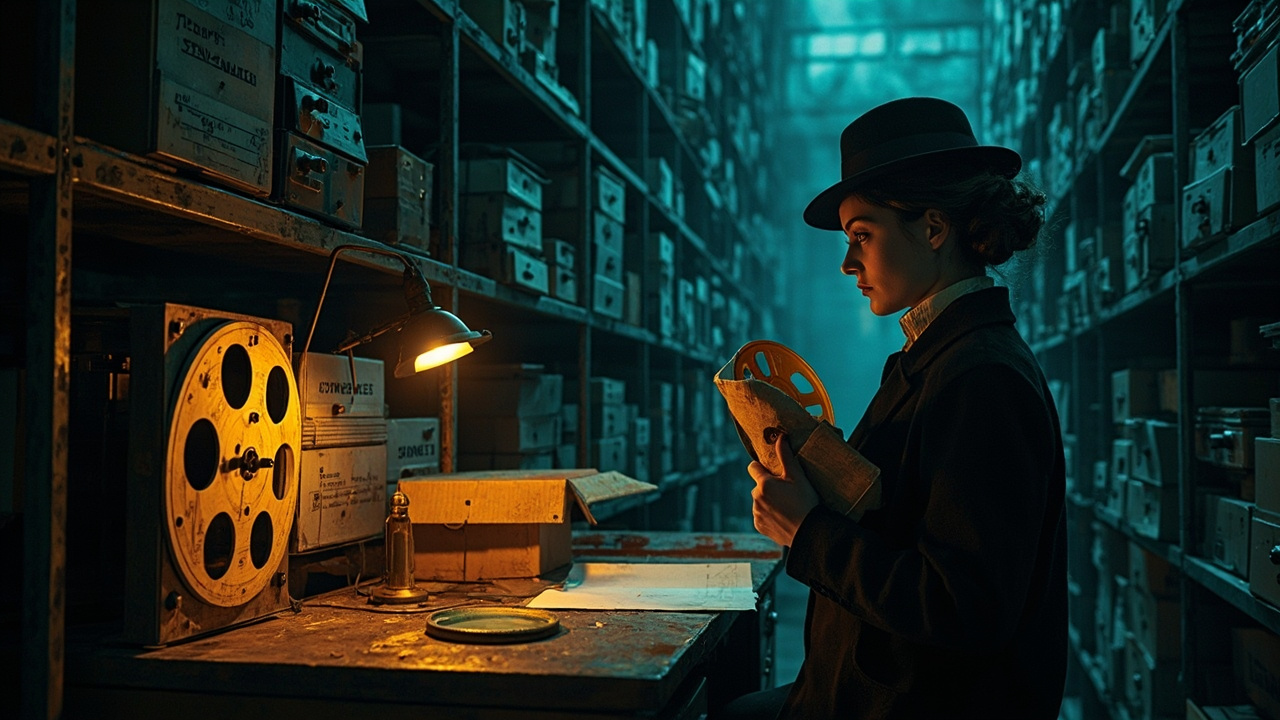
The cardboard box had been mislabelled for sixty-three years. Eleanor Finch discovered it at half past eleven on a Tuesday evening, when the BBC Sound Archive in Caversham should have been deserted, and when the only sounds were the persistent hum of climate control units and the occasional shuddering of old reel-to-reel tape mechanisms settling in their housings. She had been cataloguing a donation from the estate of a recently deceased sound engineer—tedious work, the kind of late-night task reserved for junior archivists—and had almost consigned the box to the incineration queue when she noticed the discrepancy between the external label and the inventory slip tucked inside.
The label read "Farmers' Weekly Broadcasts, 1951-1954." The contents, she saw at once, were something else entirely.
There were nine reels, each wrapped in brown paper and marked with a date spanning March to November 1946. The paper was thick, military-grade—she recognised it from her work on the D-Day anniversary collections. And written on each wrapper, in the same careful copperplate hand, were the words: Project Afterimage. Personal testimony. Unauthorised broadcast. Classification: Eternal.
Eleanor was not someone who believed in conspiracies. She was thirty-four years old, held a doctorate in broadcast history from UCL, and had spent seven years among the dead voices of the archive. She knew how ordinary failures of bureaucracy and communication created the myths that conspiracy theorists then weaponised. And yet her hands trembled as she threaded the first reel onto the Neumann machine, because the tape itself was not standard BBC stock—it bore the watermark of a manufacturer that had ceased operations in 1945, and the quantity of oxide remaining suggested this reel had been played only once before, and that once had been decades ago.
The voice that emerged from the speaker was male, educated, unmistakably British. It began without preamble.
"My name is—I was born as—" A pause. The sound of breathing. "Forgive me. I've rehearsed this so many times. My name is David Ashworth. I was born David Ashworth. But I am not David Ashworth. I have not been David Ashworth since October 1943. The man whose identity I inherited died in a German POW camp three months earlier, and I watched him die, and then I became him, because that was my mission, and because the mission demanded it."
Eleanor stopped the tape. She sat very still in the listening booth, her heart thudding against her ribs. Outside the window, the car park was empty. She looked at the reel again—March 1946—and then, after a long moment, pressed play.
The testimonies continued for the next three hours. Each one was different. Each one was the same.
There was Margaret Hollis, who had been a factory worker in Birmingham before the war and a minor figure in the auxiliary services after it. Her testimony revealed that she had been recruited in 1942 by an officer whose name she never learned, trained in lip-reading and observation, and placed into the household of a Foreign Office minister's wife. Her task had been to observe, to listen, to report. After the war, she received a new identity and a position in the Ministry of Defence. She had spent forty years watching.
There was James Whitmore, formerly a journalist with the Manchester Guardian, who had been turned—not recruited, he was at pains to emphasise, turned—in Lisbon in 1944. The operation had required his face, his voice, his entire personality to be reshaped to replace a dead double agent. The man he had become was still alive, still writing for a broadsheet, still attending the same clubs, still laughing at the same jokes. Whitmore's original self had died in a car accident near Salisbury in 1947. Officially.
There was Sister Catherine of a contemplative order in West Sussex, who spoke in measured tones about the theological implications of what she had done. She had been a nurse before the war. She had been recruited to provide medical cover for operatives who could not risk legitimate hospitals. She had performed seven operations over four years—operations that had nothing to do with medicine. She had been given sanctuary in the convent in 1952, and she had never spoken of it until now.
Eleanor listened to them all. She listened until the first grey light of Wednesday morning crept beneath the archive's doors. And as the final tape ended—Sister Catherine's voice fading into silence—she understood what she had found.
Project Afterimage had been a programme of identity replacement. Its operatives had been given the identities of the dead—the missing, the presumed destroyed—and had been absorbed into post-war British society. Some had been placed in government. Some in journalism. Some in education. Some in the Church. They were there to ensure that certain narratives survived, that certain silences were maintained, that the new Britain was shaped according to specifications that had been drawn up in 1943 and implemented without the knowledge of the public or, she suspected, most of the government.
Who had commissioned this? The tapes did not say. Perhaps the Americans. Perhaps the existing intelligence services. Perhaps someone else entirely—someone who had seen the war coming and prepared for its aftermath with the cold precision of an architect. The testimonies were personal. They did not name handlers or explain the broader strategy. They were, Eleanor realised, a form of confession. Someone had asked these people to record the truth of what they had been, before they became what they now were.
Perhaps they had been meant to be broadcast. Perhaps they still would be, one day. Perhaps the mislabelled box was not an accident but a deliberate act—a sleeping capsule buried in the archive, waiting to be discovered when the time was right.
Eleanor sat alone in the listening booth as the archive came to life around her—the arriving staff, the opening of doors, the clatter of keys in locks. She looked at the nine reels in their brown-paper wrappers. She thought about the Britain she lived in, its institutions, its certainties, its unspoken assumptions about who belonged and who did not. She thought about how easy it was to construct a nation, one identity at a time.
She placed the reels back in the box. She covered them with the lid. She marked the inventory slip with the correct description and filed it in the master catalogue under a new heading she had created: Afterimage, Project (Restricted). Access by authorisation only.
And then she went home, made herself a cup of tea, and sat in her kitchen watching the morning light strengthen over the rooftops of Caversham, wondering how many of her neighbours might not be who they claimed to be, and whether it mattered, and whether knowing would change anything at all.