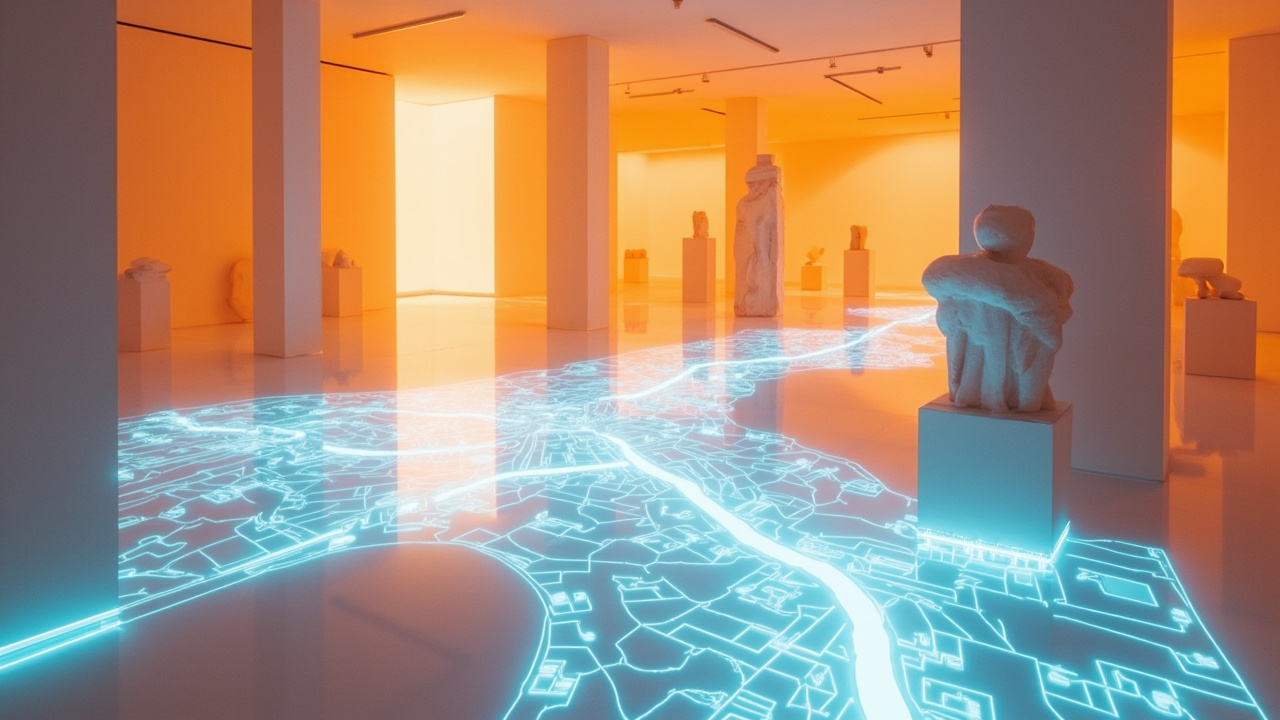
آمنت إلينور فانس دائمًا بأن العمارة، في جوهرها، كانت محادثة بين الحضور والغياب..Objects Occupied space, yes—but it was the space around them that spoke loudest. She had built a career on this principle, spending eleven years as a spatial designer for the Ashford Collection, a modernist museum perched on the Thames where contemporary exhibitions required the kind of precise choreography that most visitors never consciously noticed.
It began, as such things do, with a feeling she could not name.
The commission was a retrospective of the sculptor Yael Moran—three hundred pieces to be arranged across four interconnected galleries. Eleanor worked as she always did: measured, methodical, endlessly patient. She would plot each sculpture's position on graph paper, then transfer her notes to the digital drafting software that rendered her intuitions into blueprints the installers could follow. It was tedious work, the kind that required absolute concentration, and Eleanor had always excelled at concentration.
But that evening, alone in the studio after the rest of the team had departed, she found herself staring at the negative space between two of Moran's kinetic pieces. The gallery was empty, the sculptures motionless, and the silence felt almost deliberate—as though the room itself were holding its breath. Something about the configuration of those gaps struck her as oddly familiar. She reached for her coffee, now cold, and did not think further on the matter.
The following week, she encountered it again.
She had begun work on a new commission—a travelling exhibition of Japanese woodblock prints, requiring delicate cases and precise lighting—but her mind kept drifting back to Moran's retrospective. She pulled up the digital files from the previous project, meaning to review her work for any errors, and there it was: the negative space between the fourth and seventh pieces on the east wall, rendered in the software's faint blue lines, forming what appeared to be a junction where two roads met.
Eleanor tilted her head. It was nothing, of course. Pareidolia—the mind's insistence on finding patterns where none existed. She had read about the phenomenon, had even encountered it in the work of gestalt psychologists. Yet she enlarged the section anyway, tracing the lines with her cursor. The shape grew more pronounced. The junction became an intersection. Adjacent spaces suggested buildings, a square, the curve of what might have been a river.
She felt the hair rise on the back of her neck.
Over the following days, Eleanor began to examine her other layouts with newfound scrutiny. The Japanese print exhibition revealed nothing—or rather, revealed only the expected geometry of display cases and walkway margins. But the Moran retrospective, when she superimposed all the negative spaces onto a single plane, began to coalesce into something unmistakable. Streets. Canals, perhaps. A city.
She worked through the nights, cancelling a dinner with her sister, skipping her usual morning run. The digital files blurred before her tired eyes, but the image grew clearer with each passing evening. She had to admit, with growing unease, that she was looking at a map.
The city it depicted was old. This much was evident from the organic irregularity of its streets, the kind of organic sprawl that predated modern urban planning by centuries. Narrow lanes curved around what must have been a central market square. To the north, a river—or what remained of one—bent like a question mark. At the map's edge, in the negative space between the gallery's east wall and the nearest exhibit, a portion of the city remained incomplete.
Eleanor searched the internet for hours before she found it.
The name was Aldenmere. A fishing village that had grown into a modest town over four centuries, nestled in a valley that had been flooded in 1923 to create a reservoir for the growing city to the south. The photographs were scarce and sepia-toned: a church with a crooked spire, wooden boats drawn up on a muddy bank, children playing in a street that would soon vanish beneath forty feet of dark water. The last residents had been relocated in October of that year. The valley had flooded the following spring. By summer, Aldenmere had ceased to exist.
No one could say exactly how the town had died. Some accounts spoke of a gradual submersion, the water rising inch by inch over weeks until the rooftops alone broke the surface like the knuckles of drowned hands. Others described a sudden drowning, a single storm that filled the valley in hours. Eleanor found a poem written by one of the displaced, an elderly woman who had returned to watch the flooding:
They call it a reservoir now. I call it a grave.
But graves are supposed to hold the dead,
and I have never been able to bury
the sound of the church bell striking midnight
through water.
Eleanor printed the old maps of Aldenmere—the few that survived—and held them against her screen. The resemblance was uncanny. Not identical, perhaps; the negative spaces in her exhibition layouts had their own logic, their own aesthetic priorities, shaped by the requirements of displaying kinetic sculpture. But the bones were unmistakable. She had been mapping a drowned city without knowing it.
The question that gnawed at her was not how this was possible—she had no satisfactory answer, and suspected none existed—but why. Why should the empty spaces in her carefully designed layouts conspire to recreate a place that no longer existed, a place she had never seen, had never even heard of until a week ago?
She began to dream of water.
In the dreams, she walked streets that were not quite Aldenmere and not quite anywhere else, the buildings around her flickering between the sepia photographs and something older, stranger, more vibrant. She heard bells, though whether they rang from church spires or simply from the architecture of memory, she could not tell.
Eleanor Vance hatte stets geglaubt, dass Architektur im Herzen ein Gespräch zwischen Anwesenheit und Abwesenheit sei. Objekte nahmen Raum ein, ja – aber es war der Raum um sie herum, der am lautesten sprach. Sie hatte ihre Karriere auf diesem Prinzip aufgebaut, elf Jahre als Raumphilosophin für die Ashford Collection gearbeitet, ein modernistisches Museum an der Themse, wo zeitgenössische Ausstellungen die Art präziser Choreografie erforderten, die die meisten Besucher nie bewusst wahrnahmen.
Es begann, wie solche Dinge eben beginnen, mit einem Gefühl, das sie nicht benennen konnte.
Der Auftrag war eine Retrospektive der Bildhauerin Yael Moran – dreihundert Werke, die in vier miteinander verbundenen Galerien angeordnet werden sollten. Eleanor arbeitete wie immer: maßvoll, methodisch, endlos geduldig. Sie zeichnete die Position jeder Skulptur auf Millimeterpapier und übertrug ihre Notizen dann in die digitale Planungssoftware, die ihre Intuitionen in Blaupausen verwandelte, denen die Installateure folgen konnten. Es war mühselige Arbeit, die Art, die absolute Konzentration erforderte, und Eleanor hatte schon immer in Konzentration geglänzt.
Aber an diesem Abend, allein im Atelier, nachdem der Rest des Teams gegangen war, ertappte sie sich dabei, wie sie auf den Negativraum zwischen zwei von Morans kinetischen Werken starrte. Die Galerie war leer, die Skulpturen reglos, und die Stille fühlte sich fast absichtsvoll an – als hielte der Raum selbst den Atem an. Etwas an der Anordnung dieser Lücken kam ihr seltsam vertraut vor. Sie griff nach ihrem Kaffee, inzwischen kalt, und dachte nicht weiter darüber nach.
In der folgenden Woche begegnete sie ihm erneut.
Sie hatte begonnen, an einem neuen Auftrag zu arbeiten – einer Wanderausstellung japanischer Holzschnitte, die zarte Vitrinen und präzise Beleuchtung erforderte – aber ihre Gedanken schweiften immer wieder zur Moran-Retrospektive zurück. Sie rief die Digitaldateien des vorherigen Projekts auf, in der Absicht, ihre Arbeit auf Fehler zu überprüfen, und da war es: der Negativraum zwischen dem vierten und siebten Werk an der Ostwand, dargestellt in den schwachen blauen Linien der Software, der bildete, was wie eine Kreuzung aussah, wo zwei Straßen aufeinandertrafen.
Eleanor neigte den Kopf. Es war nichts, natürlich. Pareidolie – die Hartnäckigkeit des Geistes, Muster zu finden, wo keine existieren. Sie hatte über das Phänomen gelesen, es sogar in der Arbeit von Gestalpsychologen angetroffen. Dennoch vergrößerte sie den Abschnitt, fuhr mit dem Cursor über die Linien. Die Form wurde deutlicher. Aus der Kreuzung wurde eine Einmündung. Angrenzende Räume deuteten auf Gebäude, einen Platz, die Biegung dessen, was ein Fluss hätte sein können.
Sie spürte, wie ihr die Nackenhaare zu Berge standen.
In den folgenden Tagen begann Eleanor, ihre anderen Entwürfe mit neuem Argwohn zu untersuchen. Die japanische Druckausstellung offenbarte nichts – oder vielmehr offenbarte sie nur die erwartete Geometrie von Vitrinen und Gangrändern. Aber die Moran-Retrospektive, als sie alle Negativräume auf eine einzige Ebene projizierte, begann sich zu etwas Unverkennbarem zu verdichten. Straßen. Kanäle, vielleicht. Eine Stadt.
Sie arbeitete durch die Nächte, sagte ein Abendessen mit ihrer Schwester ab, übersprang ihren üblichen Morgenlauf. Die Digitaldateien verschwammen vor ihren müden Augen, aber das Bild wurde mit jedem vergehenden Abend klarer. Sie musste zugeben, mit wachsendem Unbehagen, dass sie auf eine Karte blickte.
Die Stadt, die sie darstellte, war alt. Das war aus der organischen Unregelmäßigkeit ihrer Straßen ersichtlich, der Art organischen Wachstums, das die moderne Stadtplanung um Jahrhunderte vorausging. Schmale Gassen krümmten sich um das, was ein zentraler Marktplatz gewesen sein musste. Im Norden bog sich ein Fluss – oder das, was davon übrig war – wie ein Fragezeichen. Am Rand der Karte, im Negativraum zwischen der Ostwand der Galerie und der nächsten Ausstellung, blieb ein Teil der Stadt unvollendet.
Eleanor suchte stundenlang im Internet, bevor sie es fand.
Der Name war Aldenmere. Ein Fischerdorf, das über vier Jahrhunderte zu einer bescheidenen Stadt herangewachsen war, eingebettet in ein Tal, das 1923 überflutet worden war, um einen Stausee für die wachsende Stadt im Süden zu schaffen. Die Fotografien waren spärlich und sepiafarben: eine Kirche mit schiefem Kirchturm, hölzerne Boote, die auf einen schlammigen Ufer gezogen waren, Kinder, die in einer Straße spielten, die bald unter vierzig Fuß dunklem Wasser verschwinden würde. Die letzten Bewohner waren im Oktober jenes Jahres umgesiedelt worden. Das Tal war im folgenden Frühjahr überflutet worden. Bis zum Sommer hatte Aldenmere aufgehört zu existieren.
Niemand konnte genau sagen, wie die Stadt gestorben war. Einige Berichte sprachen von einer schrittweisen Untertauchung, das Wasser stieg Zoll um Zoll über Wochen, bis nur noch die Dächer die Oberfläche durchbrachen wie die Knöchel ertrunkener Hände. Andere beschrieben ein plötzliches Ertrinken, einen einzigen Sturm, der das Tal in Stunden füllte. Eleanor fand ein Gedicht, geschrieben von einer der Vertriebenen, einer älteren Frau, die zurückgekehrt war, um die Flut zu beobachten:
Sie nennen es jetzt einen Stausee. Ich nenne es ein Grab.
Aber Gräber sollen die Toten halten,
und ich war nie in der Lage zu begraben
den Klang der Kirchenglocke, die Mitternacht schlägt
durch Wasser.
Eleanor druckte die alten Karten von Aldenmere – die wenigen, die überlebt hatten – und hielt sie gegen ihren Bildschirm. Die Ähnlichkeit war unheimlich. Nicht identisch, vielleicht; die Negativräume in ihren Ausstellungsentwürfen hatten ihre eigene Logik, ihre eigenen ästhetischen Prioritäten, geformt durch die Anforderungen der Präsentation kinetischer Skulptur. Aber die Knochen waren unverkennbar. Sie hatte eine versunkene Stadt kartiert, ohne es zu wissen.
Die Frage, die an ihr nagte, war nicht, wie dies möglich war – sie hatte keine befriedigende Antwort und vermutete, dass keine existierte – sondern warum. Warum sollten die leeren Räume in ihren sorgfältig gestalteten Entwürfen verschwören, um einen Ort wiederzuerwecken, der nicht mehr existierte, einen Ort, den sie nie gesehen, von dem sie nie gehört hatte, bis vor einer Woche?
Sie begann, von Wasser zu träumen.
In den Träumen wanderte sie durch Straßen, die nicht ganz Aldenmere und nicht ganz woanders waren, die Gebäude um sie herum flackerten zwischen den sepiafarbenen Fotografien und etwas Älterem, Fremderem, Lebendigerem. Sie hörte Glocken, obwohl sie nun nicht sagen konnte, ob sie von Kirchen spire oder einfach aus der Architektur der Erinnerung erklangen.
Eleanor Vance avait toujours cru que l'architecture était, dans son essence, une conversation entre la présence et l'absence. Les objets occupaient l'espace, certes — mais c'était l'espace autour d'eux qui parlait le plus fort. Elle avait bâti sa carrière sur ce principe, passant onze années en tant que designer spatial pour la Ashford Collection, un musée moderniste perché sur la Tamise où les expositions contemporaines nécessitaient le type de chorégraphie précise que la plupart des visiteurs ne remarquaient jamais consciemment.
Tout a commencé, comme c'est souvent le cas, par un sentiment qu'elle ne pouvait nommer.
La commande était une rétrospective de la sculptrice Yael Moran — trois cents pièces à disposer dans quatre galeries interconnectées. Eleanor travaillait comme toujours : mesurée, méthodique, infiniment patiente. Elle traçait la position de chaque sculpture sur du papier millimétré, puis transférait ses notes vers le logiciel de dessin numérique qui rendait ses intuitions en plans que les installateurs pouvaient suivre. C'était un travail fastidieux, du genre qui exigeait une concentration absolue, et Eleanor avait toujours excellé dans la concentration.
Mais ce soir-là, seule dans l'atelier après le départ du reste de l'équipe, elle se surprit à fixer l'espace négatif entre deux des pièces cinétiques de Moran. La galerie était vide, les sculptures immobiles, et le silence semblait presque délibéré — comme si la pièce elle-même retenait son souffle. Quelque chose dans la configuration de ces interstices lui parut étrangement familier. Elle saisit son café, maintenant froid, et n'y pensa plus.
La semaine suivante, elle le revit.
Elle avait commencé à travailler sur une nouvelle commande — une exposition itinérante d'estampes japonaises, nécessitant des vitrines délicates et un éclairage précis — mais son esprit ne cessait de revenir à la rétrospective de Moran. Elle ouvrit les fichiers numériques du projet précédent, dans l'intention de vérifier son travail pour d'éventuelles erreurs, et là : l'espace négatif entre la quatrième et la septième pièce sur le mur est, rendu par les fines lignes bleues du logiciel, formant ce qui semblait être une jonction où deux routes se rencontraient.
Eleanor inclina la tête. Ce n'était rien, bien sûr. La paréidolie — cette obstination de l'esprit à trouver des motifs là où il n'y en a pas. Elle avait lu sur ce phénomène, l'avait même rencontré dans les travaux des psychologues de la Gestalt. Pourtant, elle agrandit la section quand même, traçant les lignes avec son curseur. La forme devint plus prononcée. La jonction devint une intersection. Les espaces adjacents suggéraient des bâtiments, une place, la courbe de ce qui aurait pu être une rivière.
Elle sentit ses cheveux se dresser sur sa nuque.
Au cours des jours suivants, Eleanor commença à examiner ses autres mises en page avec une attention nouvelle. L'exposition d'estampes japonaises ne révélait rien — ou plutôt, ne révélait que la géométrie attendue des vitrines et des allées. Mais la rétrospective de Moran, lorsqu'elle superposa tous les espaces négatifs sur un seul plan, commença à se coalescer en quelque chose d'incontestable. Des rues. Des canaux, peut-être. Une ville.
Elle travailla pendant les nuits, annulant un dîner avec sa sœur, sautant sa course matinale habituelle. Les fichiers numériques se troublaient devant ses yeux fatigués, mais l'image devenait plus claire chaque soir qui passait. Elle dut admettre, avec une inquiétude croissante, qu'elle regardait une carte.
La ville représentée était ancienne. Cela ressortait de l'irrégularité organique de ses rues, le type d'expansion organique qui précédait l'urbanisme moderne de siècles. Des ruelles étroites s'incurvaient autour de ce qui avait dû être une place de marché centrale. Au nord, une rivière — ou ce qu'il en restait — se pliait comme un point d'interrogation. Au bord de la carte, dans l'espace négatif entre le mur est de la galerie et l'exposition la plus proche, une partie de la ville restait incomplète.
Eleanor chercha sur Internet pendant des heures avant de le trouver.
Le nom était Aldenmere. Un village de pêcheurs qui s'était transformé en une petite ville au fil de quatre siècles, niché dans une vallée qui avait été inondée en 1923 pour créer un réservoir pour la ville grandissante au sud. Les photographies étaient rares et sépia : une église à la flèche penchée, des bateaux en bois tirés sur une rive boueuse, des enfants jouant dans une rue qui allait bientôt disparaître sous quarante pieds d'eau sombre. Les derniers habitants avaient été relocalisés en octobre de cette année-là. La vallée avait été inondée au printemps suivant. Dès l'été, Aldenmere avait cessé d'exister.
Personne ne pouvait dire exactement comment la ville était morte. Certains récits parlaient d'une submersion progressive, l'eau montant pouce par pouce pendant des semaines jusqu'à ce que seuls les toits percent la surface comme les phalanges de mains noyées. D'autres décrivaient une noyade soudaine, une seule tempête qui avait empli la vallée en quelques heures. Eleanor trouva un poème écrit par l'une des déplacées, une vieille femme qui était revenue regarder l'inondation :
Ils l'appellent un réservoir maintenant. Moi, je l'appelle une tombe.
Mais les tombes sont censées contenir les morts, et je n'ai jamais pu enterrer
le son de la cloche d'église sonnant minuit
à travers l'eau.
Eleanor imprima les vieilles cartes d'Aldenmere — les quelques-unes qui subsistaient — et les tint contre son écran. La ressemblance était saisissante. Pas identique, peut-être ; les espaces négatifs de ses mises en page d'exposition avaient leur propre logique, leurs propres priorités esthétiques, façonnés par les exigences de la présentation de sculptures cinétiques. Mais les ossements étaient incontestables. Elle avait cartographié une ville engloutie sans le savoir.
La question qui la rongeait n'était pas comment c'était possible — elle n'avait pas de réponse satisfaisante, et soupçonnait qu'il n'y en avait pas — mais pourquoi. Pourquoi les espaces vides de ses mises en page si soigneusement conçues conspireraient-ils à recréer un lieu qui n'existait plus, un lieu qu'elle n'avait jamais vu, dont elle n'avait même jamais entendu parler jusqu'à une semaine auparavant ?
Elle commença à rêver d'eau.
Dans les rêves, elle marchait dans des rues qui n'étaient pas tout à fait Aldenmere et pas tout à fait ailleurs non plus, les bâtiments autour d'elle vacillant entre les photographies sépia et quelque chose de plus ancien, de plus étrange, de plus vibrant. Elle entendait des cloches, bien que, qu'elles sonnent du haut des flèches d'églises ou simplement de l'architecture de la mémoire, elle ne pouvait le dire.
Элеанор Ванс всегда верила, что архитектура, по своей сути, — это разговор между присутствием и отсутствием. Объекты занимали пространство, да — но говорило громче всего пространство вокруг них. Она построила на этом принципе карьеру, одиннадцать лет проработав пространственным дизайнером в Ashford Collection — музее модернизма, расположенном на Темзе, где современные выставки требовали той степени точной хореографии, которую большинство посетителей никогда сознательно не замечали.
Всё началось, как это обычно бывает, с чувства, которое она не могла назвать.
Заказ представлял собой ретроспективу скульптора Яэль Моран — триста работ, которые нужно было разместить в четырёх соединённых между собой галереях. Элеанор работала как всегда: методично, последовательно, бесконечно терпеливо. Она наносила положение каждой скульптуры на миллиметровку, а затем переносила свои заметки в программу для цифрового проектирования, которая превращала её интуитивные решения в чертежи, понятные монтажникам. Это была утомительная работа, требовавшая абсолютной концентрации, и Элеанор всегда отличалась умением сосредоточиться.
Но тем вечером, одна в студии после ухода остальной команды, она обнаружила, что пристально смотрит на негативное пространство между двумя кинетическими работами Моран. Галерея пустовала, скульптуры неподвижно стояли, и тишина казалась почти намеренной — словно комната сама затаила дыхание. Что-то в расположении этих промежутков показалось ей странно знакомым. Она потянулась к своему кофе, который к тому времени остыл, и больше не думала об этом.
На следующей неделе она столкнулась с этим снова.
Она начала работать над новым заказом — передвижной выставкой японских гравюр на дереве, требовавшей хрупких витрин и точного освещения, — но её мысли снова и снова возвращались к ретроспективе Моран. Она открыла цифровые файлы предыдущего проекта, намереваясь проверить свою работу на ошибки, и вот оно: негативное пространство между четвёртой и седьмой работами на восточной стене, обозначенное тонкими синими линиями программы, образовало нечто, похожее на развилку, где встречались две дороги.
Элеанор наклонила голову. Это ничего, конечно. Парейдолия — склонность разума видеть узоры там, где их нет. Она читала об этом явлении, даже сталкивалась с ним в работах гештальт-психологов. И всё же она увеличила этот участок, водя курсором по линиям. Форма стала более выраженной. Развилка превратилась в перекрёсток. Соседние пространства намекали на здания, площадь, изгиб того, что могло быть рекой.
У неё встали дыбом волосы на затылке.
В последующие дни Элеанор принялась с новым вниманием изучать свои остальные макеты. Японская гравюрная выставка ничего не открыла — или, вернее, открывала лишь ожидаемую геометрию витрин и проходов. Но ретроспектива Моран, когда она наложила все негативные пространства на одну плоскость, начала складываться во что-то неоспоримое. Улицы. Каналы, возможно. Город.
Она работала ночами, отменив ужин с сестрой, пропуская свою обычную утреннюю пробежку. Цифровые файлы расплывались перед её уставшими глазами, но изображение становилось всё яснее с каждым прошедшим вечером. Она должна была признать, с растущим беспокойством, что смотрит на карту.
Изображённый город был старым. Это явственно читалось в органической неправильности его улиц, том типе органического разрастания, которое предшествовало современному городскому планированию на века. Узкие переулки изгибались вокруг того, что должно было быть центральной рыночной площадью. На севере река — или то, что от неё осталось, — изгибалась знаком вопроса. На краю карты, в негативном пространстве между восточной стеной галереи и ближайшей экспозицией, часть города оставалась незавершённой.
Элеанор часами искала в интернете, прежде чем нашла.
Название было Олденмир. Рыбацкая деревня, которая за четыре столетия выросла в небольшой городок, притаившийся в долине, затопленной в 1923 году для создания водохранилища для растущего города на юге. Фотографии были редкими и сепийными: церковь с покосившимся шпилем, деревянные лодки, вытащенные на илистый берег, дети, игравшие на улице, которая вскоре должна была исчезнуть под сорока футами тёмной воды. Последних жителей переселили в октябре того года. Долину затопило следующей весной. К лету Олденмир перестал существовать.
Никто не мог точно сказать, как умер город. Некоторые источники говорили о постепенном погружении, вода поднималась дюйм за дюймом в течение недель, пока над поверхностью выступали только крыши, словно костяшки утонувших рук. Другие описывали внезапное утопление, одну бурю, залившую долину за считанные часы. Элеанор нашла стихотворение, написанное одной из переселенцев, пожилой женщиной, вернувшейся посмотреть на затопление:
Теперь они называют это водохранилищем. Я называю это могилой.
Но могилы должны хранить мёртвых,
а мне никогда не удавалось похоронить
звук церковного колокола, бьющего полночь
сквозь воду.
Элеанор распечатала старые карты Олденмира — те немногие, что уцелели — и приложила их к экрану. Сходство было поразительным. Не идентичным, возможно; негативные пространства в её выставочных макетах подчинялись собственной логике, собственным эстетическим приоритетам, сформированным требованиями экспонирования кинетической скульптуры. Но кости были неопровержимы. Она составляла карту затопленного города, сама того не зная.
Вопрос, терзавший её, был не как это возможно — у неё не было удовлетворительного ответа, и она подозревала, что его не существует, — а почему. Почему пустые пространства в её тщательно спроектированных макетах должны сговариваться воссоздать место, которого больше нет, место, которого она никогда не видела, о котором даже не слышала до прошлой недели?
Она начала видеть сны о воде.
Во снах она шла по улицам, которые не были совсем Олденмиром и не были совсем где-либо ещё, здания вокруг неё мелькали между сепийными фотографиями и чем-то более древним, более странным, более ярким. Она слышала колокола, хотя не могла сказать, звонили ли они с церковных шпилей или просто из архитектуры памяти.