مفردات لا بدّ منها
| الكلمة | العربية | Deutsch | Français | Русский |
|---|---|---|---|---|
| ملاذ | Zufluchtsort | sanctuaire | убежище | |
| دائم | dauerhaft | perpétuel | вечный | |
| تسرب | ausgelaugt | lessivé | выщелоченный | |
| متاهة | labyrinthartig | labyrinthique | лабиринтный | |
| تهريب | Schmuggelware | contrebande | контрабанда | |
| كشف | entdecken | démêler | распутать | |
| غامض | rätselhaft | cryptique | загадочный | |
| مؤامرة | Verschwörung | complot | заговор | |
| متردد | zögernd | réticent | неохотный | |
| تكليف | Auftrag | commande | заказ |
القصة
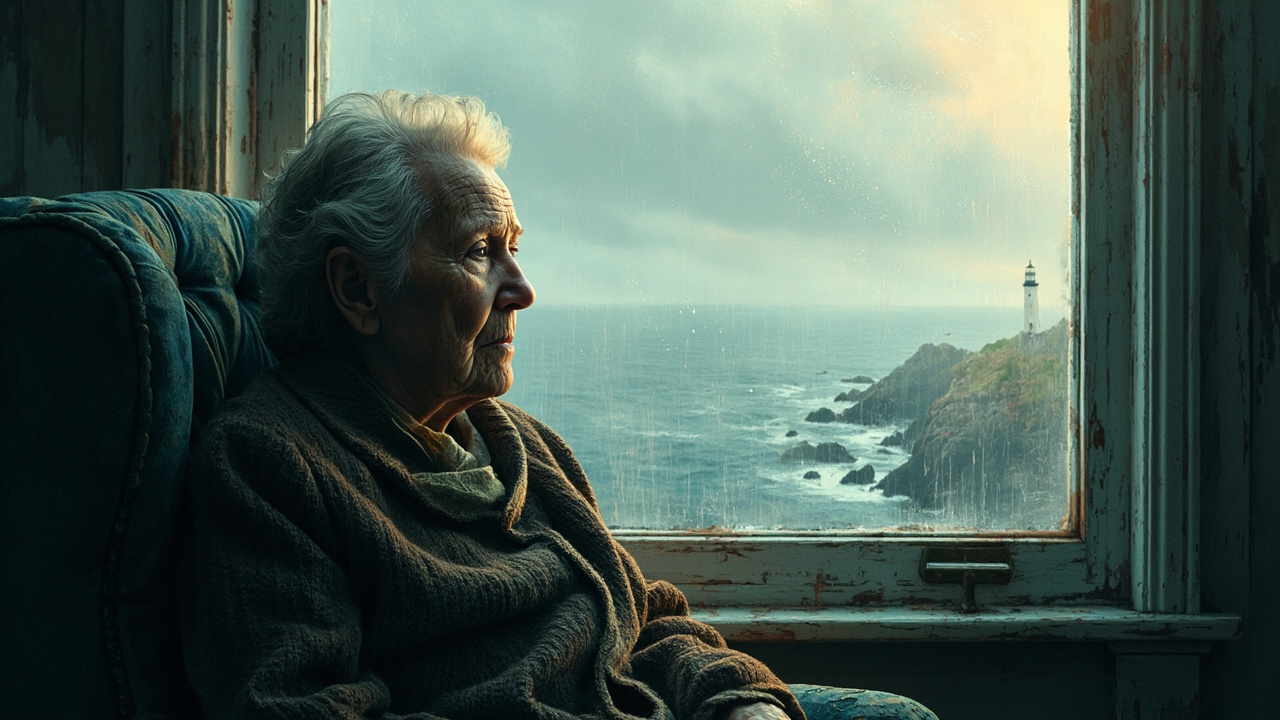
The sea had washed the colour from everything. That was the first thing Marcus noticed when he arrived in Hartwick-by-the-Sea—a town that seemed to exist in perpetual shades of grey and faded blue, as though the ocean had slowly leached the life from its stone cottages and weatherboard shops over centuries of relentless assault.
He had come with a commission: twelve portraits of elderly residents for the newly established heritage centre. The local council had been eager, almost desperate, in their correspondence. "We want to capture the soul of Hartwick," their letter had read. "Before it's too late." Marcus had assumed they meant before the last residents passed. He was not wrong, though he would come to understand their urgency in ways he had not anticipated.
His first subject was Eleanor Vance, ninety-three years old and as sharp as a winter morning. She sat in a wingback chair by her window, hands folded in her lap like a queen receiving a supplicant. The light fell across her face in a way that made Marcus's breath catch—beautiful, yes, but also revealing. Every line told a story.
"You're not the first photographer to come here," she said, not quite looking at him. "There was a man in the seventies. He wanted to capture the fishing families. We sent him away."
"And why was that?"
She was silent for a long moment. "Because some things shouldn't be documented. Some things should stay hidden, so they can stay safe."
Marcus took her portrait that afternoon, but he did not capture her soul. He knew it the moment he reviewed the images—she had given him her face, never her truth. He began to wonder what she had been protecting all those years.
The subsequent sessions brought him deeper into the town's labyrinthine history. William Hooper, eighty-eight, a former fisherman whose hands told their own story of ropes and nets and salt, spoke of the sea as though it were a living thing. "She provides, but she also takes," he said. "And sometimes, she brings things back that we didn't ask for."
"What do you mean?"
But William had fallen silent, and the moment passed.
It was Doris Chapman, ninety, who finally unravelled the thread. She had been reluctant to sit for him at all, but her daughter had insisted. Halfway through the session, she suddenly gripped his wrist with surprising strength.
"Do you know why this town exists?" she asked. "Not for the fishing. That was just the story we told. We were a sanctuary—a place where people could disappear. My grandmother came here in 1939, on a boat that wasn't supposed to exist. She had nothing but the clothes she wore and a secret she carried to her grave."
Marcus set down his camera. "What secret?"
"The same one everyone here carried, in one form or another." Doris released his wrist and sat back. "This town was built by people running from something. The lighthouse wasn't built to guide ships—it was built to guide us. The smuggler's coves weren't for contraband; they were for people. We gave them new names, new histories. We buried their old lives so they could start again."
She gestured towards the window, towards the grey sea beyond. "The council wants to celebrate us? They don't even know what they're celebrating. Hartwick was never about fishing. It was about protection. It was about giving the lost a place to belong."
Marcus thought of Eleanor's guarded silence, of William's cryptic words. He understood now. The town had been a conspiracy of compassion—a silent agreement spanning generations that some truths were too dangerous to speak aloud, even in a world where the danger had long since passed.
"Why tell me now?" he asked.
Doris smiled, and for a moment she looked every one of her ninety years. "Because I'm the last who remembers. My children know nothing. The council knows nothing. When I'm gone, the truth goes with me, and perhaps that's as it should be. But you—you're an outsider. You can decide what to do with it."
Marcus completed the portrait session, but his commission had transformed entirely. He had come to capture faces; he left with an inheritance he had never expected. On his last evening in Hartwick, he walked the cliff path as the sun set over the grey water, painting the town in shades of amber and rose it rarely saw. The lighthouse stood sentinel in the distance, no longer guiding fishing boats but standing as a monument to something far older and more sacred than any official history acknowledged.
He never did deliver the portraits to the heritage centre. Instead, he donated them to the town with a single condition: they were to be displayed without explanation, without interpretation. Let the faces speak for themselves, he had written. Let visitors wonder what lies behind the eyes of the forgotten.
Some secrets, he had come to understand, were not meant to be revealed. They were meant to be honoured through silence.