مفردات لا بدّ منها
| الكلمة | العربية | Deutsch | Français | Русский |
|---|---|---|---|---|
| محامٍ | Anwalt | notaire | нотариус | |
| مُتَأَلِّم | trauernd | endeuillé | скорбящий | |
| بستاني | gärtnerisch | horticole | садоводческий | |
| مُتِراك | überwuchert | envahi par la végétation | заросший | |
| فهرسة | katalogisieren | cataloguer | каталогизировать | |
| صنف نباتي مُزَرَّع | Kultivar | cultivar | культурный сорт | |
| تأقلم | akklimatisieren | s'acclimater | акклиматизироваться | |
| قلويد | Alkaloid | alcaloïde | алкалоид | |
| علاجي | therapeutisch | thérapeutique | терапевтический | |
| عينة | Exemplar | spécimen | образец |
القصة
I. The Letter
When the solicitor's letter arrived, I confess I was more perplexed than bereaved. I had never known my great-aunt Cordelia, a woman who had apparently lived her entire ninety-three years in a crumbling Georgian house on the Suffolk coast, tending a garden that, according to local legend, contained plants found nowhere else on earth.
The will was unambiguous: everything, including the notorious garden, passed to me. The solicitor's accompanying note was diplomatically phrased but unmistakable in its implication—the property required "someone with botanical expertise" given its "unique horticultural situation."
II. First Impressions
I arrived on a grey November afternoon, the house looming against a pewter sky like a forgotten monument. The estate agent had warned me it would need considerable work. She had undersold it spectacularly.
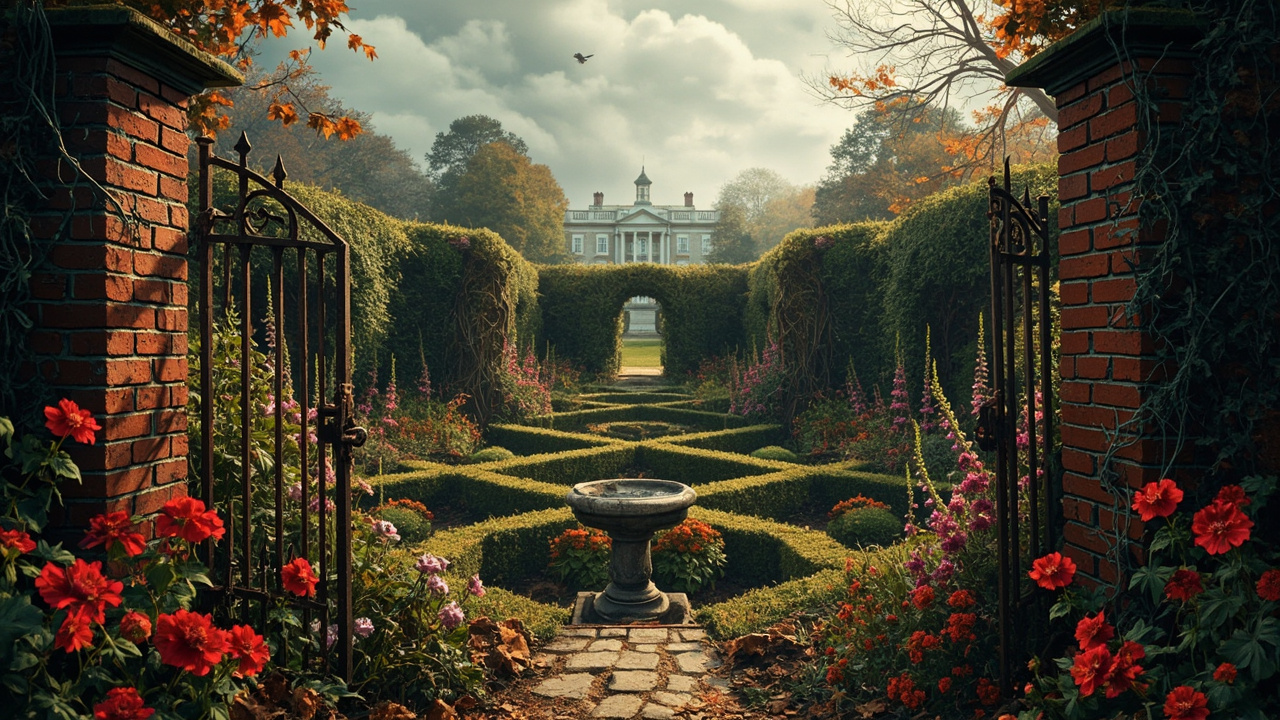
The garden was hidden behind walls of weathered red brick, so old they seemed to predate the house itself. A rusted gate yielded to my key with a groan of protest, and I stepped into a world that defied expectation.
At first glance, it appeared entirely overgrown. Brambles had colonised the pathways, ivy strangled the ancient apple tree, and everywhere the weeds held sway. But as my eyes adjusted, I began to perceive order beneath the chaos. The beds were still geometric, the paths still radiated from a central fountain long dry. Someone had designed this space with meticulous intention.
More remarkable still were the plants that had survived—or perhaps flourished—in the absence of any human care. I counted seventeen different species of geranium alone, their flowers defiantly blooming despite the season. There were foxgloves taller than I was, their spotted throats pointing skyward like small cathedral spires. A hedge of something silver-leaved and aromatic framed a formal knot garden, its geometric patterns barely visible beneath a century of growth.
III. The Discovery
Over the following weeks, as I cleared the worst of the overgrowth, I began to catalogue what I had inherited. The botanical names meant little to me; the plants themselves meant everything. Some I recognised from my own research into rare cultivars. Others were entirely alien, their leaf structures and growth patterns conforming to no classification system I knew.
It was in the old greenhouse—half-collapsed but still sheltering an impossible collection of tropical specimens—that I found the first clue to the garden's true purpose. Tucked beneath a workbench, protected by oilcloth and sealed in a lead-lined box, was a leather-bound journal. The handwriting inside was cramped and precise, the work of someone trained in scientific observation.
My great-aunt had not merely been gardening. She had been conducting experiments.
The dated entries began in 1942. "The specimens from Bletchley have acclimatised well," read the first. "Dr. Henshaw assures me the alkaloid concentrations are within projected parameters. We may yet produce something of genuine therapeutic value."
IV. The Hidden Legacy
The journal told a story I could scarcely credit. During the darkest years of the war, when bombing raids reduced cities to rubble and young men bled to death in fields far from any hospital, a small team of botanists and pharmacologists had been working in secret. Their mission: to develop medicines from plants with extraordinary properties—species gathered from every corner of the empire, cultivated in this unassuming garden, their potential kept hidden from prying eyes.
The war ended. The project was deemed too sensitive to publish. My great-aunt, who had devoted her finest years to it, was bound by the Official Secrets Act and forbidden to speak of her work. Rather than watch her life's research destroyed, she had simply continued it alone, tending the plants, refining the extracts, waiting for a time when such knowledge might once again prove useful.
That time, I suspected, had come.
V. The Heir
I read the final entry several times, searching for any hint of madness or delusion. There was none. My great-aunt had been, by any measure, entirely rational. She had simply made a choice: to preserve what others would have destroyed, to believe that knowledge abandoned in one era might be rediscovered in another.
She had left me not merely a garden, but a responsibility. The plants that surrounded me were more than curiosities; they were possibilities. Solutions to problems we had not yet encountered. Remedies for diseases not yet named.
I closed the journal and walked among the beds in the fading afternoon light. Somewhere in this garden lay compounds that might revolutionise medicine. But my great-aunt's final lesson was not about science. It was about patience. She had not demanded that the world acknowledge her work. She had merely ensured it would survive until someone came along capable of understanding it.
I intended to be worthy of that trust.