مفردات لا بدّ منها
| الكلمة | العربية | Deutsch | Español | Français | Italiano |
|---|---|---|---|---|---|
| تباعد | Divergenz | divergencia | divergence | divergenza | |
| ارتجاف | Schauder | escalofrío | frisson | brivido | |
| مُهمَل | stillgelegt | clausurado | désaffecté | in disuso | |
| نقش | Glyphe | glifo | glyphe | glifo | |
| رنين | Resonanz | resonancia | résonance | risonanza | |
| صوت | Phonem | fonema | phonème | fonema | |
| طبولوجيا | Topologie | topología | topologie | topologia | |
| مُفصلي | artikulatorisch | articulatorio | articulatoire | articolatorio | |
| مُعاير | kalibriert | calibrado | étalonné | calibrato | |
| تصميم حركي | Choreografie | coreografía | chorographie | coreografia |
القصة
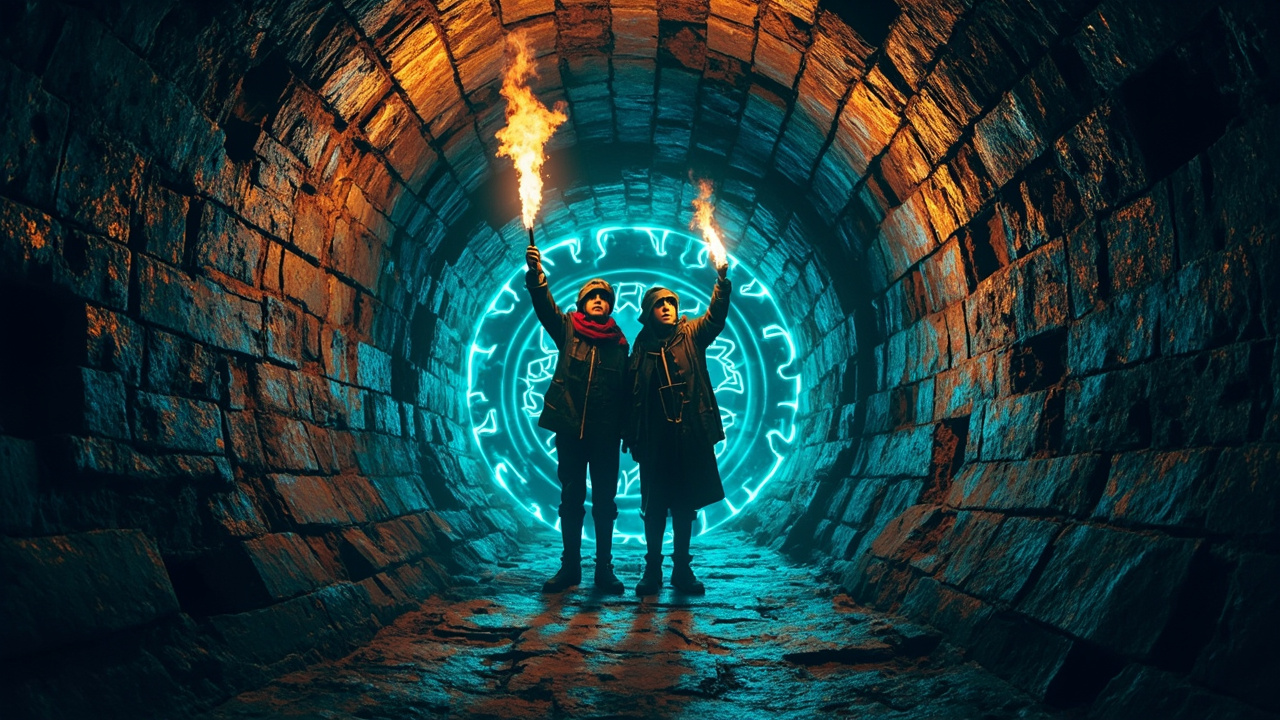
Marcus Thorne had descended into the abandoned junction at Aldgate seventeen times before he noticed the divergence. The Metropolitan line's mothballed platforms had always presented an allure of sorts—not merely the frisson of trespass, but the peculiar silence that settled in those decommissioned corridors, a silence so complete it seemed to possess its own texture. On that particular evening in late November, with his companion Yara Chen measuring distances by the pale beam of her torch, he paused at the junction where two disused passages branched westward, and something arrested him.
"This one," he said, tapping the left-hand wall where a faint glyph had been etched into the Victorian brickwork, half-obscured by a century of accumulated grime. "I've walked it four times. There's a harmonic response from the tunnel ahead—a resonance that shifts depending on where you stand."
Yara knelt, tracing the glyph with her fingers. She was a phonologist by training, though she had long since abandoned the university's fluorescent corridors for the company of those who preferred their research conducted without ethics committee approval. "It's not decorative," she said slowly. "The proportions relate to acoustic intervals. Whoever carved this understood something about sound propagation in cylindrical spaces."
They spent the following weeks mapping the abandoned network with meticulous care. The old Waterloo and City stations. The sealed entrance to the British Museum spur. The labyrinthine convergence of passages beneath the Bank that had been bricked over in 1945 and apparently forgotten by all but those who still remembered. What emerged from their surveys was not merely a series of disused routes but a pattern—a topology that bore no relationship to the functional geometry of the working railway above.
It was Yara who discerned the principle. "Each junction corresponds to a consonant or vowel phoneme," she announced one evening, spreading her diagrams across the floor of Marcus's flat in Bow. "The distances between them—the time it takes sound to travel between each node—are calibrated to specific acoustic frequencies. The entire network is a physical model of a phonetic system."
Marcus studied the diagrams. The logic was elegant and entirely mad. "You're suggesting the Victorians built an underground railway as an articulatory apparatus. A machine for speaking."
"Not speaking," Yara corrected. "Reproducing. The system is designed to be navigated in a particular sequence. Walk the wrong path, and the echoes cancel. Walk the right path—and here is where my blood runs cold—in the correct order, at the correct pace, the acoustic properties of the tunnels would reproduce an entire spoken language."
They identified seven others who had independently arrived at the same conclusion. A retired civil engineer named Priya Subramaniam who had spent her career buried in archival maps of London's subsurface. David Osei, a Ghanaian linguist whose academic career had foundered on the rocks of institutional indifference. The Okonkwo twins, whose expertise in architectural acoustics had earned them commissions on three continents before they chose to pursue more esoteric enquiries. And three others, whose backgrounds were less easily categorised but whose commitment to the investigation was beyond question.
Together, they returned to the tunnels beneath the Bank.
The sequence that unlocked the system was eleven nodes long. Yara had deduced it by analysing the acoustic properties of each junction—the precise frequency each segment would produce when stimulated at source. Walking it required absolute synchronisation. Three of the party would position themselves at designated nodes and generate a sustained tone; the remaining five would traverse the connecting passages in a carefully timed choreography that Yara had drilled into them across a dozen rehearsals in a disused canal tunnel in Hertfordshire.
Marcus took the first node. As he struck the brick wall with a rubber-headed mallet—a signal, not a sound, he reminded himself—he felt the vibration travel through his boots and up into his chest. Around him, at stations he could no longer name, his companions began their movements.
What emerged was not audible in any conventional sense. It was not sound transmitted through air but through structure—through the bones of a city that had been built to listen. The frequency pattern rose and fell, surged and retreated, and Yara, standing at the seventh node with tears streaming down her face, understood it as language in its most ancient and total form. Not words. Not syntax. The raw phonemic architecture of a tongue that had never been written, only ever spoken, only ever carried in the living breath of those who knew the labyrinth.
The message was brief. It spoke of a vault beneath the old Royal Society building—a repository established by scholars who had recognised, centuries before such recognition became academically fashionable, that certain forms of knowledge could not survive the scrutiny of print. They had encoded their understanding into the stone and iron of London's deepest foundations, trusting that the tunnels would endure where books would burn.
The Okonkwo twins located the vault three weeks later. Its contents, which have not been made public, are the subject of ongoing deliberation among the nine who walked the labyrinth. But Marcus, who had once believed that the greatest thrill of urban exploration was the discovery of what had been forgotten, now understands that the true enigma is why certain knowledge was buried in the first place—and whether those who interred it knew something that the rest of us are not yet ready to learn.