مفردات لا بدّ منها
| الكلمة | العربية | Deutsch | Español | Français | Italiano |
|---|---|---|---|---|---|
| دفتر الحسابات | Hauptbuch | libro mayor | grand livre | libro mastro | |
| تدقيق | Prüfung | auditoría | audit | revisione contabile | |
| تحول | Umwandlung | transmutación | transmutation | trasmutazione | |
| غامض | geheimnisvoll | arcano | arcane | arcano | |
| خزنة | Tresor | caja fuerte | coffre-fort | cassaforte | |
| طبقة خارجية | Patina | pátina | patine | patina | |
| مصالحة | Abstimmung | conciliación | rapprochement | riconciliazione | |
| تحت الأرض | unterirdisch | subterráneo | souterrain | sotterraneo |
القصة
The November fog had descended upon the city like a shroud, muting the familiar geometries of brick and glass into something spectral and strange. It was on such an evening that Eleanor Marsh first encountered the ledger that would unravel everything she believed about her profession, her employer, and the very nature of wealth itself.
She had been tasked with the quarterly audit of the Hargreave & Sons vaults—a duty she performed with the dispassionate rigour expected of a senior auditor at one of London's oldest private banking institutions. The vault, a subterranean labyrinth of iron and stone that predated the current building by three centuries, contained the usual accoutrements of inherited affluence: share certificates brittle with age, deeds to properties long since demolished, and the more esoteric holdings that prosperous families accumulate over generations like sediment.
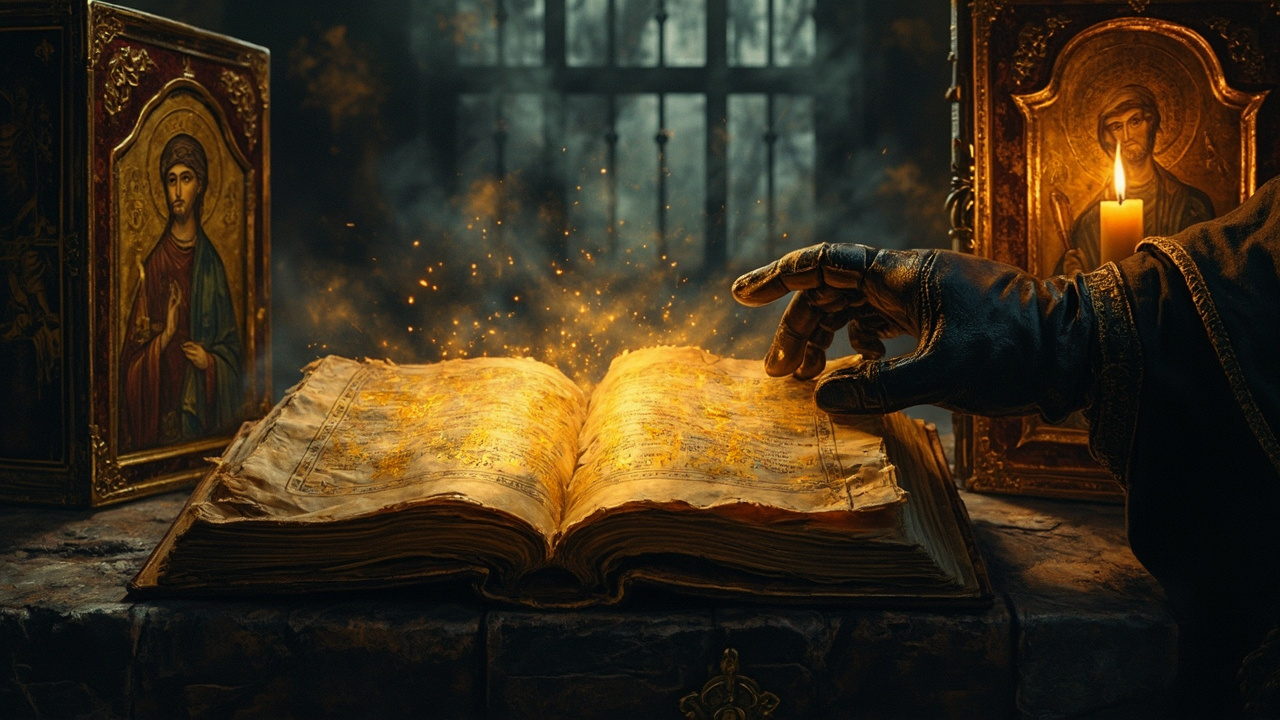
The ledger lay wedged behind a collection of Russian icons in a forgotten strongbox. It was bound in leather so dark it appeared almost black, its surface worked with symbols that Eleanor did not immediately recognise. The pages within were of a heavy vellum, covered in a cramped but elegant script that shifted between Latin phrases, chemical formulae, and something that resembled Elizabethan shorthand.
The first entry, dated 14th October 1847, read: "The Magnum Opus achieved at the twenty-third attempt. Lead transmuted to gold of exceptional purity. Proceeds: £47,000 deposited to the account of J.H., with distribution to recipients as instructed."
Eleanor paused. She was not, by temperament, a superstitious woman. She believed in spreadsheets, in reconciliation statements, in the audited truth of numbers. Yet something in the peculiar specificity of that phrase—proceeds—snagged at her attention. She turned the page.
The entries continued with mechanical regularity through the 1850s and 1860s. Each recorded what appeared to be alchemical experiments: the quantities of base metals, the reagents employed, the dates of successful transmutations. And yet, woven through this arcane vocabulary like veins of gold through quartz, ran the unmistakable grammar of financial transaction. Deposited. Transferred. Distributed. Converted. The amounts were considerable—sometimes vast—and they corresponded, Eleanor realised with a cold prickle of recognition, to figures she had encountered in historical documents related to the bank's most prominent Victorian-era clients.
She worked through the night, her torch casting long shadows across the vault's ancient stones. By dawn, she had established an extraordinary correlation. The ledger's transmutations—its phoenixes and philosophers' stones—mapped precisely onto a series of deposits that appeared in no official records. Someone, or some succession of someones, had been laundering money through the bank for over a century and a half, and had chosen to conceal their transactions behind the patina of medieval mysticism.
But why? Why this particular pretence? Eleanor puzzled over the question as she ascended to the bank's modern offices, blinking against the unforgiving fluorescence of the trading floor. The fog had lifted, but a different kind of murkiness had settled into her thoughts.
The answer came three days later, in a conversation with the bank's archivist—a wizened gentleman named Whitmore who had served Hargreave & Sons for forty years and seemed to regard the institution's history with the devotion of a monk to his scriptures.
"That ledger," Whitmore said slowly, when Eleanor described her discovery. "I always wondered where it had gone. Old Mr. Hargreave—back in the 1890s—ordered it removed from public view. Said it was too eccentric for a respectable establishment."
"But what is it, really?"
Whitmore removed his spectacles and polished them with a handkerchief, a gesture that seemed to buy him time for consideration. "The bank was founded in 1714 by a syndicate of... let us say, gentlemen with eclectic interests. Alchemy was fashionable among the wealthy of that period—not as genuine belief, you understand, but as a kind of elaborate metaphor. The transformation of lead into gold became their code for converting questionable wealth into respectable wealth. The ledger is their running record of every transaction they sanitised for their clients. Every fortune they laundered through property purchases, art acquisitions, and charitable foundations—all written up in the language of transmutation to confuse any who might stumble upon it without the key to the cipher."
Eleanor felt the ground shift beneath her, not physically but epistemologically. All her professional life, she had understood her work as the careful examination of truth—the bringing of light to obscure corners, the rendering of accounts transparent. Yet here was a system designed precisely to prevent that illumination, a darkness so profound it had persisted for three hundred years because it had been clothed in the impossible language of magic.
"The syndicate dissolved in 1912," Whitmore continued, "but the bank continued the practice. Different management, same methods. The language evolved—now they speak of restructuring and offshore vehicles—but the substance remains unchanged. Every generation finds its own vocabulary for the old darkness."
Eleanor sat in silence for a long moment. She thought of the career she had built, the reputation for incorruptibility she had cultivated, the faith she placed in systems and protocols. She thought, too, of what she owed to her profession and what she owed to herself.
"I'm going to need to see every record this bank has ever maintained," she said finally. "And I'm going to need a very large cup of tea."
Whitmore smiled—the first genuine expression she had ever seen him wear. "I suspected you might say that. The records are in the east wing. I'll have them brought to your office."
He paused at the door, turning back with an expression that mingled admiration with something older and sadder. "You're the first auditor in the bank's history to read that ledger correctly. The others saw only mysticism, or madness, or misdirection. But you understood what it truly was: a confession written in riddles by men who assumed that no one would ever take the time to decipher it."
Eleanor met his gaze steadily. "The truth rarely announces itself plainly. One learns to listen for it in strange dialects."
That evening, she began her true audit. The ledger lay open before her, its ancient pages glowing in the lamplight like something from a fairy tale—which, she supposed, it was. But fairy tales, she had always believed, were merely histories whose authors had lacked the courage to name themselves. This one had been writing itself for three centuries, waiting only for a reader brave enough to speak its meaning aloud.
And when the Financial Conduct Authority's investigators arrived three weeks later, clutching warrants signed by judges who had not known what they would find, they would discover Eleanor Marsh at her desk, the ledger open, her annotations covering every margin in the neat, unforgiving hand of someone who had finally found work worthy of her considerable talents.