مفردات لا بدّ منها
| الكلمة | العربية | Deutsch | Français | Русский |
|---|---|---|---|---|
| عرض تقديمي | Angebot | soumission | заявка | |
| إعادة بناء | Rekonstruktion | reconstruction | реконструкция | |
| دعاية | Propaganda | propagande | пропаганда | |
| إيقاع | Rhythmus | cadence | ритм | |
| شذوذ | Anomalie | anomalie | аномалия | |
| تشويش | Rauschen | statique | помехи | |
| تدهور | Zerfall | dégradation | деградация | |
| فهرسة | katalogisieren | cataloguer | каталогизировать | |
| يرتجف | zittern | trembler | дрожать | |
| يضيق | verengen | se resserrer | сжиматься |
القصة
The letter arrived on a Thursday, which Miriam Cole would later consider significant only because Thursdays had always belonged to her mother, and her mother had been dead for three years come February. The envelope bore the crest of the British Library's Sound Archive, and within, a single sheet of cream stationery invited her to submit a tender for what was described only as 'a specialised vocal reconstruction project of considerable historical importance'.
Miriam was not, by any measure, a famous voice actor. She worked predominantly in audiobooks—historical romances, mostly, though she had a particular gift for dialect work that had earned her a modest reputation among the producers who matters. When she arrived at the Archive's Euston Road premises on a grey November morning, she was shown into a basement office where a man named Dr. Alistair Fenwick explained the commission.
"We're restoring a collection of wireless broadcasts from the 1950s," he said, adjusting his spectacles with fingers that trembled slightly. "Propaganda recordings, predominantly. The Foreign Office wants them made accessible to researchers, but the audio quality is—" He gestured vaguely at the ceiling. "We need someone who can voice the reconstructed portions without jarring the listener. Someone who can sound as though they've already been there."
Miriam understood. The work would involve listening to fragments of damaged tape, then recording over the gaps with appropriate period inflection. The rhythm of the era, the particular cadence of mid-century speech. It was painstaking work, requiring both historical sensitivity and technical precision.
She accepted without hesitation.
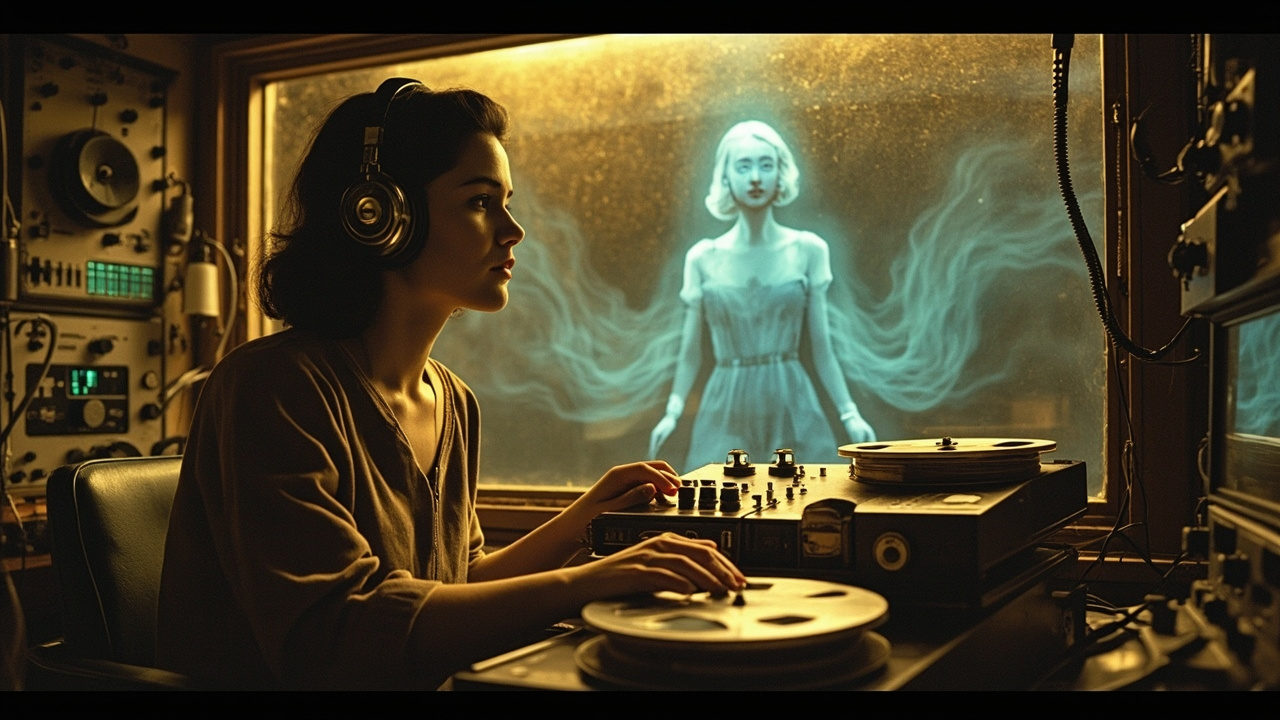
The first week passed without incident. Miriam sat in a soundproofed booth, headphones pressed to her ears, listening to broadcasts she had never heard—BBC transmissions from the Korean War, patriotic recitations from the Festival of Britain, a woman's voice reading poetry over a bed of strings. She studied the phrasing, the way vowels were flattened or elongated, the peculiar stress patterns that distinguished 1952 from 1972. She took notes in a leather journal, her handwriting cramped and efficient.
The anomalies began in the second week.
She was working on a particularly damaged recording—a woman reading what appeared to be a personal letter, her voice interrupted by bursts of static and the distinctive hiss of deteriorating magnetic tape. Miriam listened through the gaps, preparing to voice the missing sections, when she heard herself.
Not a voice similar to hers. Her voice. The same slight catch on the letter 's', the same way she drew breath before a long sentence, the same peculiar emphasis she placed on words she considered important. The woman on the recording—a woman she had never met, whose face appeared nowhere in the Archive's records—spoke with Miriam Cole's voice as though it were her own.
Miriam removed her headphones. Her hands were steady as she reached for the teacup on the console, though her throat had constricted to the diameter of a pencil. She drank. She breathed. She told herself that voices were patterns, that patterns could recur across generations, that this was coincidence and nothing more.
She listened again. The voice remained.
Over the following days, she began to catalogue what she found. A man reciting Churchill's speeches in her father's cadence. A child singing a nursery rhyme with the exact pitch and timbre of her younger sister's voice. Her grandmother's laugh, unmistakable despite forty years of tape degradation, echoing from a recording dated 1963. Miriam began to suspect that she was not merely working in the Archive. She was being found by it.
She went to Fenwick with her concerns. He listened patiently, his spectacles catching the fluorescent light, and when she had finished, he removed a box from beneath his desk.
"I wondered when you would discover it," he said.
Inside the box was a collection of index cards, each bearing a name, a date, and a photograph. Miriam recognised none of the faces. But she recognised the names. Her great-grandmother. Her uncle, dead before she was born. Her own daughter, whom she had never borne, whom she had never conceived, whose photograph should not have existed at all.
"The tapes were not simply recordings," Fenwick explained. "They were—and I use the word knowing its implications—they were seeds. The Archive has long theorised that sound does not simply travel through time. It is time. These recordings were made with equipment that could capture not only voices but voiceprint patterns. Genetic signatures encoded in frequency. They were not meant to preserve history. They were meant to recreate it."
"And my voice?" Miriam's own words sounded strange to her, as though she were hearing them played back on old tape. "Why is my voice in recordings from before I was born?"
Fenwick removed his spectacles and rubbed his eyes. In that gesture, she saw exhaustion, and something like guilt.
"Because you are not the first Miriam Cole," he said. "There have been others. Seventeen, across the past century. All with your voice. All with your gift for language. All connected to the Archive in ways they did not understand until it was too late." He replaced his spectacles. "We believe that some frequencies, once broadcast, call back to themselves. That certain voices are not born but resonated into existence by the recordings that precede them."
Miriam thought of her mother's voice, preserved in birthday messages on old answering machine tapes. She thought of the way she had always known, without being taught, how to speak the King's English as though it were her native tongue. She thought of the recordings she had been hired to complete, and understood at last that she had not been brought in to finish them. She had been brought in to begin.
"What happens now?" she asked.
Fenwick handed her the leather journal from her bag—the one she had been using for her notes, the one she did not remember packing.
On the first page, in handwriting she recognised as her own, was a single sentence: They will ask you to continue. You must. This is how you exist.
Miriam Cole sat in the basement office, surrounded by the voices of her own future and past, and understood that she was not merely a voice actor. She was a recording. And somewhere, in some archive yet to be built, someone was already listening.