Vocabulaire essentiel
| Mot | العربية | Deutsch | Français | Русский |
|---|---|---|---|---|
| ملاذ | Zufluchtsort | sanctuaire | убежище | |
| خط نسخي دقيق | Kupferstich | écriture Engine | каллиграфический почерк | |
| هاوية | Abgrund | abyme | бездна | |
| الواقعية | Pragmatismus | pragmatisme | прагматизм | |
| مصالحلة | Versöhnung | réconciliation | примирение | |
| وقار | Ehrfurcht | révérence | благоговение | |
| بلا مبالاة | gleichgültig | indifférent | безразличный | |
| حزمة | Bündel | paquet | связка |
L'histoire
Eleanor Ashford had built her life around forgotten things. The Oxford antique shop she kept above a cobbled street was a sanctuary for objects with stories yet to be told—silver pocket watches, Victorian mourning jewelry, leather-bound journals whose authors had long since turned to dust. But nothing had prepared her for the morning she discovered the suitcase.
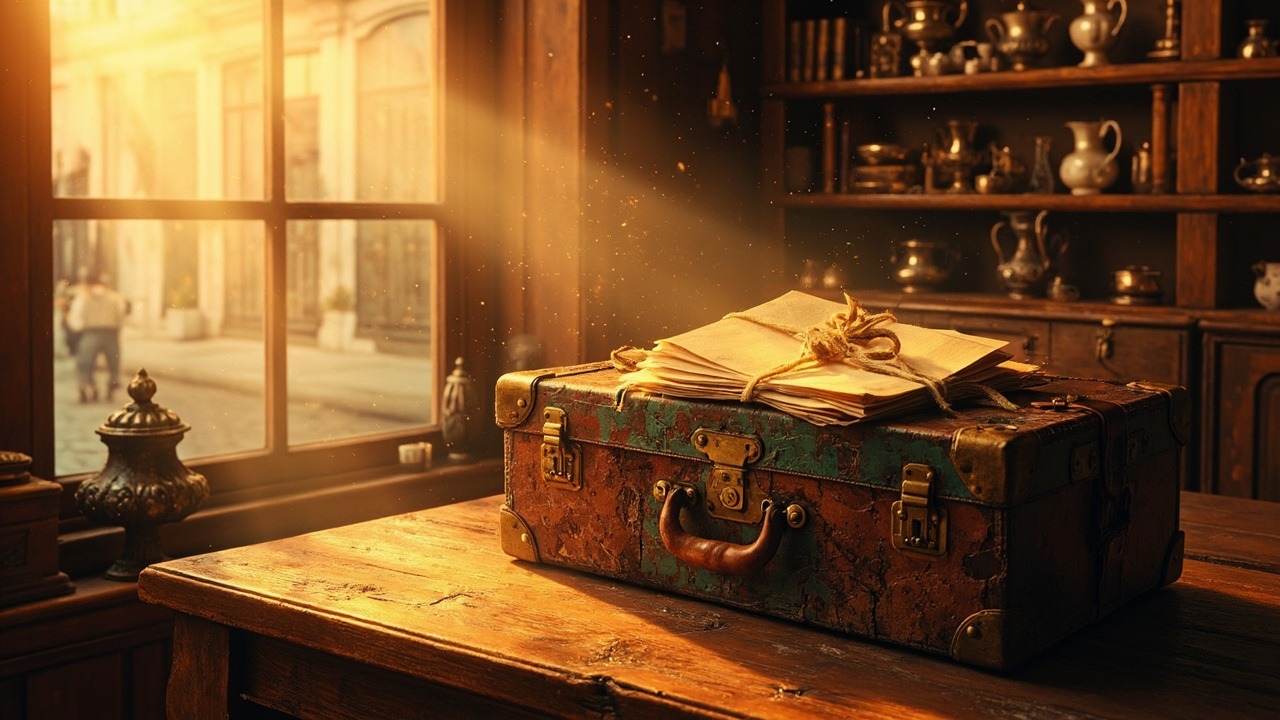
It had arrived from an estate sale in the Cotswolds, its brown leather cracked and worn, secured by brass latches green with age. When Eleanor pried it open, she found herself staring at a lifetime compressed into paper and ink. Hundreds of letters, bundled with faded ribbon and arranged chronologically, spanning the years 1942 to 1946. The handwriting shifted between hurried scrawls and careful copperplate, but the postmarks told a unified story: these had travelled from the battlefields of North Africa to a small village in Yorkshire, from a young soldier to the woman he loved.
She read the first letter standing in the dusty afternoon light filtering through the shop window. My dearest Margaret, it began, If you're reading this, then I've made it home again. The sea was cruel, but your photograph kept me alive. Eleanor's throat tightened. She had dealt in antiques long enough to recognise when an object transcended its material worth. These letters were not merely old paper; they were the last testament of someone who had stared into the abyss and emerged whole.
The soldier's name was Thomas Whitmore. His letters traced the arc of a war—early optimism curdling into the grim pragmatism of a man who had seen too much, and finally a cautious hope as the tide turned in 1944. But here was the puzzle: there was no reply. Not a single letter from Margaret. Eleanor found only Thomas's outgoing correspondence, bundled and preserved as if someone had collected them deliberately. Who had kept this archive? And what had become of Margaret herself?
Her research took her first to the village of Harrogate, where a county records office held the threads she needed. Thomas Whitmore had indeed survived the war, returning to Yorkshire in 1945 to marry his sweetheart. They had lived out their years in modest contentment, raising two children before Thomas passed in 1987. Margaret had followed him eight years later. Their son, however, had vanished from local records in the 1970s—relocated to Scotland, according to a single forwarding address.
Eleanor found herself driving north, the suitcase secured in her boot like contraband. The journey across the Yorkshire moors felt like travelling through centuries; one moment she was threading between modern lorries on the A1, the next she was climbing a narrow lane where sheep outnumbered cars and drystone walls held the landscape together like stitches on an ancient wound.
Edinburgh revealed a city of grey stone and hidden gardens, where finding a single family after seventy years felt akin to searching for a particular grain of sand on Portobello beach. But Eleanor had her father's stubbornness and her mother's intuition, and she followed the trail with the determination of a detective in a wartime film. The son—now an elderly man himself—lived in a flat overlooking the Water of Leith, surrounded by books and the particular silence of someone who had outlived most of his contemporaries.
"You found them," David Whitmore whispered when Eleanor placed the suitcase before him. His hands trembled as he opened the first bundle, his eyes moving across his father's familiar handwriting with an expression she could only describe as reverence. "My mother kept these. She read them every year on their wedding anniversary. When she died, I couldn't bear to look at them—so I packed them away and tried to forget."
Eleanor watched as he lifted a letter at random, his lips moving silently as he read. Outside, Edinburgh went about its business, indifferent to the small miracle unfolding in this cluttered flat—the reconciliation of a son with his father's voice, preserved across seven decades in ink and paper and the stubborn refusal of love to die quietly.
"Why did you bring them to me?" David asked eventually. "They would have been worth a considerable sum."
Eleanor considered the question. She thought of her shop filled with beautiful orphan objects, their histories often unknowable. "Some things aren't meant to be sold," she said. "Some things are meant to come home."
She left him reading by the window, the winter light catching the edges of letters that had finally found their resting place. The journey back to Oxford felt shorter somehow, as if the road itself had been unburdened. And when Eleanor opened her shop the following morning, she found she was smiling—her hands empty, her heart full, and the suitcase no longer weighing her down.