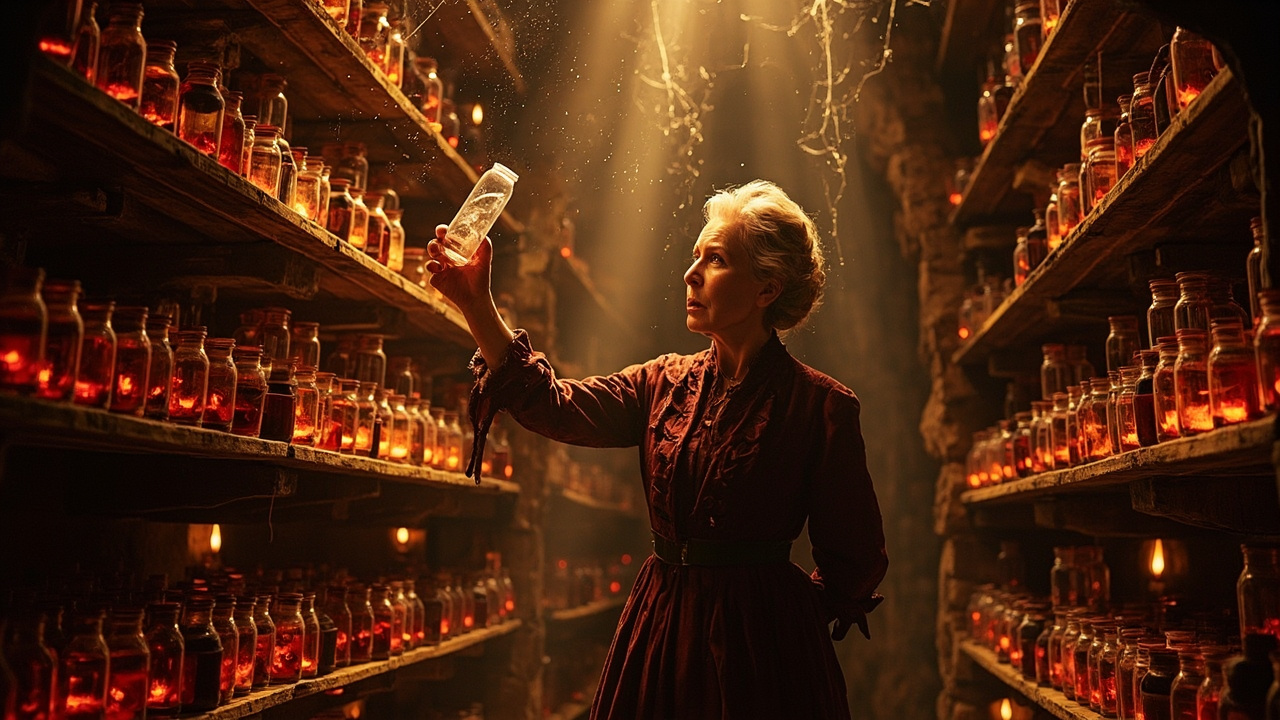
وصل البرقي في صباحٍ رماديٍّ من شهر نوفمبر، كقدومه المفاجئ كالتكليف الذي نقله. كان على الدكتورة إلينور مارش، العالمة النباتية الأولى في حدائق كيو الملكية النباتية، الإشراف على فهرسة وحفظ قبوٍ كان قد ظل مُختومًا تحت البيت المعتدل لقرنين تقريبًا. نزلت الدرجات الحجرية البالية في الساعة التاسعة والنصف، حيث كانت حلقة المفاتيح باردة في راحة يدها. كان القبو قد أُعيد اكتشافه أثناء أعمال التجديد الروتينية — حجرة من الطوب اليدوي الصنع، بابه الحديدي مُحفر بالصدأ لكنه لا يزال ثابتًا بلا حراك، مضمونًا بآلية قفل ذات اختراع فريد. لم يكن أحدٌ من الأحياء قد رأى ما بداخله. انفتح الباب نحو الداخل على نفحة هواء حَمَلَت عطر التاريخ: الأرز، والبتلات المجففة، وشيءٌ كيميائيٌّ خفيف — مركبات حفظ من تركيبة القرن الثامن عشر. في الداخل، رُتبت الأرفف على طول كل جدار، وعليها صفٌّ تلو صفٍّ من القوارير الزجاجية، لا أكبر من إبهام كل منها، مُختومة بشمع أحمر داكن كاللون الشرياني. أطلقت إلينور زفيرًا. كانت قد أمضت خمس عشرة سنة تدرس النباتات الطبية في جبال الأنديز، وواجهت دوار الارتفاع واضطرابات سياسية من أجل عينة واحدة من الفصيلة الجنتيانية. لكن هذا — هذا أسرَ أنفاسها. رفعت القارورة الأولى وفحصت ملصقها، مكتوبًا بخط يدوي أنيق اصفرّ لكنه لم يتلاشَ: Lathyrus odoratus، البازلاء الحلوة. ثلاث بذرات. سجلتها في دفترها وامتدت إلى التالية. استغرق الفهرسة أسابيع. عملت وحدها في القبو كل صباح، تُسجّل الأنواع، وتُقيّم صلاحية البقاء، وتعمل منهجيًا عبر المجموعة. كان في اليوم السابع عشر حين توقفت. كانت قد لاحظت الكميات — بذرة واحدة، ثلاث بذرات، سبع بذرات، بذرتان — وعلق قلمها فوق الصفحة. سبع بذرات من Lathyrus odoratus. ثلاث من Nigella damascena. خمس من Dianthus caryophyllus. قلبت صفحاتها ورأت معدتها تهبط انزعاجًا بطيئًا. رسمت الأرقام بيانيًا. استشارت فهرسًا نباتيًا من القرن الثامن عشر وعملت على مقارنة رموز الأنواع التي استخدمتها جمعية الصيادلة. ما ظهر لم يكن مجموعة عشوائية من العينات بل تعليمات، رسالة مُشفرة في ترتيب البذور نفسه. الكميات تُهجّي حروفًا. الأنواع تُحدد ترتيبها. والشمع — فحصته تحت التكبير ووجدت انطباعات صغيرة، بالكاد محسوسة، كنفَس ختم مضغوط في طين دافئ. رسائل مبدئية. تواريخ. إحداثيات. استندت إلينور إلى مقعدها وتراوحت عيناها عند جدار القوارير. كانت جماعة سرية، تعمل في لندن في عهد جورج، قد بنت هذا القبو ليس فقط لحفظ البذور بل لإخفاء شيء. ووثقت بألنباتات ذاتها لتتحدث. فكّت الشفرة بعناية. كانت لغة لينيوس — التسمية الثنائية، التصنيف الكوني للنباتات — قد خدمت كمفتاح الشفرة. Rosa للرمز R، Viola للرمز V، Iris للرمز I. حلت الرسالة بشكل حتمي كنظرية: موقع. نقطة في مرتفعات إسكتلندا حيث دُفن شيء ما. لكن بقاء القبو أصبح الآن مهددًا بشكل خطير. غُمر الطابق السفلي ذلك ديسمبر — اخترق مد التيار الطيني لنهر التايمز جدران المحيط، وتراكمت المياه على أرضية الحجر في تسرب رتيب كئيب. عملت إلينور طوال الليل، نقلت أكثر العينات هشاشة إلى أرفف أعلى، واخترعت حواجز من الرمل والبلاستيك. لم يعد تغير المناخ تجريدًا؛ كان بركة من الماء البارد تمتد فوق حذائها. عرضت نتائجها على مجلس الأمناء في يناير، وصوتها ثابت رغم الإنهاك المنقوش في ملامحها. أظهرت لهم الشفرة. أظهرت لهم الإحداثيات المفكوكة. وأظهرت لهم نماذج الإسقاط — فيضانات أكثر، طقس متطرف أكثر، تدهور مستمر في السلامة الهيكلية للقبو. لم تكن المجموعة ذات أهمية تاريخية فحسب. كانت مكتبة جينية جمعها علماء نبات توقعوا بالضبط هذا النوع من الكوارث. كانوا يعرفون، منذ مئتي عام، أن المناخ سيتغير. وقد تخطيطوا وفقًا لذلك. غادرت الحملة إلى المرتفعات في مارس، بقيادة إلينور وفريق صغير من الحافظين. الموقع، في منطقة نائية لم يكن بها طريق وقليل من السكان، أظهر كنزًا من السرية العظيمة: غرف تحت الأرض مختومة تحوي بذورًا وأنسجة نباتية من أكثر من ثلاثمائة نوع، كثير منها انقرض الآن في البرية. كانت الجماعة حذرة ودقيقة وبعيدة النظر. قد حفظوا ما سيحتاجه المستقبل بشدة. وقفت إلينور عند مدخل الوادي مع حلول الشفق فوق الخلنج، وثقل قرنين يضغط برفق على كتفيها. فكرت في الأيدي التي اختتمت تلك الغرف، والعقول التي وثقت بلغة الأزهار لتتحدث أعلى من الصمت. أدركت، أخيرًا، أن علم النبات لم يكن يومًا مجرد علم تعريف. كان حوارًا عبر الزمن — والليلة، سُمعت البذور أخيرًا.
Das Telegram kam an einem grauen Novembermorgen, seine Ankunft so unerwartet wie die Aufgabe, die es übermittelte. Dr. Eleanor Marsh, leitende Botanikerin der Royal Botanic Gardens in Kew, sollte den Katalog und die Erhaltung eines Gewölbes überwachen, das nahezu zwei Jahrhunderte lang unter dem Temperierten Haus versiegelt gelegen hatte. Sie stieg die abgetretenen Steinstufen um halb zehn hinunter, ein Schlüsselbund kalt in ihrer Handfläche. Das Gewölbe war bei routinemäßigen Renovierungsarbeiten wiederentdeckt worden — eine Kammer aus handverlegten Ziegeln, ihre eiserne Tür vom Alter punktiert, aber noch immer unbeweglich, gesichert durch einen Schließmechanismus einzigartiger Erfindungsgabe. Niemand, der noch lebte, hatte gesehen, was darin lag. Die Tür schwang nach innen auf einem Hauch von Luft, der den Duft der Geschichte trug: Zedernholz, getrocknete Blütenblätter und etwas schwach Chemisches — Konservierungsmittel einer Formulierung aus dem 18. Jahrhundert. Im Inneren waren Regale an jeder Wand angebracht, und darauf ruhten Reihe um Reihe von Glasfläschchen, jedes nicht größer als ein Daumen, jedes versiegelt mit Wachs von tiefem, arteriellem Rot. Eleanor holte Atem. Sie hatte fünfzehn Jahre damit verbracht, die Heilpflanzen der Anden zu studieren, hatte Bergkrankheit und politische Unruhen für das Wohl einer einzigen Probe der Enzianfamilie riskiert. Aber das hier — das nahm ihr den Atem. Sie hob das erste Fläschchen hoch und untersuchte sein Etikett, handschriftlich in eleganter Schrift, die vergilbt, aber nicht verblasst war: Lathyrus odoratus, die Duftende Platterbse. Drei Samen. Sie trug es in ihr Hauptbuch ein und griff nach dem nächsten. Der Katalog nahm Wochen in Anspruch. Sie arbeitete jeden Morgen allein im Gewölbe, dokumentierte Arten, bewertete Lebensfähigkeit, arbeitete sich methodisch durch die Sammlung. Am siebzehnten Tag hielt sie inne. Sie hatte die Mengen notiert — ein Samen, drei Samen, sieben Samen, zwei Samen — und ihr Stift schwebte über der Seite. Sieben Samen von Lathyrus odoratus. Drei von Nigella damascena. Fünf von Dianthus caryophyllus. Sie blätterte durch ihre Einträge zurück und ihr Magen machte eine langsame, beunruhigende Senkung. Sie zeichnete die Zahlen in ein Diagramm. Sie konsultierte einen botanischen Index aus dem 18. Jahrhundert und verglich Artcodes, die von der Gesellschaft der Apotheker verwendet wurden. Was auftauchte, war keine zufällige Sammlung von Proben, sondern eine Anweisung, eine Nachricht, verschlüsselt in der Anordnung der Samen selbst. Die Mengen buchstabierten Buchstaben. Die Arten gaben ihre Reihenfolge an. Und die Wachssiegel — sie untersuchte sie unter Vergrößerung und fand winzige Eindrücke, kaum wahrnehmbar, wie der Atem eines Siegels, in warme Ton gedrückt. Initialen. Daten. Koordinaten. Eleanor lehnte sich in ihrem Stuhl zurück und starrte auf die Wand der Fläschchen. Eine Geheimgesellschaft, die im georgianischen London operierte, hatte dieses Gewölbe nicht nur gebaut, um Samen zu erhalten, sondern um etwas zu verbergen. Und sie hatten den Pflanzen selbst vertraut zu sprechen. Sie entschlüsselte die Chiffre methodisch. Die Sprache von Linné — binäre Nomenklatur, die universelle Taxonomie der Pflanzen — hatte als Schlüssel gedient. Rosa für R, Viola für V, Iris für I. Die Nachricht löste sich mit der Unausweichlichkeit eines Theorems auf: ein Ort. Ein Punkt in den schottischen Highlands, wo etwas vergraben lag. Aber das Überleben des Gewölbes war jetzt ernsthaft gefährdet. Der Keller wurde in diesem Dezember überflutet — der Gezeitenanstieg der Themse durchbrach die Umfassungsmauern, und Wasser sammelte sich über den Steinboden in einem düsteren, stetigen Sickern. Eleanor arbeitete die ganze Nacht, verlagerte die zerbrechlichsten Proben auf höhere Regale, improvisierte Barrieren aus Sand und Plastikfolie. Der Klimawandel war keine Abstraktion mehr; es war eine Pfütze kalten Wassers, die sich über ihre Stiefel ausbreitete. Sie legte ihre Ergebnisse im Januar dem Vorstand vor, ihre Stimme fest trotz der Erschöpfung, die in ihre Züge gemeißelt war. Sie zeigte ihnen die Chiffre. Sie zeigte ihnen die entschlüsselten Koordinaten. Und sie zeigte ihnen die Projektionsmodelle — mehr Überschwemmungen, mehr extremes Wetter, die fortgesetzte Verschlechterung der strukturellen Integrität des Gewölbes. Die Sammlung war nicht nur historisch bedeutsam. Sie war eine genetische Bibliothek, zusammengestellt von Botanikern, die genau diese Art von Katastrophe vorausgesehen hatten. Sie hatten gewusst, vor zweihundert Jahren, dass sich das Klima verändern würde. Und sie hatten dementsprechend geplant. Die Expedition in die Highlands brach im März auf, geleitet von Eleanor und einem kleinen Team von Naturschützern. Der Standort, tief in einem Tal ohne Straße und wenige Bewohner, förderte einen Schatz magnificenter Geheimhaltung zutage: versiegelte unterirdische Kammern mit Samen und Pflanzengewebe von über dreihundert Arten, viele jetzt in freier Wildbahn ausgestorben. Die Gesellschaft war vorsichtig, gründlich, weitsichtig gewesen. Sie hatten erhalten, was die Zukunft verzweifelt brauchen würde. Eleanor stand am Eingang des Tals, als die Dämmerung sich über das Heidekraut senkte, das Gewicht von zwei Jahrhunderten sanft auf ihren Schultern lastend. Sie dachte an die Hände, die diese Kammern versiegelt hatten, an die Geister, die der Sprache der Blumen vertraut hatten, lauter als Stille zu sprechen. Sie verstand endlich, dass Botanik niemals bloß eine Wissenschaft der Identifikation gewesen war. Es war ein Gespräch durch die Zeit — und tonight, die Samen waren finally gehört worden.
Le télégramme arriva par un matin gris de novembre, aussi inattendu que la mission qu'il transmettait. Le Dr Eleanor Marsh, botaniste principale aux Jardins Botaniques Royaux de Kew, devait superviser le catalogage et la préservation d'une chambre forte qui était restée scellée sous la Maison Tempérée pendant près de deux siècles. Elle descendit les marches de pierre usées à neuf heures et demie, un trousseau de clés froid contre sa paume. La chambre forte avait été redécouverte lors de travaux de rénovation de routine — une salle de briques posées à la main, sa porte de fer piquée par l'âge mais toujours immuable, sécurisée par un mécanisme de serrure d'une ingéniosité singulière. Personne de vivant n'avait vu ce qui se trouvait à l'intérieur. La porte s'ouvrit vers l'intérieur sur un souffle d'air qui portait le parfum de l'histoire : cèdre, pétales séchés et quelque chose de légèrement chimique — des composés de conservation d'une formulation du XVIIIe siècle. À l'intérieur, des étagères tapissaient chaque mur, et dessus reposaient rangée après rangée de fioles de verre, pas plus grandes qu'un pouce, chacune scellée à la cire d'un rouge profond et artériel. Eleanor inspira profondément. Elle avait passé quinze années à étudier les plantes médicinales des Andes, avait bravé le mal des montagnes et les troubles politiques pour un seul spécimen de Gentianaceae. Mais ceci — ceci lui coupa le souffle. Elle souleva la première fiole et examina son étiquette, écrite à la main d'une écriture élégante qui avait jauni sans se décolorer : Lathyrus odoratus, le pois de senteur. Trois graines. Elle l'inscrivit dans son registre et attrapa la suivante. Le catalogage prit des semaines. Elle travailla seule dans la chambre forte chaque matin, notant les espèces, évaluant la viabilité, travaillant méthodiquement à travers la collection. C'était le dix-septième jour qu'elle s'arrêta. Elle avait noté les quantités — une graine, trois graines, sept graines, deux graines — et sa plume s'immobilisa sur la page. Sept graines de Lathyrus odoratus. Trois de Nigella damascena. Cinq de Dianthus caryophyllus. Elle feuilleta ses entrées et son estomac fit une lente et troublante chute. Elle traça les chiffres en graphique. Elle consulta un index botanique du XVIIIe siècle et croisa les codes d'espèces utilisés par la Société des Apothicaires. Ce qui émergea n'était pas une collection aléatoire de spécimens mais une instruction, un message codé dans l'arrangement même des graines. Les quantités épelaient des lettres. Les espèces indiquaient leur ordre. Et les sceaux de cire — elle les examina sous magnification et trouva de minuscules empreintes, à peine perceptibles, comme le souffle d'un sceau pressé dans de l'argile chaude. Initiales. Dates. Coordonnées. Eleanor s'adossa à sa chaise et fixa le mur de fioles. Une société secrète, opérant dans le Londres georgien, avait construit cette chambre forte non seulement pour préserver des graines mais pour cacher quelque chose. Et elles avaient fait confiance aux plantes elles-mêmes pour parler. Elle décoda le chiffre méthodiquement. Le langage de Linné — la nomenclature binomiale, la taxonomie universelle des plantes — avait servi de clé de chiffrement. Rosa pour R, Viola pour V, Iris pour I. Le message se résolut avec l'inévitabilité d'un théorème : un lieu. Un endroit dans les Highlands écossais où quelque chose était enterré. Mais la survie de la chambre forte était maintenant gravement menacée. Le sous-sol fut inondé en décembre — la marée de la Tamise brisa les murs périmétriques, et l'eau s'accumula sur le sol de pierre en un suintement lugubre et régulier. Eleanor travailla toute la nuit, déplaçant les spécimens les plus fragiles vers des étagères plus hautes, improvisant des barrières de sable et de bâches plastiques. Le changement climatique avait cessé d'être une abstraction ; c'était une flaque d'eau froide qui s'étendait sur ses bottes. Elle présenta ses conclusions au conseil d'administration en janvier, sa voix stable malgré l'épuisement gravé sur ses traits. Elle leur montra le chiffre. Elle leur montra les coordonnées décodées. Et elle leur montra les modèles de projection — plus d'inondations, plus de temps extrême, la détérioration continue de l'intégrité structurelle de la chambre forte. La collection n'était pas seulement significativement historique. C'était une bibliothèque génétique assemblée par des botanistes qui avaient anticipé exactement ce type de catastrophe. Ils avaient su, il y a deux cents ans, que le climat changerait. Et ils avaient planifié en conséquence. L'expédition vers les Highlands partit en mars, menée par Eleanor et une petite équipe de conservacionnistes. Le site, au profond d'une vallée sans route et peu d'habitants, révéla un trésor de magnificence secrète : des chambres souterraines scellées contenant des graines et des tissus végétaux de plus de trois cents espèces, dont beaucoup sont maintenant éteintes à l'état sauvage. La société avait été prudente, minutieuse, visionnaire. Ils avaient préserver ce dont le futur aurait desperately besoin. Eleanor se tenait à l'entrée de la vallée alors que le crépuscule s'installait sur la bruyère, le poids de deux siècles pesant doucement sur ses épaules. Elle pensait aux mains qui avaient scellé ces chambres, aux esprits qui avaient fait confiance au langage des fleurs pour parler plus fort que le silence. Elle comprit, enfin, que la botanique n'avait jamais été simplement une science de l'identification. C'était une conversation à travers le temps — et ce soir, les graines avaient finalement été entendues.
Телеграмма пришла серым ноябрьским утром, её появление было столь же неожиданным, как и поручение, которое она доставила. Доктор Элеанор Марш, старший ботаник Королевских ботанических садов в Кью, должна была руководить каталогизацией и сохранением хранилища, которое оставалось запечатанным под Температурным домом почти два столетия. Она спустилась по стёртым каменным ступеням в половине десятого, кольцо ключей холодило ладонь. Хранилище было вновь обнаружено во время плановых ремонтных работ — камера из ручной кирпичной кладки, её железная дверь, испещрённая временем, но всё ещё неподвижная, закреплённая замковым механизмом уникальной изобретательности. Никто из живущих не видел, что находится внутри. Дверь распахнулась внутрь на волне воздуха, нёсшего аромат истории: кедр, засушенные лепестки и что-то слегка химическое — консервирующие соединения восемнадцатого века формулы. Внутри вдоль каждой стены тянулись полки, а на них рядами стояли стеклянные флаконы, каждый не больше большого пальца, каждый запечатанный воском глубокого, артериального красного цвета. Элеанор вдохнула. Она провела пятнадцать лет, изучая лекарственные растения Анд, сражалась с горной болезнью и политическими потрясениями ради единственного экземпляра семейства горечавковых. Но это — это заставило её затаить дыхание. Она подняла первый флакон и рассмотрела его этикетку, написанную от руки элегантным почерком, который пожелтел, но не выцвел: Lathyrus odoratus, душистый горошек. Три семени. Она записала это в журнал и потянулась к следующему. Каталогизация заняла недели. Она работала в хранилище каждое утро в одиночестве, занося виды, оценивая жизнеспособность, методично продвигаясь по коллекции. На семнадцатый день она остановилась. Она заметила количества — одно семя, три семени, семь семян, два семени — и её перо застыло над страницей. Семь семян Lathyrus odoratus. Три Nigella damascena. Пять Dianthus caryophyllus. Она пролистала свои записи назад, и её желудок сделал тревожный кувырок. Она нанесла числа на график. Проконсультировалась с ботаническим указателем восемнадцатого века и сверила коды видов, использовавшиеся Обществом аптекарей. То, что появилось, не было случайной коллекцией образцов, а инструкцией, посланием, зашифрованным в самом расположении семян. Количества складывались в буквы. Виды указывали их порядок. А восковые печати — она рассмотрела их под увеличением и обнаружила крошечные оттиски, едва различимые, как дыхание печати, вдавленное в тёплую глину. Инициалы. Даты. Координаты. Элеанор откинулась на спинку стула и уставилась на стену флаконов. Тайное общество, действовавшее в георгианском Лондоне, построило это хранилище не просто для сохранения семян, а чтобы что-то скрыть. И они доверились самим растениям говорить. Она методично расшифровала шифр. Язык Линнея — бинарная номенклатура, универсальная систематика растений — послужил ключом шифрования. Rosa для R, Viola для V, Iris для I. Послание раскрылось с неизбежностью теоремы: место. Точка в Шотландском нагорье, где что-то зарыто. Но существование хранилища теперь находилось в серьёзной опасности. Подвал затопило в декабре — приливная волна Темзы прорвала ограждающие стены, и вода скопилась на каменном полу в мрачном, непрерывном просачивании. Элеанор работала всю ночь, перемещая самые хрупкие образцы на верхние полки, изобретая барьеры из песка и пластиковой плёнки. Изменение климата перестало быть абстракцией; это была лужа холодной воды, расползавшаяся по её сапогам. В январе она представила свои выводы совету попечителей, её голос был твёрдым, несмотря на усталость, прочертившую её черты. Она показала им шифр. Она показала им расшифрованные координаты. И она показала им проекционные модели — больше наводнений, больше экстремальных погодных условий, продолжающееся ухудшение структурной целостности хранилища. Коллекция была не просто исторически значима. Это была генетическая библиотека, собранная ботаниками, которые предвидели именно такой тип катастрофы. Они знали, двести лет назад, что климат изменится. И они соответственно спланировали. Экспедиция в нагорья выступила в марте под руководством Элеанор и небольшой команды специалистов по охране природы. Место, расположенное глубоко в долине без дорог и с few жителей, открыло кладовую величественной тайны: запечатанные подземные камеры, содержащие семена и растительные ткани более трёхсот видов, многие из которых теперь исчезли в дикой природе. Общество было осторожным, тщательным, дальновидным. Они сохранили то, что будущему отчаянно понадобится. Элеанор стояла у входа в долину, когда сумерки опускались на вересковые пустоши, вес двух столетий мягко давил на её плечи. Она думала о руках, запечатавших те камеры, о умах, доверившихся языку цветов говорить громче тишины. Она поняла, наконец, что ботаника никогда не была merely наукой идентификации. Это был разговор сквозь время — и tonight, семена наконец были услышаны.