Vocabulaire essentiel
| Mot | العربية | Deutsch | Français | Русский |
|---|---|---|---|---|
| التقييد بالمذهب | Orthodoxie | orthodoxie | ортодоксия | |
| مخطوطة | Manuskript | manuscrit | рукопись | |
| التطهير | Säuberung | purge | чистка | |
| أرشيف | Archiv | archives | архив | |
| محمية | Heiligtum | sanctuaire | убежище | |
| نسخ | Transkription | transcription | транскрибирование | |
| الذاتية | Innerlichkeit | intériorité | внутренний мир | |
| مصادرة | beschlagnahmen | confisquer | конфисковать | |
| سكين | Gelassenheit | équanimité | невозмутимость | |
| أصل الكلمة | Etymologie | étymologie | этимология |
L'histoire
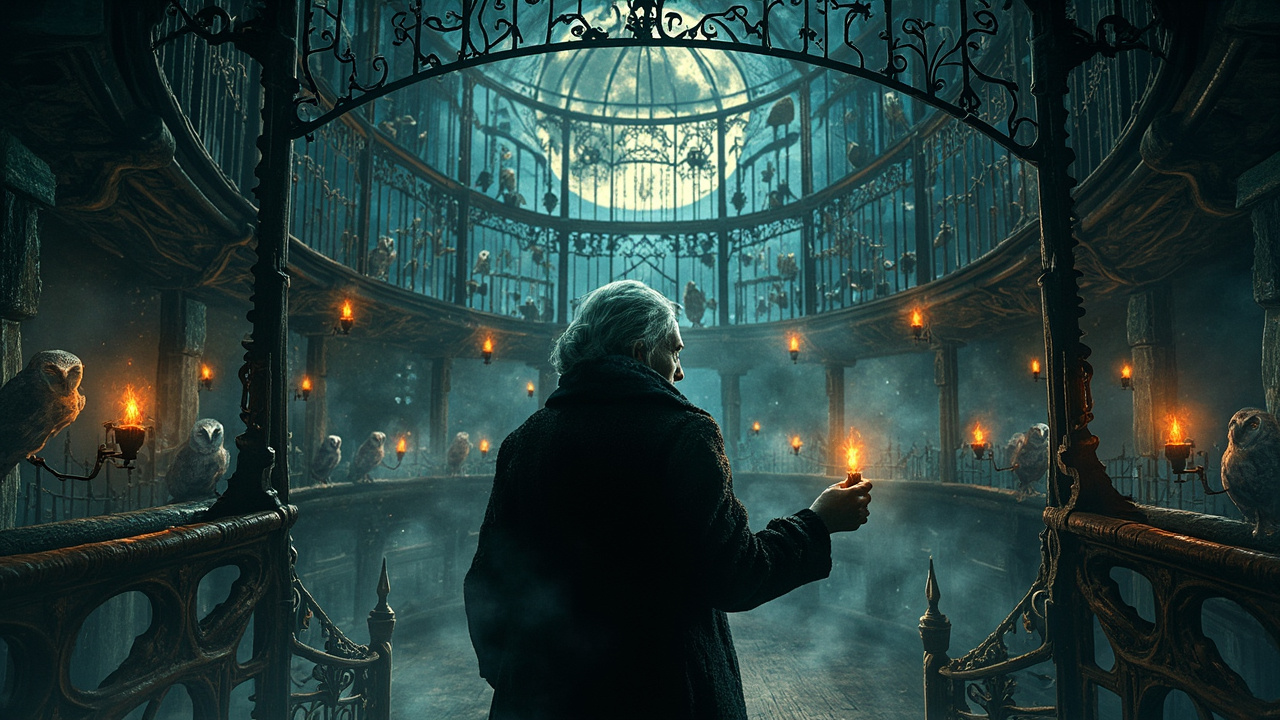
The Ministry of Orthodoxy had outlawed fire for warmth in the winter of 2039, citing its propensity for ideological arson. By the following autumn, they had outlawed candles. Miriam kept a single one burning regardless, tucked behind the rafter where the owl cages met the stone wall, because the manuscripts demanded light and the manuscripts, as she often reminded her colleagues, did not care for ministerial decree.
She was the eldest among them by two decades, though age had long since ceased to matter in the way it once had. What mattered was that she had read Milton before the Purging. She had read Woolf, Achebe, Naipaul. She had read the great contentious novels that the state had deemed sociogenic—works capable of producing dangerous sympathies in the reader's conscience. The fact that she could still recite passages from Heart of Darkness from memory was, in the estimation of the Ministry, a more serious crime than anything she had ever stolen.
The owl sanctuary had been her idea. In the third year after the Purging, when the last printing presses had been dismantled and the libraries reduced to administrative archives of approved correspondence, Miriam had stood in the ruins of the Birmingham library and watched two owls descend through a shattered skylight to nest among the empty shelves. The birds had regarded her with an equanimity that she found deeply instructive. They did not mourn what had been lost. They simply adapted, found the hollow places, and endured.
She had built the sanctuary from that instinct. The rusted Victorian aviary in the Worcestershire hills became a registered charitable organisation. She recruited scholars—a literary historian from Edinburgh, a linguist from Swansea, a former university librarian from Durham who knew the Deccadont and the Penguin Classics catalogue by heart. They learned to wear waxed jackets and wellies. They learned to talk about pellet regurgitation and dietary calcium requirements. They learned that the Ministry's own ornithological monitoring officers were profoundly bored by anything more complex than a monthly census of wing spans.
And beneath the cages, in a root cellar that the owls had no reason to visit, they had built the archive.
It was not large. Four hundred and thirty-one volumes in total, each one a handwritten copy made over fourteen years of moonlit transcription. The originals had been burned in the first Purging, and the task of reconstruction had been undertaken with the grim patience of people who understood that language, once lost, could only be retrieved through the stubbornness of the living. They copied Chekhov and Conrad, Adeyemi and Adichie, Morrison and García Márquez. They copied Yeats and Heaney, and the great Welsh poets whose work the Ministry had deemed culturally seditious for its insistence on interiority. They copied them not because they hoped to return the books to print—they had no such illusion—but because the act of copying was itself a form of memory, and memory, as Orwell had once written and the Ministry had long since excised from the curriculum, was the only weapon that could not be confiscated.
The owls, for their part, performed their role in the conspiracy with absolute fidelity. They did not hoot during the day when visitors arrived. They did not disturb the manuscripts, which were wrapped in acid-free linen and stored in archival boxes made from reclaimed church pews. They perched in their cages with the grave patience of creatures who had, over millions of years, evolved to survive by silence and by seeing what others could not. It was, Miriam thought, not so different from what they were doing.
She called them the Parliament. It was the collective noun for owls, and it pleased her to use it, though the original meaning—deriving from the old observation that owls appeared to convene in council before deciding on a course of action—had long since been lost to etymology. She did not mind. She had made the name her own.
The Owl arrived in November.
Not an owl from the sanctuary—though that is what she told herself at first, when the figure appeared at the gate in the blue half-light of early morning. It was a person, young, wrapped in a coat too thin for the weather, clutching a canvas bag as though it contained something that burned. Miriam recognised the tremor in the hand. She had seen it before, in the faces of those who had read forbidden things and found themselves unable to stop.
The young woman's name was Clara. She had been a student at Manchester before the closure. She had been copying novels by hand in her cell at a re-education facility, filling exercise books with passages from Le Carré and Le Guin, when one of the books was discovered and she was placed on a transport to nowhere in particular. She had escaped during a checkpoint confusion, followed a network of handwritten instructions passed between trusted hands, and arrived at the sanctuary with two bags containing sixty-three volumes of copied text.
Sixty-three volumes. The Parliament had added twelve to its own collection that year. Clara had produced more in a re-education facility than the sanctuary had managed in twelve months of relative safety.
Miriam looked at the young woman's hands. They were ruined—fingers bent at angles that spoke of frostbite, of cramped writing in freezing cells, of a determination that had outlasted any reasonable measure of self-preservation. Clara placed the bags on the table between them with a care that bordered on reverence, and Miriam understood that she was looking at something that no Ministry officer could comprehend: not contraband, but an act of faith.
That evening, after Clara had eaten and slept and woken to eat again, Miriam brought her down to the root cellar. She lit the candle. The archive stood before them in its linen wrapping, four hundred and thirty-one volumes of memory, and now four hundred and ninety-four, because Clara's sixty-three had been absorbed into the collection with the quiet ceremony that any addition to the Parliament demanded.
Clara stood among the shelves. She ran her damaged fingers along the spines without reading the titles. She did not need to. She knew what was there because she had spent years of her life committing the same words to paper, again and again, until they became indistinguishable from breath.
"Will it matter?" Clara asked. Her voice was hoarse. "In the end. Will any of it matter?"
Miriam looked at the candle. She looked at the owl in the cage above, watching them both with its liquid, binocular gaze. She thought of the Birmingham library. She thought of the two owls descending through the shattered skylight, settling into the ruins as though the ruins were a cathedral and they had always belonged there.
"The owls survived," she said. "The books did not, and then they did, because we copied them. That is the answer. We copy them. We keep copying them. We do not stop because we cannot prove it will matter. We copy them because the copying is itself the proof that it does."
Clara nodded. She did not argue, and she did not weep. She simply sat down at the transcription desk, took up the pen that had belonged to the librarian from Durham, and began, in her ruined hand, to copy the sixty-fourth volume from memory.
Above them, in the blue November dark, an owl hooted once, softly, and was silent.