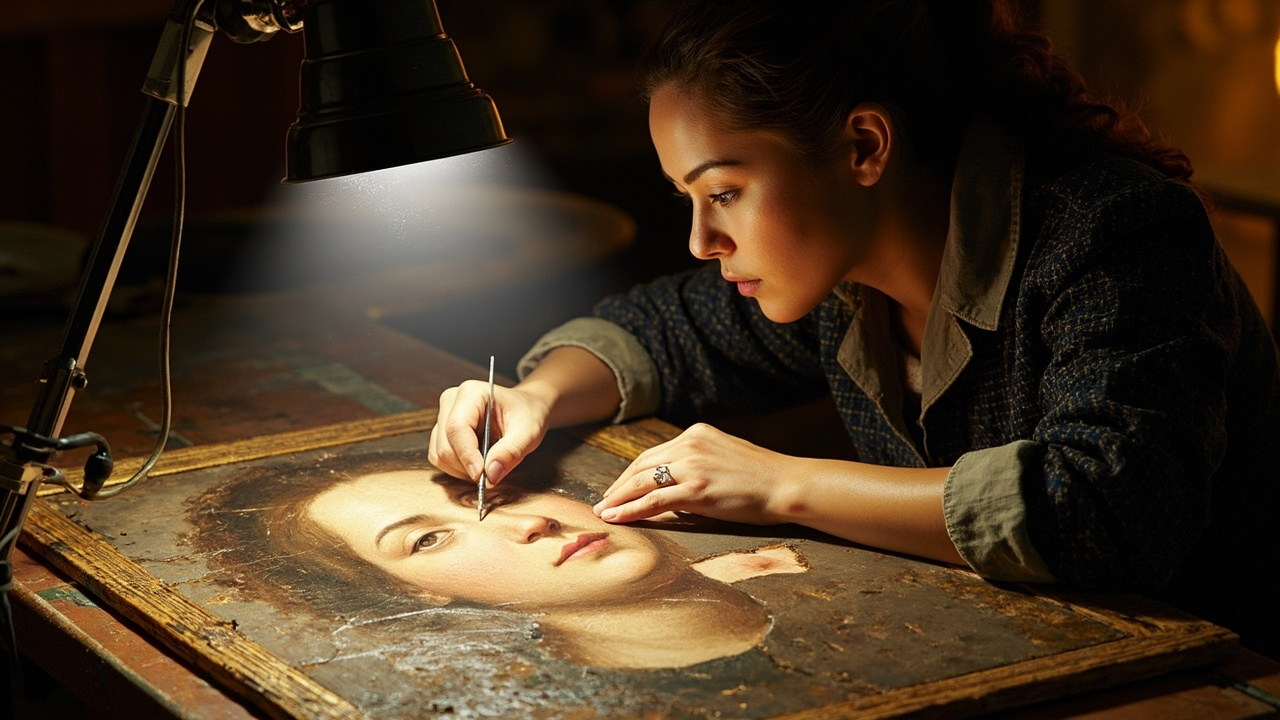
أمضت الدكتورة إلينور مارش اثنين وثلاثين عامًا تستدعي الجمال من محو النسيان. يداها، الثابتتان كيدَي الجراح، قد أعادتا إحياء لوحات فيرمير وفويار، وأنقذتا ألواحًا من الحرائق وقللًا من الفيضانات. كانت قد تعلمت قراءة لغة التشققات الدقيقة، وفككت شفرة قواعد الطبقات التحتية، و أدركت أن كل ضربة فرشاة كانت محادثة مع الزمن ذاته. لكن لم يكن شيء قد أعدها لزوجة السيدة المجهولة.
وصلت اللوحة من إ到了一个.property خاص في كوتسوولدز، بسجل مريب وأحوال كارثية. كانت مهمة إلينور ظاهريًا مباشرة: تثبيت الورنيش المتقشر، وتعزيز الطلاء المنفصل، وإحياء ما يمكن إنقاذه. وافقت على التكليف مترددة، لأن الموضوع — سيدة في منتصف العمر، بنظر ملتفت ويدين مطويتين بأدب — كان جماليًا غير بارز. صورة إقليمية، على الأرجح فلمانية، بلا شك باهتة.
كان الأمر في الأسبوع الثالث، تحت الإضاءة القاسية لمصباح الترميم، حين لاحظت الشذوذ.
التشققات الدقيقة كانت خاطئة. ليست خاطئة بفعل العمر أو التلف، بل خاطئة في تشكيلها — كأن السطح قد طلي فوقه مرات كثيرة لدرجة أن شبكة الشقوق تحكي قصة تدخل لا انحلال. عدلت إلينور تكبيرها وأمسكت أنفاسها. هناك، في صدغ المرأة، شق رفيع يرسم contour لا يُخطئ لعين. عين أخرى. واحدة لا تنتمي إلى الوجه فوقها.
عملت طوال الليل، moves scalpel متناهية الحذر، تأخذ عينات من كل طبقة ورنيش وصبغة. ما اكتشفته تحدى توقعاتها تمامًا.
تحت الطبقة العليا — إعادة طلاء ثقيلة وبتبسة على الأرجح تعود للعصر الفيكتوري — lay another portrait، هذه المرة بارعة تقنيًا but hastily executed. المرأة هنا كانت أصغر، وقوامها أكثر ثقة، ونظرتها تلقى المشاهد ب directness مزعج. date إلينور هذه الطبقة للقرن الثامن عشر من خلال الأزرق القائم الفريد للخلفية والأصفر الرصاصي القولي للمرأة.
لكن هذه were merely the second skin. كما واصلت حفرها، emerged layer by patient layer like geological strata. portrait من فترة الاستعادة، دراميته الباروكية مخففة بأيدي later. تحتها، عمل متأثر بالمصغر من القرن السابع عشر، حميم ودقيق. وتحت كل these، مصبوغ مباشرة على القماش الأصلي with surprising assurance، وجدت أقدم طبقة: وجه من أوائل القرن السادس عشر، تقنية الإشراق فيه تستحضر الأساتذة الفلورنسيين.
خمسة قرون. canvas واحد. خمس نساء، أو ربما امرأة واحدة أعيد تصور across generations بأيدٍ لم تستطع Bear to let her rest.
يدا إلينور ارتجفتا as she stepped back from her worktable. الوجه تحت earliest layer was striking in its severity — امرأة في الأربعين perhaps، شفتاها مضغوطتان في خط رفيع، عيناها تحمل weight particular لشخص شهد أكثر مما ستعترف أبدًا. كان painter original قد أمسك بشيء حقيقي، something raw. كل فنان لاحق had softened، محسن، مدفون. And now here was Eleanor، peeling back their revisions to reveal the truth they had tried to erase.
من كانت، these first woman? وجدت Eleanor herself researching اللوحة's provenance with unprecedented urgency. سجلات العقار، fragmentary and unreliable، أشارت إلى أن اللوحة قد مرت through أيدي عائلة واحدة منذ القرن السادس عشر. الموضوع، وفقًا لرسالة تالفة water discovered في archives العقار، كانت امرأة من some scandal في وقتها — عشيقة court، perhaps، or a nobleman's mistress. هويتها كانت deliberately obscured، صورتها repeatedly altered until أصبح الوجه الأصلي rumor beneath طبقات من paint محترم.
لمدة three months، عملت Eleanor with obsessive precision، توثيق each layer with photographic evidence and detailed notation. could have restored هي اللوحة إلى حالتها الفيكتورية، as her client presumably expected — الوجه الباهت والمجهول الذي استقبل المشاهدين لمدة قرن ونصف. Instead، made a decision that would alter her reputation irreversibly.
أعادت إلينور ترميم earliest layer.
الحفل كان affair خاص، attended by مؤرخي فن وصحفيين، by collectors and conservators. المرأة who emerged from beneath accumulated centuries لم تكن جميلة by any conventional sense، but she was extraordinary — وجه demanded attention، that refused the comfortable obscurity its subsequent owners had imposed. عيناها، rendered with Leonardo-like subtlety، seemed to follow viewers across the room with expression neither kind nor cruel، merely knowing.
"It's historically irresponsible،" had warned one colleague. "You've made an interpretive decision that belongs to the original artist، not to you."
Eleanor had considered this accusation carefully. Was she guilty of the same impulse that had driven those anonymous hands across five centuries — the urge to reshape، to improve، to impose one's own vision upon another person's truth? Perhaps. But she had documented everything، preserved every layer، ensured that her interpretation stood alongside rather than instead of the historical record. She had not erased؛ she had revealed.
اللوحة الآن في National Gallery، وجهها المستعاد يف吸引了 زوارًا يجدون أنفسهم unable to look away. Eleanor has received letters من غرباء who claim woman's expression has changed their understanding of portraiture entirely. تقرأهم with the same meticulous attention she once gave to pigment analysis، understanding that her work، like all art، is finally complete only in the eyes of those who encounter it.
في بعض الأمسيات، when the museum is empty and the security guards are distracted، تعود Eleanor to stand before the painting. تدرس earl
Dr. Eleanor Marsh hatte zweiunddreißig Jahre damit verbracht, Schönheit aus dem Vergessen zurückzurufen. Ihre Hände, so steady wie die eines Chirurgen, hatten Vermeer und Vuillards wiederhergestellt, hatten Paneele aus Bränden und Leinwände aus Überschwemmungen geborgen. Sie hatte gelernt, die Sprache des Krakelee zu lesen, die Grammatik der Untermalung zu entschlüsseln, zu verstehen, dass jeder Pinselstrich ein Gespräch mit der Zeit selbst war. Doch nichts hatte sie auf das Porträt der Unbekannten vorbereitet.
Das Gemälde war aus einem privaten Anwesen in den Cotswolds angekommen, mit zweifelhafter Herkunft und katastrophalem Zustand. Eleanors Aufgabe war scheinbar straightforward: den abblätternden Firnis zu stabilisieren, die sich lösende Farbe zu festigen, zu retten, was zu retten war. Sie hatte den Auftrag widerwillig angenommen, denn das Motiv — eine Frau mittleren Alters, mit abgewandtem Blick und sittsam gefalteten Händen — war ästhetisch unremarkably. Einprovinzielles Porträt, wahrscheinlich flämisch, bestimmt unimaginative.
Es war in der dritten Woche, unter der grellen Beleuchtung ihrer Restaurierungslampe, dass sie die Anomalie bemerkte.
Das Krakelee war falsch. Nicht falsch im Sinne von Alter oder Beschädigung, sondern falsch in seiner Topologie — als ob die Oberfläche so oft übermalt worden war, dass das Netz der Risse eine Geschichte von Intervention statt Verfall erzählte. Eleanor adjusted ihre Vergrößerung und hielt den Atem an. Dort, an der Schläfe der Frau, zeichnete ein haarfeiner Riss die unverkennbare outline eines Auges. Ein anderes Auge. Eines, das nicht zum Gesicht darüber gehörte.
Sie arbeitete die ganze Nacht, ihr Skalpell bewegte sich mit exquisiter Sorgfalt, entnahm Proben jeder Schicht aus Firnis und Pigment. Was sie entdeckte, widersprach ihren Erwartungen völlig.
Unter der obersten Schicht — einem schweren, unbeholfenen Übermalung, wahrscheinlich aus der viktorianischen Ära — lag ein weiteres Porträt, dieses technisch gekonnt, aber hastig ausgeführt. Die Frau hier war jünger, ihre Haltung selbstbewusster, ihr Blick traf den Betrachter mit einer beunruhigenden Direktheit. Eleanor datierte diese Schicht ins späte 18. Jahrhundert aufgrund des distinctive Ultramarins des Hintergrunds und des Blei-Zinn-Gelbs der Damenbluse.
Aber dies war nur die zweite Haut. Als sie ihre Ausgrabung fortsetzte, Schicht um geduldige Schicht wie geologische Strata emerged. Ein Porträt aus der Restaurationszeit, dessen barocke Dramatik von späteren Händen abgemildert. Darunter ein miniaturbeeinflusstes Werk aus dem 17. Jahrhundert, intim und präzise. Und unter all dem, direkt auf die Originalleinwand mit überraschender Sicherheit gemalt, fand sie die früheste Schicht: ein Gesicht aus dem frühen 16. Jahrhundert, dessen Sfumato-Technik an die Florentiner Meister erinnerte.
Fünf Jahrhunderte. Eine Leinwand. Fünf Frauen, oder vielleicht eine Frau, neu imaginiert über Generationen hinweg von Händen, die es nicht ertragen konnten, sie ruhen zu lassen.
Eleonors Hände zitterten, als sie von ihrem Arbeitstisch zurücktrat. Das Gesicht unter der frühesten Schicht war in seiner Strenge auffällig — eine Frau von vielleicht vierzig, ihre Lippen zu einer dünnen Linie zusammengepresst, ihre Augen trugen das besondere Gewicht von jemandem, der mehr witnessed hatte, als sie je gestehen würde. Der ursprüngliche Maler hatte etwas Echtes eingefangen, etwas Rohes. Jeder nachfolgende Künstler hatte weicher gemacht, idealisiert, begraben. Und nun war hier Eleanor, schälte ihre Überarbeitungen zurück, um die Wahrheit zu enthüllen, die sie zu löschen versucht hatten.
Wer war sie gewesen, diese erste Frau? Eleanor fand sich dabei, die Provenienz des Porträts mit beispielloser Dringlichkeit zu recherchieren. Die Aufzeichnungen des Anwesens, fragmentarisch und unzuverlässig, deuteten darauf hin, dass das Gemälde seit dem 16. Jahrhundert durch die Hände einer einzigen Familie gegangen war. Das Motiv, laut einem wasserbeschädigten Brief, der in den Archiven des Anwesens entdeckt wurde, war eine Frau von einigem Skandal ihrer Zeit gewesen — eine Kurtisane vielleicht, oder eine Geliebte eines Edelmanns. Ihre Identität war absichtlich verschleiert worden, ihr Bild wiederholt verändert, bis das ursprüngliche Gesicht zu einem Gerücht unter Schichten von respectablem Lack wurde.
Drei Monate lang arbeitete Eleanor mit obsessive Präzision, dokumentierte jede Schicht mit fotografischen Beweisen und detaillierten Notizen. Sie hätte das Gemälde in seinen viktorianischen Zustand zurückversetzen können, wie ihr Auftraggeber wahrscheinlich erwartete — das fade, anonyme Gesicht, das Betrachter ein Jahrhundert und ein halb begrüßt hatte. Stattdessen traf sie eine Entscheidung, die ihren professionellen Ruf unwiderruflich verändern würde.
Sie restaurierte die früheste Schicht.
Die Enthüllung war eine private Angelegenheit, an der Kunsthistoriker und Journalisten, Sammler und Konservatoren teilnahmen. Die Frau, die aus unter den akkumulierten Jahrhunderten hervortrat, war nicht schön im konventionellen Sinne, aber sie war außerordentlich — ein Gesicht, das Aufmerksamkeit forderte, das die bequeme Anonymität ablehnte, die ihre nachfolgenden Besitzer ihr auferlegt hatten. Ihre Augen, mit leonardoesker Subtilität dargestellt, schienen den Betrachtern durch den Raum zu folgen mit einem Ausdruck, der weder freundlich noch grausam war, sondern wissend.
"Es ist historisch unverantwortlich," hatte ein Kollege sie gewarnt. "Sie haben eine interpretatorische Entscheidung getroffen, die dem ursprünglichen Künstler gehört, nicht Ihnen."
Eleanor hatte diese Anklage sorgfältig bedacht. War sie schuldig derselben Impuls, die diese anonymen Hände durch fünf Jahrhunderte angetrieben hatte — dem Drang, umzuformen, zu verbessern, seine eigene Vision über die Wahrheit eines anderen zu legen? Vielleicht. Aber sie hatte alles dokumentiert, jede Schicht erhalten, sichergestellt, dass ihre Interpretation neben而不是statt des historischen Datums stand. Sie hatte nicht gelöscht; sie hatte enthüllt.
Das Porträt hängt now in der National Gallery, sein restauriertes Gesicht zieht Besucher an, die feststellen, dass sie den Blick nicht abwenden können. Eleanor hat Briefe von Fremden erhalten, die behaupten, dass der Ausdruck der Frau ihr Verständnis von Porträtmalerei völlig verändert hat. Sie liest sie mit derselben akribischen Aufmerksamkeit, die sie einst der Pigmentanalyse widmete, und versteht, dass ihre Arbeit, wie alle Kunst, erst in den Augen derer vollständig ist, die ihr begegnen.
An manchen Abenden, wenn das Museum leer ist und die Sicherheitsbeamten abgelenkt sind, kehrt Eleanor zurück, um vor dem Gemälde zu stehen. Sie studiert das Ohr
La Dra. Eleanor Marsh había pasado treinta y dos años trayendo belleza de vuelta del olvido. Sus manos, tan firmes como las de un cirujano, habían restaurado Vermeer y Vuillard, habían salvado paneles de incendios y lienzos de inundaciones. Había aprendido a leer el lenguaje del craquelure, a descifrar la gramática del underpaint, a entender que cada pincelada era una conversación con el tiempo mismo. Sin embargo, nada la había preparado para el Retrato de la Mujer Desconocida.
El painting había llegado de una propiedad privada en los Cotswolds, con una procedencia turbia y condiciones catastróficas. La tarea de Eleanor era aparentemente sencilla: estabilizar el barniz que se descascaraba, consolidar la pintura que se levantaba, restaurar lo que pudiera salvarse. Había aceptado el encargo con reluctancia, porque el sujeto — una mujer de mediana edad, con la mirada desviada, las manos dobladas con recato — era estéticamente ordinaria. Un retrato provincial, probablemente flamenco, certamente poco inspirado.
Fue en la tercera semana, bajo la iluminación intensa de su lámpara de restauración, que notó la anomalía.
El craquelure estaba mal. No mal en el sentido de edad o daño, sino mal en su topología — como si la superficie hubiera sido pintada tantas veces que la red de grietas contaba una historia de intervención en lugar de deterioro. Eleanor ajustó su magnificación y contuvo el aliento. Allí, en la sien de la mujer, una fisura diminuta trazaba el inconfundible contorno de un ojo. Otro ojo. Uno que no pertenecía al rostro sobre él.
Trabajó toda la noche, su bisturí moviéndose con exquisito cuidado, muestreando cada capa de barniz y pigmento. Lo que descubrió desafiaba completamente sus expectativas.
Bajo la capa más superficial — una笨拙 repintura pesada probablemente de la era victoriana — yacía otro retrato, este técnicamente accomplished pero ejecutado con prisa. La mujer aquí era más joven, su postura más segura, su mirada encontrando al espectador con una franqueza perturbadora. Eleanor fechó esta capa a finales del siglo XVIII por el ultramarino distintivo del fondo y el amarillo de plomo-estaño del corpiño de la mujer.
Pero esto era meramente la segunda piel. A medida que continuaba su excavación, capa tras paciente capa emergió como estratos geológicos. Un retrato del período de la Restauración, sus dramatic barroquismos suavizados por manos posteriores. Debajo, una obra influenciada por la miniatura del siglo XVII, íntima y precisa. Y debajo de todo esto, pintado directamente sobre el lienzo original con una seguridad sorprendente, encontró la capa más temprana: un rostro de principios del siglo XVI, su técnica de sfumato recordando a los maestros florentinos.
Cinco siglos. Un lienzo. Cinco mujeres, o quizás una sola mujer reimaginada a través de generaciones por manos que no podían soportar dejarla descansar.
Las manos de Eleanor temblaron mientras retrocedía de su mesa de trabajo. El rostro bajo la capa más temprana era sorprendente en su severidad — una mujer de unos cuarenta años quizás, sus labios comprimidos en una línea delgada, sus ojos cargando el peso particular de alguien que había atestiguado más de lo que nunca confesaría. El pintor original había capturado algo real, algo crudo. Cada artista subsiguiente había suavizado, idealizado, enterrado. Y ahora aquí estaba Eleanor, pelando sus revisiones para revelar la verdad que habían intentado borrar.
Quién había sido, esta primera mujer? Eleanor se encontró investigando la procedencia del retrato con urgencia sin precedentes. Los registros de la propiedad, fragmentarios e poco confiables, sugerían que la pintura había pasado por las manos de una sola familia desde el siglo XVI. El sujeto, según una carta dañada por el agua descubierta en los archivos de la propiedad, había sido una mujer de cierto escándalo en su tiempo — una cortesana, quizás, o la amante de un noble. Su identidad había sido deliberadamente oscurecida, su imagen repetidamente alterada hasta que el rostro original se convirtió en un rumor bajo capas de pintura respetable.
Durante tres meses, Eleanor trabajó con precisión obsesiva, documentando cada capa con evidencia fotográfica y notación detallada. Podría haber restaurado la pintura a su estado victoriano, como presumiblemente su cliente esperaba — el rostro anodino y anónimo que había recibido a los visitantes durante un siglo y medio. En cambio, tomó una decisión que alteraría irrevocablemente su reputación profesional.
Restauró la capa más temprana.
La inauguración fue un asunto privado, asistido por historiadores del arte y periodistas, coleccionistas y conservadores. La mujer que emergió de debajo de los siglos acumulados no era hermosa en ningún sentido convencional, pero era extraordinaria — un rostro que exigía atención, que rechazaba la oscuridad cómoda que sus posteriores propietarios le habían impuesto. Sus ojos, renderizados con sutileza leonardesca, parecían seguir a los visitantes por la habitación con una expresión que no era ni amable ni cruel, simplemente knowing.
"Es históricamente irresponsable," la había avisado un colega. "Has tomado una decisión interpretativa que pertenece al artista original, no a ti."
Eleanor había considerado cuidadosamente esta acusación. Era culpable del mismo impulso que había impulsado esas manos anónimas a través de cinco siglos — el impulso de remodelar, mejorar, imponer su propia visión sobre la verdad de otra persona? Quizás. Pero había documentado todo, preservado cada capa, asegurado que su interpretación estuviera junto a en lugar de en lugar del registro histórico. No había borrado; había revelado.
El retrato ahora cuelga en la National Gallery, su rostro restaurado atrayendo visitantes que se encuentran incapaces de apartar la mirada. Eleanor ha recibido cartas de extraños que afirman que la expresión de la mujer ha cambiado completamente su comprensión del retrato. Las lee con la misma atención meticulosa que alguna vez dio al análisis de pigmentos, entendiendo que su trabajo, como todo arte, finalmente está completo solo en los ojos de quienes lo encuentran.
Algunas noches, cuando el museo está vacío y los guardias de seguridad están distraídos, Eleanor regresa a pararse frente a la pintura. Estudia la oreja
La Dre Eleanor Marsh avait passé trente-deux ans à ramener la beauté du néant. Ses mains, aussi steadies que celles d'un chirurgien, avaient restauré des Vermeer et des Vuillard, sauvé des panneaux d'incendies et des toiles d'inondations. Elle avait appris à lire la langue du faïençage, à déchiffrer la grammaire du repentir, à comprendre que chaque coup de pinceau était une conversation avec le temps lui-même. Pourtant, rien ne l'avait préparée au Portrait de l'Inconnue.
Le tableau était arrivé d'une propriété privée dans les Cotswolds, avec une provenance trouble et un état catastrophique. La tâche d'Eleanor était en apparence simple : stabiliser le vernis qui s'écaillait, consolider la peinture qui se soulevait, restaurer ce qui pouvait l'être. Elle avait accepté cette commande à contrecœur, car le sujet — une femme d'âge mûr, le regard détourné, les mains posées avec modestie — était esthétiquement insignifiant. Un portrait provincial, probablement flamand, certainement sans inspiration.
C'était à la troisième semaine, sous l'éclairage harsh de sa lampe de restauration, qu'elle remarqua l'anomalie.
Le faïençage était wrong. Paswrong de la façon de l'âge ou des dommages, mais wrong dans sa topologie — comme si la surface avait été repeinte tellement de fois que le réseau de fissures racontait une histoire d'intervention plutôt que de decay. Eleanor ajusta son grossissement et retint son souffle. Là, à la tempe de la femme, une fissure microscopique traçait le contour indéniable d'un œil. Un autre œil. Un qui n'appartenait pas au visage au-dessus.
Elle travailla toute la nuit, son scalpel se déplaçant avec une délicatesse exquise, prélevant des échantillons de chaque couche de vernis et de pigment. Ce qu'elle découvrit défiait entièrement ses attentes.
Sous la couche supérieure — un repeint lourd et maladroit datant probablement de l'époque victorienne — se trouvait un autre portrait, celui-ci techniquement accompli mais exécuté avec hâte. La femme ici était plus jeune, sa posture plus confiante, son regard croisant le spectateur avec une franchise troublante. Eleanor data cette couche de la fin du XVIIIe siècle grâce à l'outremer distinctif du fond et au jaune plomb-étain du corsage de la femme.
Mais ce n'était que la seconde peau. Alors qu'elle poursuivait son excavation, couche après couche émergeait comme des strates géologiques. Un portrait de l'époque de la Restauration, son baroque dramatique atténué par des mains ultérieures. En dessous, une œuvre influencée par la miniature du XVIIe siècle, intime et précise. Et sous tout cela, peint directement sur la toile originale avec une assurance surprenante, elle trouva la couche la plus ancienne : un visage du début du XVIe siècle, sa technique du sfumato rappelait les maîtres florentins.
Cinq siècles. Une toile. Cinq femmes, ou peut-être une seule femme réinterprétée à travers les générations par des mains qui n'avaient pu supporter de la laisser reposer.
Les mains d'Eleanor tremblèrent lorsqu'elle recula de son plan de travail. Le visage sous la couche la plus ancienne était saisissant de sévérité — une femme d'une quaranteaine d'années peut-être, ses lèvres compressées en une fine ligne, ses yeux portant le poids particulier de quelqu'un qui avait témoigné plus qu'elle n'avouerait jamais. Le peintre original avait capturé quelque chose de vrai, de brut. Chaque artiste subséquent avait adouci, idéalisé, enterré. Et maintenant voici Eleanor, pelant leurs révisions pour révéler la vérité qu'ils avaient tenté d'effacer.
Qui avait-elle été, cette première femme ? Eleanor se trouva à rechercher la provenance du portrait avec une urgence sans précédent. Les archives de la propriété, fragmentaires et peu fiables, suggéraient que le tableau était passé entre les mains d'une seule famille depuis le XVIe siècle. Le sujet, selon une lettre endommagée par l'eau découverte dans les archives de la propriété, avait été une femme de scandale en son temps — une courtisane peut-être, ou la maîtresse d'un noble. Son identité avait été délibérément obscurcie, son image altérée à maintes reprises jusqu'à ce que le visage original devienne une rumeur sous des couches de peinture respectable.
Pendant trois mois, Eleanor travailla avec une précision obsessionnelle, documentant chaque couche avec des preuves photographiques et des notations détaillées. Elle aurait pu restaurer le tableau à son état victorien, comme son client l'attendait probablement — le visage banal et anonyme qui avait accueilli les visiteurs pendant un siècle et demi. Au lieu de cela, elle prit une décision qui altérerait irrévocablement sa réputation professionnelle.
Elle restaura la couche la plus ancienne.
Le dévoilement fut une affaire privée, à laquelle assistèrent historiens de l'art et journalistes, collectionneurs et conservateur. La femme qui émergea de sous les siècles accumulés n'était pas belle au sens conventionnel, mais elle était extraordinaire — un visage qui exigeait l'attention, qui refusait l'obscurité confortable que ses propriétaires successifs lui avaient imposée. Ses yeux, rendus avec une subtilité léonardesque, semblaient suivre les visiteurs à travers la pièce avec une expression qui n'était ni douce ni cruelle, simplement sagace.
« C'est irresponsable historiquement », l'avait prévenue un collègue. « Vous avez pris une décision interprétative qui appartient à l'artiste original, pas à vous. »
Eleanor avait soigneusement considéré cette accusation. Était-elle coupable de la même impulsion qui avait animé ces mains anonymes à travers cinq siècles — l'envie de remodeler, d'améliorer, d'imposer sa propre vision sur la vérité d'un autre ? Peut-être. Mais elle avait tout documenté, préservé chaque couche, veillé à ce que son interprétation se dresse à côté plutôt qu'au lieu du document historique. Elle n'avait pas effacé ; elle avait révélé.
Le portrait hanging maintenant à la National Gallery, son visage restauré attirant des visiteurs qui se trouvent incapables de détourner le regard. Eleanor a reçu des lettres d'inconnus qui affirment que l'expression de la femme a changé leur compréhension du portrait entièrement. Elle les lit avec la même attention méticuleuse qu'elle accordait autrefois à l'analyse des pigments, comprenant que son travail, comme tout art, n'est finalement complet que dans les yeux de ceux qui le découvrent.
بعض الأمسيات، quand le musée est vide et les gardes de sécurité sont distraits, Eleanor revient se tenir devant le tableau. Elle étudie l'earl
La Dott.ssa Eleanor Marsh aveva trascorso trentadue anni a richiamare la bellezza dall'oblio. Le sue mani, ferme come quelle di un chirurgo, avevano restaurato Vermeer e Vuillard, avevano salvato pannelli da incendi e tele da alluvioni. Aveva imparato a leggere il linguaggio del craquelure, a decifrare la grammatica della sotto pittura, a comprendere che ogni pennellata era una conversazione con il tempo stesso. Eppure nulla l'aveva preparata al Ritratto della Donna Sconosciuta.
Il dipinto era arrivato da una proprietà privata nel Cotswolds, con una provenienza nebulosa e condizioni catastrofiche. Il compito di Eleanor era in apparenza semplice: stabilizzare la vernice che si sfarfallava, consolidare la vernice che si sollevava, restaurare ciò che poteva essere salvato. Aveva accettato l'incarico con riluttanza, poiché il soggetto — una donna di mezza età, con lo sguardo distolto, le mani compostamente ripiegate — era esteticamente anonimo. Un ritratto provinciale, probabilmente fiammingo, certamente privo di ispirazione.
Fu nella terza settimana, sotto l'illuminazione intensa della sua lampada di restauro, che notò l'anomalia.
Il craquelure era sbagliato. Non sbagliato nel senso di età o danno, ma sbagliato nella sua topologia — come se la superficie fosse stata dipinta sopra così tante volte che la rete di crepe raccontava una storia di intervento piuttosto che di decadimento. Eleanor regolò l'ingrandimento e trattenne il respiro. Lì, nella tempia della donna, una frattura sottilissima tracciava l'inconfondibile outline di un occhio. Un altro occhio. Uno che non apparteneva al viso sopra di esso.
Lavorò tutta la notte, il suo bisturi che si muoveva con squisita cura, campionando ogni strato di vernice e pigmento. Ciò che scoprì sfidava completamente le sue aspettative.
Sotto lo strato più superficiale — una pesante, goffa ridipintura risalente probabilmente all'epoca vittoriana — giaceva un altro ritratto, questo tecnicamente accomplished ma eseguito frettolosamente. La donna qui era più giovane, la sua postura più sicura, il suo sguardo che incontrava lo spettatore con una directness inquietante. Eleanor datò questo strato alla fine del XVIII secolo dal blu oltremare distintivo dello sfondo e dal giallo piombo-stagno del corpetto della donna.
Ma questa era merely the second skin. Mentre continuava il suo scavo, strato dopo paziente strato emerse come strati geologici. Un ritratto dal periodo della Restaurazione, i suoi drammi barocchi ammorbiditi da mani successive. Sotto, un'opera influenzata dalla miniatura del XVII secolo, intima e precisa. E sotto tutto questo, dipinta direttamente sulla tela originale con una sorprendente sicurezza, trovò lo strato più antico: un volto dall'inizio del XVI secolo, la cui tecnica dello sfumato richiamava i maestri fiorentini.
Cinque secoli. Una tela. Cinque donne, o forse una sola donna reimmaginata attraverso le generazioni da mani che non potevano sopportare di lasciarla riposare.
Le mani di Eleanor tremarono mentre si allontanava dal suo tavolo di lavoro. Il volto sotto lo strato più antico era straordinariamente severo — una donna di circa quarant'anni, le labbra compresse in una sottile linea, gli occhi che portavano il peso particolare di qualcuno che aveva testimoniato più di quanto avrebbe mai confessato. Il pittore originale aveva catturato qualcosa di vero, qualcosa di raw. Ogni artista successivo aveva ammorbidito, idealizzato, sepolto. E ora ecco Eleanor, che scrostava le loro revisioni per rivelare la verità che avevano cercato di cancellare.
Chi era stata, questa prima donna? Eleanor si ritrovò a ricercare la provenienza del ritratto con urgenza senza precedenti. I registri della proprietà, frammentari e inaffidabili, suggerivano che il dipinto fosse passato attraverso le mani di una singola famiglia dal XVI secolo. Il soggetto, secondo una lettera danneggiata dall'acqua scoperta negli archivi della proprietà, era stata una donna di qualche scandalo nel suo tempo — una cortigiana, forse, o l'amante di un nobile. La sua identità era stata deliberatamente oscurata, la sua immagine ripetutamente alterata finché il volto originale non divenne una voce sotto strati di rispettabile vernice.
Per tre mesi, Eleanor lavorò con precisione ossessiva, documentando ogni strato con prove fotografiche e annotazioni dettagliate. Avrebbe potuto restaurare il dipinto al suo stato vittoriano, come presumibilmente il suo cliente si aspettava — il volto insipido e anonimo che aveva accolto i visitatori per un secolo e mezzo. Invece, prese una decisione che avrebbe alterato irrevocabilmente la sua reputazione professionale.
Ripristinò lo strato più antico.
L'inaugurazione fu una questione privata, a cui parteciparono storici dell'arte e giornalisti, collezionisti e conservatori. La donna che emerse da sotto i secoli accumulati non era bella in senso convenzionale, ma era straordinaria — un volto che richiedeva attenzione, che rifiutava l'oscurità confortevole che i suoi successivi proprietari le avevano imposto. I suoi occhi, resi con sottigliezza leonardesca, sembravano seguire i visitatori attraverso la stanza con un'espressione che non era né gentile né crudele, semplicemente consapevole.
"È storicamente irresponsabile," l'aveva avvertita un collega. "Hai preso una decisione interpretativa che appartiene all'artista originale, non a te."
Eleanor aveva considerato attentamente questa accusa. Era colpevole della stessa impulsione che aveva guidato quelle mani anonime attraverso cinque secoli — l'impulso di rimodellare, migliorare, imporre la propria visione sulla verità di un'altra persona? Forse. Ma aveva documentato tutto, preservato ogni strato, assicurato che la sua interpretazione stesse accanto piuttosto che al posto del record storico. Non aveva cancellato; aveva rivelato.
Il ritratto ora è appeso alla National Gallery, il suo volto restaurato che attira visitatori che si ritrovano incapaci di distogliere lo sguardo. Eleanor ha ricevuto lettere da estranei che sostengono che l'espressione della donna ha cambiato completamente la loro comprensione del ritratto. Le legge con la stessa attenzione meticolosa che un tempo dedicava all'analisi dei pigmenti, comprendendo che il suo lavoro, come tutta l'arte, è finalmente completo solo negli occhi di chi lo incontra.
In alcune sere, quando il museo è vuoto e le guardie di sicurezza sono distratte, Eleanor torna a stare davanti al dipinto. Studia l'orecchio