Vocabulaire essentiel
| Mot | العربية | Deutsch | Español | Français | Italiano |
|---|---|---|---|---|---|
| اليتم الروحي | Verlassenheit | desolación | abandon existentiel | abbandono esistenziale | |
| رقّ جلدي | Pergament | vitela | parchemin | pergamena | |
| محكمة استئنافية تاريخية | Gerichtshof | tribunal de justicia | assises | corti d'assise | |
| إفادة قانونية | Aussage | declaración jurada | déposition | deposizione | |
| كلمة ذات أصل مشترك | Verwandtes Wort | palabra cognada | cognat | parola imparentata | |
| محدِّد | Trauernde | doliente | deuil | lutto | |
| هوس | Besessenheit | obsesión | obsession | ossessione | |
| يشمل | umfassen | abarcar | englober | comprendere | |
| نَسَبي | genealogisch | genealógico | généalogique | genealogico |
L'histoire
The manuscript lay where it had rested for three centuries, its vellum pages brown with age, the ink faded to the colour of weak tea. Dr Eleanor Vance had grown accustomed to such documents—after fifteen years cataloguing the linguistic detritus of the seventeenth century, very little surprised her anymore. But this particular bundle of Assize records, retrieved from a mouldering box in the North Yorkshire archives, contained something that would alter the architecture of her thoughts.
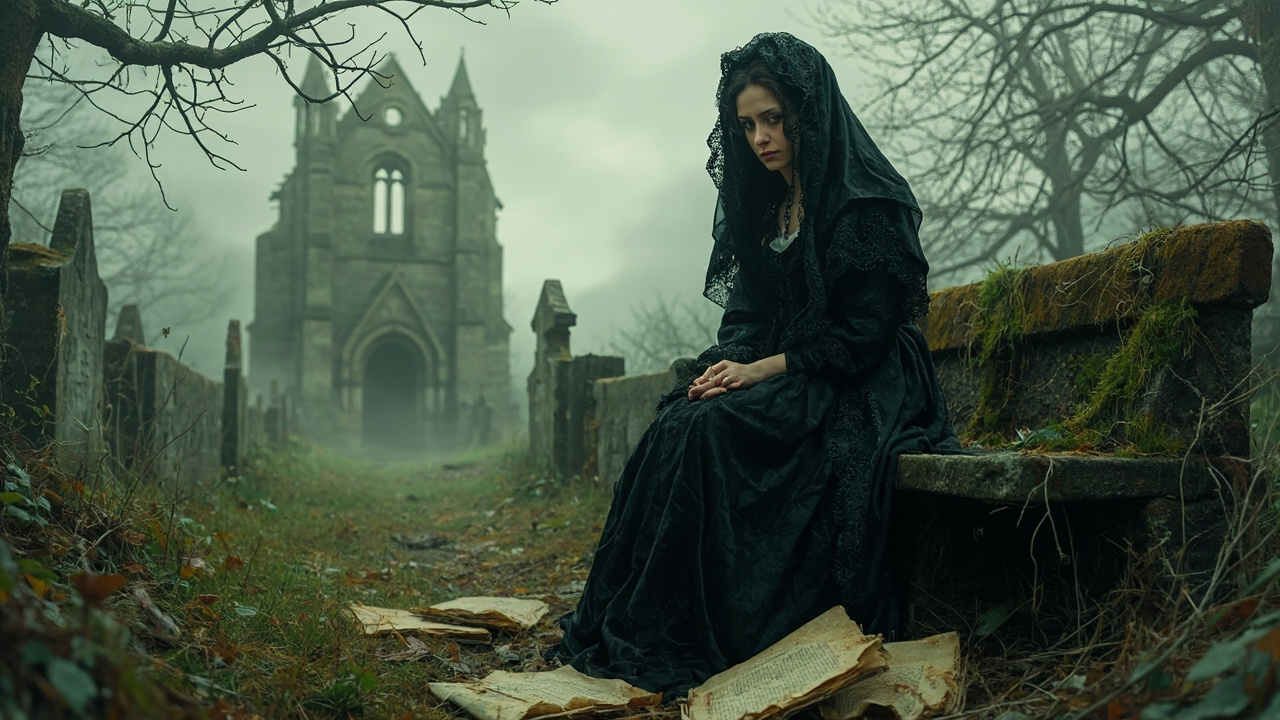
The word appeared in a deposition from the summer of 1641. A woman—her name redacted by centuries of worm and water damage to read only E. W.—had been questioned regarding her behaviour at the funeral of her husband. The court scribe had noted her 'strangeness', her refusal to weep alongside the other mourners, her insistence on sitting in the churchyard long after the burial party had dispersed. And then, in a phrase that snagged Eleanor's attention like a fishhook: 'She did not weep, but sat in Lornnesse, her gaze fixed upon the open grave as though awaiting the return of one who had not yet departed.'
Lornnesse. Eleanor repeated the word aloud in the empty archive room, tasting its consonants. It was not in any dictionary she possessed. It was not in the vast electronic corpuses she consulted nightly. It had no cognates, no derivations, no scholarly articles explicating its meaning. It existed, so far as she could determine, in this single instance alone—spoken or written once, captured accidentally by a clerk more concerned with legal procedure than lexical precision, and then lost entirely to the drift of centuries.
She became, in the months that followed, something less than a scholar and more than an obsession. She visited the village where E.W. had lived, now a picturesque cluster of stone cottages unrecognisable from the agricultural community of the 1640s. She traced parish records, traced tax documents, traced the thin threads of genealogical evidence that remained. E.W. had been married at seventeen to a husband twelve years her senior. She had borne no children. She had been widowed at twenty-four. And then, in the summer of her twenty-fifth year, she had attended her husband's funeral and sat in what the court scribe called Lornnesse.
The word, Eleanor came to understand, described a condition for which English had no other name. It was not simple grief—grief had a thousand words, from anguish to woe to heartbreak. It was not depression, though it might encompass it. Lornnesse was something more specific: a sensation of having been abandoned not merely by the dead, but by the living world itself. It was the feeling of standing in a familiar room and finding it utterly strange. Of knowing that the future, which had once seemed a continuation of the past, had become a void. Of looking at other people and seeing them as figures in a painting—present, visible, but fundamentally unreachable.
Eleanor understood this because she had begun to feel it herself.
It came gradually, the way dawn comes—not all at once but by degrees, each morning slightly lighter than the last. Her husband James had died in the November of her fifty-third year, a swift and merciful heart attack that left her no time for final words. She had arranged the funeral, accepted condolences, returned to work. She had done all the things that widows are expected to do. But somewhere beneath the performance of grief, a different sensation had taken root.
She would stand in the kitchen where she had prepared a thousand meals and feel that she was looking at someone else's house. She would walk to the university through the familiar streets and sense that the buildings around her were props, elaborately painted backdrops for a life she was merely observing. She attended lectures on Old English texts and heard herself speaking as though from a great distance. The world continued, as worlds do. People moved and talked and carried their daily concerns. But she had become, without quite understanding why, a spectator to existence rather than a participant in it.
One February evening, unable to sleep, she returned to the 1641 deposition. She read it again, slowly, aloud: 'She did not weep, but sat in Lornnesse, her gaze fixed upon the open grave as though awaiting the return of one who had not yet departed.'
And she understood, with a clarity that felt almost violent, that she was sitting in Lornnesse now. That a woman who had died three hundred and sixty years ago had felt precisely this—this absence that was not absence, this presence of a void, this terrible knowledge that the world went on but you had somehow stepped outside its borders and could not find your way back. The feeling had no name in modern English. It had no name at all, except this one word that a clerk had jotted down in a moment of inadvertent precision.
Eleanor wept then, for the first time since James had died. Not for James, exactly, though he was there in her tears. She wept for the woman in the churchyard, for the impossibility of fully articulating what either of them had felt. Language, she understood, is a net cast over experience, and some things slip through its meshes. But sometimes, very rarely, a word survives that captures something essential—something that would otherwise be lost to the silence between generations.
She published her findings that summer, in a small journal devoted to historical linguistics. Her article was brief: a description of the word, its single attestation, the probable meaning she had reconstructed from context and from the biography of E.W. She included the passage from the deposition. She proposed that lornness might be revived as a useful English term, a word for a feeling that had always existed but had somehow been rendered wordless.
The article attracted little attention. A few citations in subsequent papers on archaic emotion terms. A mention in a blog post about strange historical words. Eleanor did not mind. She had found what she was looking for—or rather, what had found her. She had discovered that the distance between the seventeenth century and the twenty-first was, in matters of the heart, negligible. That grief, and especially this particular species of grief, did not change. That a woman who had sat in a Yorkshire churchyard in 1641 had reached across the centuries to touch her hand.
She kept a copy of the deposition in the drawer of her bedside table. On difficult nights, she would take it out and read those words again, finding in them a companionship she had not expected. She was not alone in her Lornnesse. She had never been alone. The word had been waiting, patient as stone, to tell her so.