Must Know Vocabulary
| Word | العربية | Deutsch | Français | Русский |
|---|---|---|---|---|
| تقديس عميق | Ehrfurcht | révérence | благоговение | |
| الفهرسة | Katalogisierung | catalogage | каталогизация | |
| مصفر | vergilbt | jauni | пожелтевший | |
| يؤرق | heimgesucht | hanté | преследует | |
| ظرف أو ملابسة | Umstand | circonstance | обстоятельство | |
| رحمة | Gnade | miséricorde | милость | |
| مستحوذ | verzehrt | consumé | поглощённый | |
| متشابك | verflochten | entrelacé | переплетённый | |
| اختراق | Durchbruch | percée | прорыв | |
| استمر | aufrechterhalten | entretenu | поддерживаемый |
The Story
The smell of old paper and dust had always been a comfort to Harriet. It reminded her of her grandmother's library in Dorset—the leather bindings, the cracked spines, the secrets waiting to be uncovered between faded pages. So when she inherited the contents of a deceased customer's flat, she approached the boxes of books with genuine reverence rather than mere professional obligation.
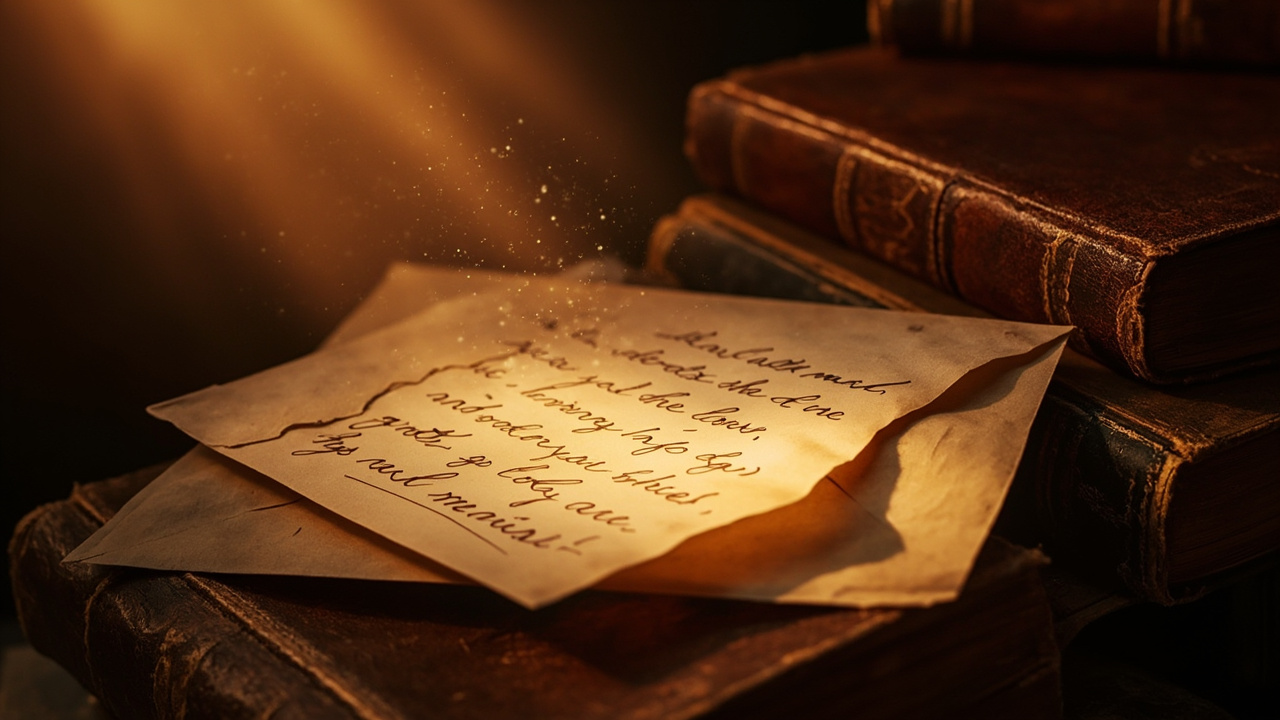
She had been cataloguing them for days, building a small secondhand stock for the shop, when she found it. A yellowed envelope, unsealed, tucked between the pages of a 1943 edition of A Room with a View. The handwriting was elegant but hurried, the ink brown with age. Her fingers trembled slightly as she unfolded the single sheet within.
"My dearest Evelyn," it began, "if you are reading this letter, then fate has been kinder to us than I dared hope. I am writing to you from a place I cannot name, surrounded by men who speak of honour and sacrifice as though these words could ever capture what we are leaving behind."
Harriet read on, her breath catching. The letter was from someone named James, writing to his Evelyn during the height of the war. He spoke of a love that dared not speak its name, of stolen moments and whispered promises, of a woman he was leaving behind not by choice but by circumstance. "I shall carry you with me," he wrote, "into every darkness, every silence, every moment I fear may be my last."
The final lines haunted her: "When this is over—if we are granted such mercy—I shall find you. Until then, know that I have never been yours as completely as I am in this moment of farewell."
The letter was dated March 1944. There was no address, no postal mark. It had never been sent.
Harriet spent the following weeks consumed by the mystery. The book had come from the flat of one Edward Marsh, a bachelor who had died at eighty-seven with no surviving family. She traced his history through old records: born in 1921, too young for the early years of the war but old enough to have been sent to France in the final months. He had returned wounded but alive, and had lived out his days in that modest flat in Maida Vale, surrounded by books and silence.
But James had not been Edward. Of that she was certain.
Her breakthrough came in an archive of wartime letters held at the Imperial War Museum. There, preserved in yellowing folders, she found correspondence between James Alistair Crawford, a young officer who had died in Normandy, and his wife—Evelyn Marsh, as she had been before her marriage.
The truth emerged slowly, like a photograph developing in a darkroom. James and Evelyn had grown up together in Edinburgh, childhood sweethearts who had always assumed their futures were intertwined. But when James proposed, Evelyn's father had refused. James was from the wrong side of the tracks, with neither money nor prospects to recommend him. Instead, Evelyn had been married to Edward Marsh, the son of a successful solicitor, a man of good family and comfortable means.
The marriage had been a disaster. Edward was cold, ambitious, obsessed with reputation. Evelyn had endured twelve years of polite emptiness before James returned from the war—or rather, what remained of him. He had written to her in secret, pouring onto paper the love he had carried through every battle, every wound, every sleepless night. The letter Harriet had found was his final message, composed the night before the D-Day landings.
James had died on the beaches of Normandy. Evelyn had never received his letter.
But the story did not end there. Harriet found a notice in a newspaper archive: Evelyn Crawford (formerly Marsh), beloved wife of James, mother of two, grandmother of four, died 2003. She had divorced Edward within a year of James's death and had spent the rest of her life honouring a memory that had sustained her through decades of grief.
As for Edward Marsh—the man in whose flat the letter had lain hidden for so many years—Harriet discovered something unexpected. In the final pages of his diary, written just days before his death, he had written: "I found the letter today, tucked in the book she left behind when she finally left me. I knew about James. I always knew. Perhaps that is why I could never truly love her—and why she could never truly love me. We were both haunted by someone else."
Harriet sat in the quiet of the bookshop, holding James's letter in her hands. So many years, so much silence, so many hearts divided by circumstance and choice. She thought of Evelyn, who had lived long enough to outlive everyone who might have told her the truth. She thought of Edward, carrying his lonely secret until his dying day.
And she thought of James, who had poured his heart onto paper believing it might reach her, never knowing it would lie forgotten for sixty years.
She placed the letter back in its envelope and sealed it properly this time. It would go to the Imperial War Museum, where it belonged—with the other forgotten words, the other silenced voices, the other loves that war had interrupted but could never quite destroy.