Must Know Vocabulary
| Word | العربية | Deutsch | Français | Русский |
|---|---|---|---|---|
| طائرة سيسنا | Cessna | Cessna | Сесна | |
| لوحة الأجهزة | Instrumentenbrett | tableau de bord | приборная панель | |
| مدرج المطار | Startbahn | piste d'atterrissage | взлётно-посадочная полоса | |
| الارتفاع | Flughöhe | altitude | высота | |
| الأفق | Horizont | horizon | горизонт | |
| شذوذ | Anomalie | anomalie | аномалия | |
| غائم | bewölkt | nuageux | облачно | |
| نظام تحديد المواقع العالمي | GPS | GPS | джипиэс | |
| مدرج إسفلتي | Asphaltbahn | piste | взлётная полоса | |
| أثر التكثيف | Kondensstreifen | traînée de condensation | инверсионный след |
The Story
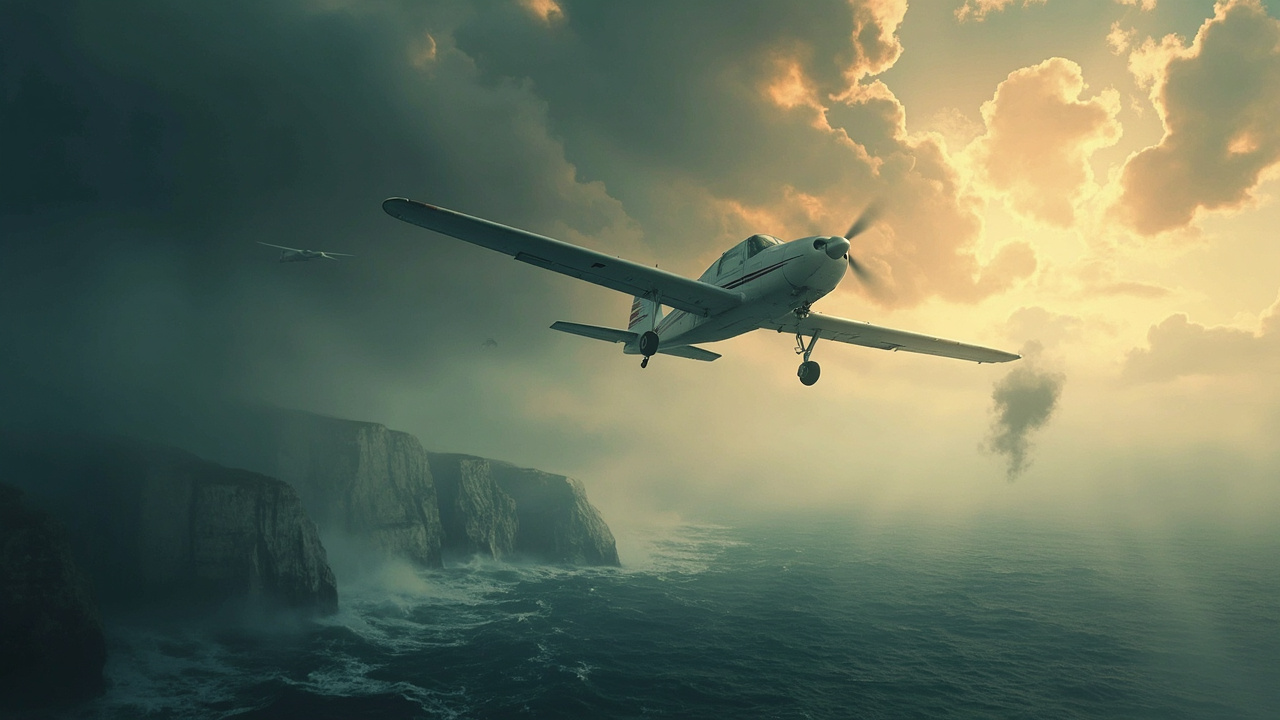
The autumn sun hung low over the Kent coastline as Captain James Whitaker brought the Cessna to the eastern holding point of Manston airfield. At sixty-three, he had accumulated more than twelve thousand hours in the cockpit, and his weathered hands moved across the instrument panel with the unconscious certainty of a man who had long ago ceased to think about what his fingers were doing. The pre-flight checks were a ritual as familiar to him as breathing.
Today's flight was unremarkable: a routine positioning run to Le Bourget to collect a replacement engine component for a vintage Spitfire restoration project he maintained at great expense and even greater affection in his hangar. The Channel crossing was scheduled for late afternoon, when the summer tourist traffic had thinned and the airspace felt almost peaceful. Nothing about the forecast had suggested anything out of the ordinary.
He filed his flight plan with the calm efficiency of decades, accepted his clearance, and taxied to the active runway. The engine—a Lycoming IO-540 that had been rebuilt twice already—sang its familiar four-cylinder song as the sparrow, as he'd affectionately named his aircraft, thundered down the tarmac and lifted into the pale sky.
For the first thirty minutes of the crossing, the flight proceeded without incident. Dover's white cliffs receded behind him, shrinking to a pale smudge on the horizon. To his left, the vast grey expanse of the Channel stretched toward the French coast. Commercial aircraft traced their highways at higher altitudes, their contrails dissolving in the upper winds. James adjusted his heading by a degree or two, checked his fuel burn, and allowed himself to slip into that meditative state that long flights induced in those who had grown accustomed to solitude in the sky.
It was at 3:47 PM, according to his watch, that the world tilted slightly off its axis.
At first, he dismissed it as a trick of the light—some unusual refraction through the cockpit canopy, perhaps, or the afterimage of a cloud formation. But then it resolved itself into something his mind struggled to process. Ahead of him, perhaps three miles out and at roughly his altitude, a shape hung motionless against the overcast sky. It was too large to be a bird, too slow to be an aircraft, and it seemed to possess a quality of presence that made the hairs on his forearms stand at attention. It was dark, and yet it appeared to absorb rather than reflect the diffuse light around it. There were no wings, no tail, no recognisable aviation features whatsoever. It simply was—a void in the shape of something that should not exist.
James found his hand moving toward the radio transmitter, the reflex of a lifetime's training urging him to report the anomaly. But something stopped him. A feeling of being observed that was almost physical in its intensity. He glanced at his instruments: altitude steady, heading unchanged, airspeed exactly where it should be. The ADF crackled with static. His GPS flickered, just once, then returned to normal.
The object—if object it was—remained stationary for perhaps ninety seconds. Then, without any visible means of propulsion, it began to move. Not toward him, nor away, but sideways, in a direction that bore no relation to wind or current. It crossed several hundred metres in the span of a heartbeat, then simply ceased to be there. One moment it occupied that patch of grey sky; the next, the space was empty, as though it had never contained anything at all.
James sat in silence for a long moment after it had gone. His heart was beating faster than the situation strictly warranted, and there was a peculiar taste in his mouth—metallic, almost electric. He looked at his fuel gauge, at his compass, at the altimeter. Everything read correctly. The Channel stretched before him, utterly ordinary, the French coastline beginning to materialise through the haze ahead.
He picked up the radio and keyed the transmit switch. 'Manston Approach, this is Golf-Hotel-Sparrow, requesting priority landing. Medical situation.' It was a lie, and he was not a man who told lies. But the alternative was to file a report that would see his licence scrutinised, his competence questioned, and his reputation—the only legacy a working-class boy from Gravesend had managed to accumulate—drawn and quartered by men in suits who had never felt the joy of a perfect crosswind landing.
The tower granted his request without question. As he brought the Cessna down through the grey afternoon and felt the wheels kiss the runway with satisfying precision, James Whitaker made his decision. The encounter would remain his secret, a private impossibility filed alongside other mysteries he had never quite understood—his father's death, his mother's silence, the particular way sunlight fell through the window of his childhood bedroom on winter mornings.
That night, he poured himself a whisky in his hangar and sat beside the Spitfire he was slowly coaxing back to life. Perhaps, he thought, some things were not meant to be reported. Perhaps their purpose was simply to remind us, once in a while, that the world contained more than we had been permitted to see.
He never flew the Channel crossing again.