Must Know Vocabulary
| Word | العربية | Deutsch | Français | Русский |
|---|---|---|---|---|
| إجازة علمية | Sabbatical | sabbatique | академический отпуск | |
| هوامش | Randnotizen | notes marginales | заметки на полях | |
| روافد النهر | Nebenfluss | affluent | приток | |
| بنطلون مائي | Wathosen | cuissardes | забродные сапоги | |
| تآكل | Aushöhlung | érosion | размыв | |
| قطران | Pech | goudron | смола | |
| محافظ آثار | Konservator | conservateur | реставратор | |
| ليتورجي | liturgisch | liturgique | литургический | |
| منمق | illuminiert | enluminé | миниатюрный | |
| ورشة كتابة | Schreibstube | scriptorium | скрипторий |
The Story
The October floods had receded three days before Dr. Eleanor Marsh received the call that would upend her sabbatical. She had been pottering about her Oxford college, half-heartedly annotating marginalia in a fourteenth-century chronicle, when her phone buzzed with a message from the county archaeological liaison: Unusual finds reported in the upper Thames tributary. Advise immediate assessment.
She drove through sodden countryside that morning, past hedgerows still dripping with the memory of the deluge. The village of Millthorpe straggled along the riverbank like something that had grown there rather than been built—a handful of stone cottages, a pub with a leaking thatch, and a wooden notice board advertising a scarecrow festival that seemed to have weathered the storm with pitiful resolve.
Tom Hargreaves was waiting for her by the old stone bridge, a thermos of tea in one calloused hand and mud on his waders. He was a man of perhaps sixty, built like a man who had spent a lifetime pulling things from rivers—thick-armed, deep-chested, with eyes the colour of river stones. He'd been a fisherman, he explained, since before he could walk, and he knew every bend and gravel bar in this stretch of water.
"Found something last Tuesday," he said, handing her the thermos. "When the water dropped. Thought it were just flood wreckage at first. Driftwood, you know. But then I saw the joinery."
He led her downstream, along a footpath churned to porridge by the recent rains. The river ran high still, brown and urgent, though it had lost the fury of the flood. Half a mile beyond the village, where the bank curved around an ancient meander, Tom stopped.
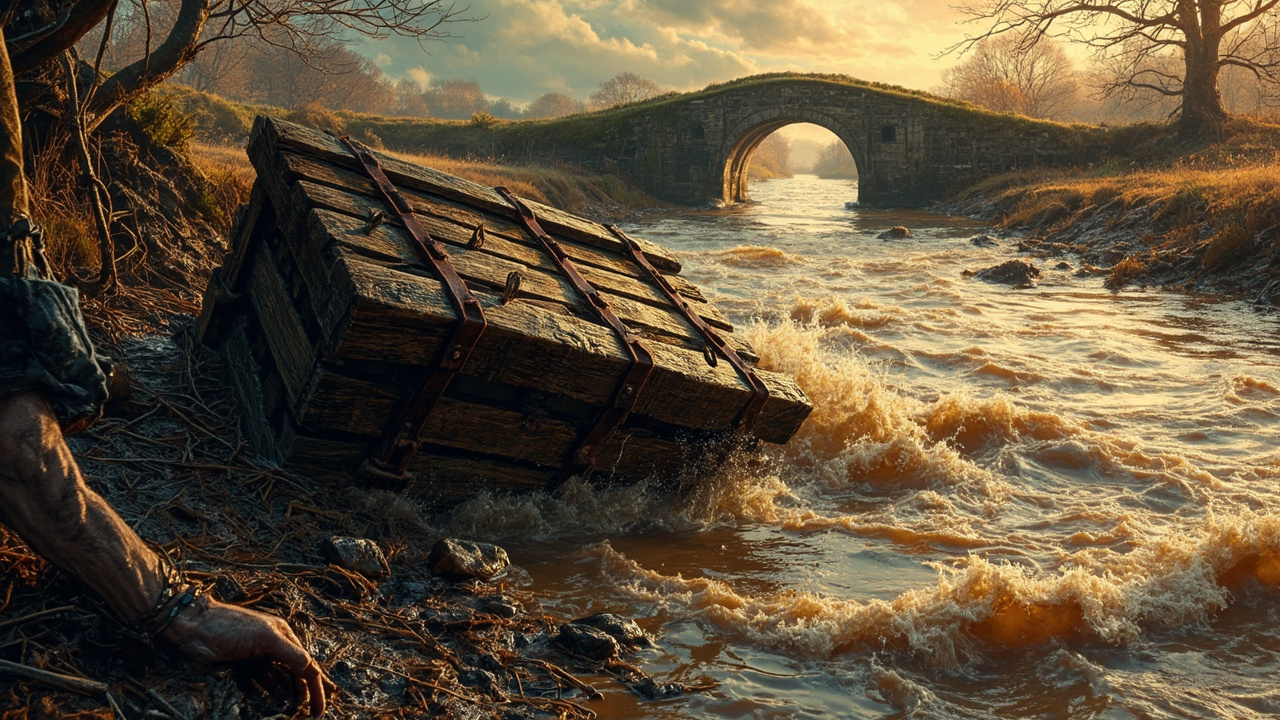
"There," he said, pointing to a shelf of gravel where the current had carved a deep scour. Half-emerged from the riverbed, wedged between stones like something vomited up by the water, lay a timber crate the size of a coffin.
Eleanor felt her heart quicken. The wood was dark with age, blackened at the edges, but the construction was unmistakable—heavy oak planks joined with iron bands, the joints sealed with what looked like pitch and moss. Medieval. It had to be medieval.
"There are more," Tom said quietly. "Three more that I've counted. The flood moved this one, but the others are still buried. Must've been here for centuries."
They worked for three days, Eleanor and Tom, wading through the cold shallows with the careful patience of archaeologists and the practical wisdom of a man who understood floodwaters. The local museum dispatched conservators. A police presence was established to ward off treasure hunters who had heard rumours. The papers, predictably, went berserk.
But it was Eleanor who pieced together the story, working by lamplight in the back room of Tom's cottage while the rain hammered the windows. The crates, she determined, had been deliberately cached—the pitch seals designed to make them watertight, the iron bands hammered tight to resist the crush of river debris. Someone had placed them here intentionally, perhaps in haste.
Her hypothesis came together slowly, built from watermarks and pollen analysis and the careful dating of the manuscripts within. The monastery at Ashford, three miles upstream, had been dissolved in 1536 during Henry VIII's purge of the religious houses. Its priors had been given eighteen months to disband. Most had complied. Most had handed over their treasures.
But not all.
The manuscripts were liturgical texts and devotional works, illuminated in the distinctive style of the Ashford scriptorium. There were chronicles recording the monastery's founding in the eleventh century, land deeds, correspondence with the great abbeys of the region. One volume, preserved in remarkable condition despite its five centuries beneath the river, contained a letter in a prior's own hand: We have salvaged what we could. Let the river guard what we cannot carry. May God forgive our deception and preserve these things for those who come after.
Tom read over her shoulder that night, his brow furrowed in concentration. "They hid them deliberate," he said. "The monks. They knew someone would come looking."
"Yes." Eleanor set down her tea. "They must have cached them here, intending to return when things calmed down. But they never did. Perhaps they were imprisoned, or executed, or simply... forgot." She looked at the letter, the careful medieval script. "Five hundred years, lost to the river. And now here we are."
Tom was quiet for a long moment. Then he said, "Funny thing, isn't it? How some things want to be found."
The manuscripts were eventually catalogued and distributed to appropriate institutions—the British Library, the Bodleian, the county archive. Eleanor wrote the definitive paper on their discovery and spent the following year giving lectures up and down the country. But she never forgot those three days in Tom's cottage, the rain on the windows, the smell of old parchment and river mud, the strange communion between past and present.
She went back to Millthorpe the following spring, when the river had settled into its summer calm. Tom was mending nets on the bank, the same spot where she had first seen the crates. He looked up as she approached.
"Dr. Marsh," he said. "Good to see you."
She sat beside him and watched the river flow. Somewhere beneath the surface, among the gravel and the reeds, other secrets might still be waiting—the things the monks had hidden too well to be found, the mysteries that preferred the dark. But for now, she thought, this was enough. Some stories only needed half a telling. The rest belonged to the river.