Must Know Vocabulary
| Word | العربية | Deutsch | Français | Русский |
|---|---|---|---|---|
| مخطوطة علمية | Monographie | monographie | монография | |
| حطام | Trümmer | débris | обломки | |
| توهج | Lumineszenz | luminescence | свечение | |
| نار الراعي | Holzlicht | foxfire | блуждающие огни | |
| المدفن | Steuerbord | tribord | правый борт | |
| تبييض | Vertuschung | blanchiment | сокрытие | |
| تحقيق | Untersuchung | enquête | расследование | |
| بحري | maritim | maritime | морской |
The Story
Dr Eleanor Ashworth had spent thirty-two years devoted to the Titanic. She had lectured at universities from Southampton to Cape Town, authored three acclaimed monographs on shipboard social hierarchies, and once spent a bone-cold fortnight diving to the debris field off Newfoundland. Yet nothing in her distinguished career had prepared her for the morning the letter arrived.
The Arrival
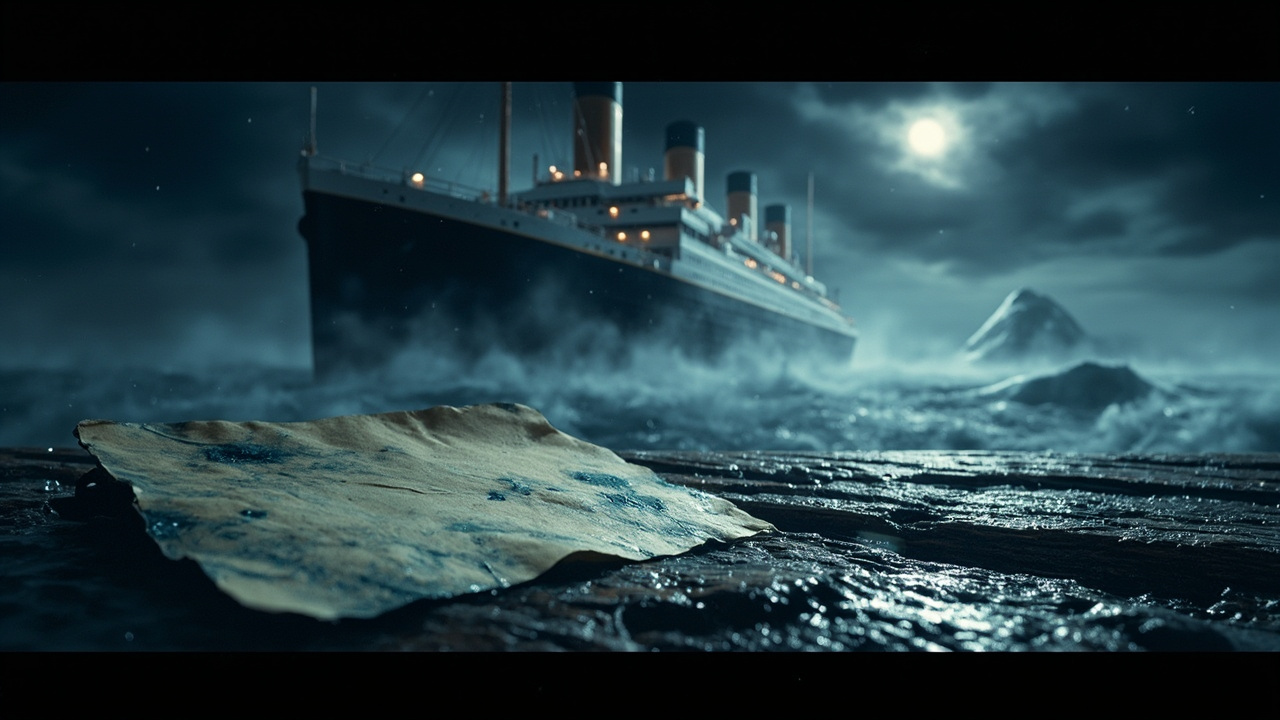
It came without return address, bundled with three others inside a jiffy bag postmarked Bristol, though the handwriting on the inner envelope belonged to neither collector nor crackpot. The paper was thin, cream-coloured, water-stained at one corner in a pattern she recognised instantly — the distinctive tide-mark left by seawater. The ink had bled in places, letters dissolving into blue-grey halos, as though the writer had composed the words with trembling hands while the world tilted around her.
There was no name. No signature. Just three densely written pages that began without preamble or courtesy.
14 April 1912
If you are reading this, then I have failed to send it, or it has outlived me, which amounts to the same thing. I write quickly because the cold is unbearable and my hands will not stay steady. I must set down what I saw, though I am not certain anyone will believe it, or that belief matters anymore.
The Account
Dr Ashworth read the letter twice before permitting herself to breathe. The author described the collision not as a glancing blow but as something far stranger — a sound beneath the hull that resonated through the ship's bones like a struck bell, followed by a shudder that seemed to travel aft from bow to stern in a wave. The official testimony spoke of ice. This letter spoke of something else.
According to the writer, who claimed a position near the bridge, the iceberg — or what had struck them — had carried a peculiar luminescence in the moments before impact. A pale, organic glow, visible even through the fog. She compared it to foxfire, the phosphorescent decay of wood in autumn fields. Several officers had remarked upon it. None of their testimonies, she implied, had made it into the public record.
But it was the final paragraph that made Ashworth set the letter down and walk to the window, needing sky and distance and the ordinary hum of traffic below.
The writer claimed she had seen a second vessel — not the Californian, whose silence had haunted the inquiry for over a century, but something smaller. A craft moving without lights, circling the starboard side of the Titanic after the lifeboats had been lowered. She described figures aboard who made no attempt to assist, merely watched, their faces unreadable in the darkness. She wrote that she had shouted to them, that her voice had been carried away on the wind, and that a man aboard the vessel had raised his hand as if in greeting or farewell before the ship had turned and vanished into the fog.
The Historian's Doubt
Ashworth spent the following week cross-referencing every detail. The description of the collision was idiosyncratic but not inconsistent with accounts she had studied for decades. Survivor's memory is notoriously unreliable — distorted by trauma, by subsequent retelling, by the relentless pressure of collective memory — yet this letter carried the unmistakable texture of immediacy. The sentences were short and urgent. The corrections, the blots where the pen had lifted and returned, the way one word had been abandoned in favour of another: all of it bespoke a mind working at the very edge of comprehension.
She called her colleague Marcus, a maritime archaeologist with a speciality in early twentieth-century emergency protocols. She read him the relevant passages. He was quiet for a long time before speaking.
"It could be fabrication," he said. "Someone with detailed knowledge, making a sophisticated contribution to the mythology."
"Or?"
"Or it's genuine, and the official inquiry was a whitewash far more comprehensive than we imagined."
Neither possibility sat comfortably with her. Ashworth was a scholar; she dealt in evidence and corroboration, not conspiracy. And yet the letter's emotional truth was difficult to dismiss. Whoever had written those words had been frightened. Genuinely frightened. Not of the water or the cold or the inevitability of death — but of the thing she had seen watching from the darkness.
The Decision
In the end, Ashworth did what scholars do. She catalogued the letter, noted its provenance, dated it as approximately contemporary with the disaster based on paper stock and ink composition, and filed it among her research materials. She wrote a single private notation in the margin of her copy: Unverifiable but structurally significant. Do not publish without further evidence.
She told herself she was being cautious. Disciplined. Responsible to the historical record.
But late at night, alone in her study with a glass of whisky and the letter unfolded before her, she allowed herself to wonder. The Titanic had always carried a surplus of meaning — hubris, class, the limits of human confidence in machines. Perhaps it also carried secrets that had sunk beyond the reach of any inquiry. Perhaps some stories are not meant to be told all at once, but left floating in the deep, waiting for the right moment to surface.
The letter had no sender. It had no name. But it had survived a hundred and twelve years in salt water and darkness, and it had found its way to her desk.
Ashworth folded it carefully, returned it to its envelope, and placed it in the locked drawer where she kept her most treasured — and most troubling — acquisitions.
Some mornings, she still finds herself standing at the window, looking out at the grey stretch of the estuary, half-expecting to see a light moving on the water where no light should be.