Must Know Vocabulary
| Word | العربية | Deutsch | Español | Français | Italiano |
|---|---|---|---|---|---|
| زوقروزة / صف من الأعمدة | Säulenreihe | columnata | colonnade | colonnato | |
| أنقاض | Trümmer | escombros | décombres | macerie | |
| إعادة الإعمار | Wiederaufbau | reconstrucción | reconstruction | ricostruzione | |
| غياب | Abwesenheit | ausencia | absence | assenza | |
| عقار سكني | Mietshaus | casa de vecindad | immeuble d'habitation | caseggiato | |
| منتدى / ساحة عامة | Forum | foro | forum | foro | |
| أرشيف | Archiv | archivo | archives | archivio | |
| بلدي | kommunal | municipal | municipal | comunale | |
| دليل / برهان | Beweis | evidencia | preuve | prova | |
| قابل للتحقق | überprüfbar | verificable | vérifiable | verificabile |
The Story
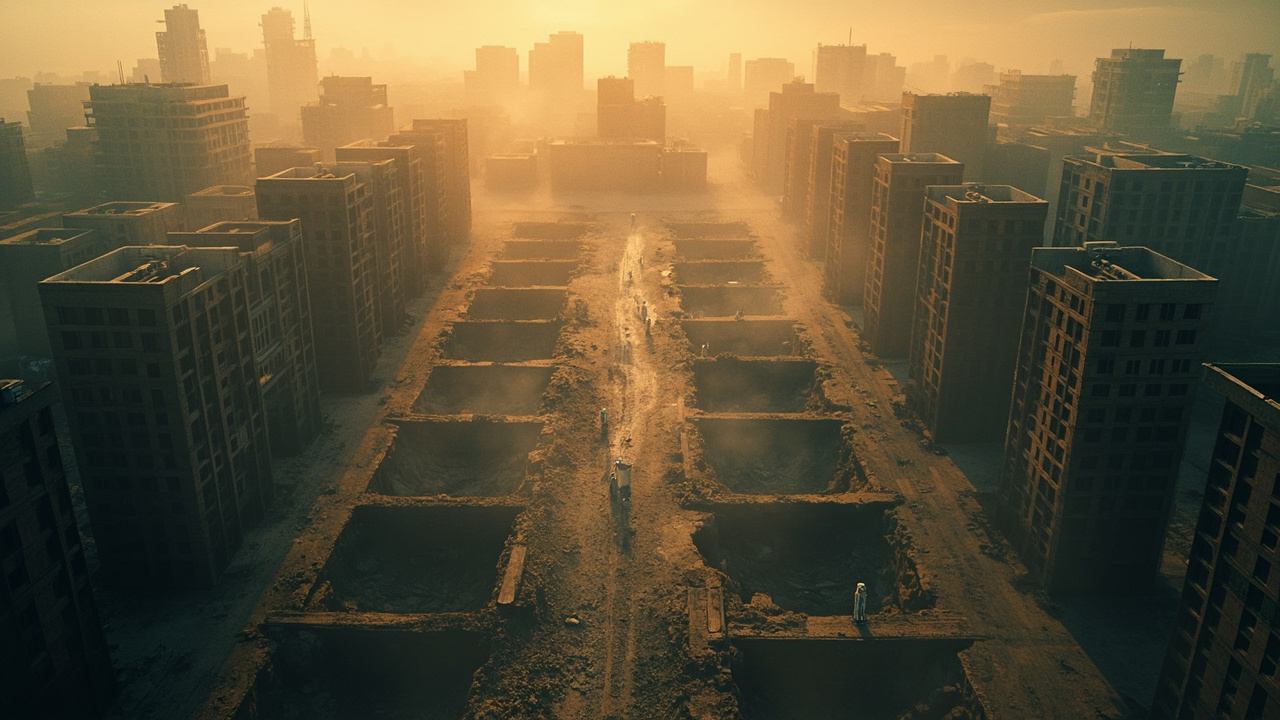
The city had been a wound that refused to heal cleanly. Five years after the bombing, the reconstruction teams still worked in its shadow, and Mira Voss had learned to read the landscape like a medical chart—some streets healthy and striving, others still festering with unresolved absence. She led a team of urban planners tasked with the eastern district, where the rubble had been cleared but nothing yet rebuilt, leaving a grid of empty foundations that waited, patient and accusatory, for someone to tell them what they should become.
It was on the third day of their survey that Mira first heard mention of the colonnade. An elderly woman, one of the few original residents who had returned, pointed to an empty lot between two rebuilt tenements and said, with absolute certainty: "There, where the colonnade used to stand. We gathered there every Sunday."
Mira consulted her plans. The lot in question was listed as open ground, pending development. There was no record of any colonnade. No architectural drawings, no historical photographs, no mention in any document she could locate. She assumed the woman had confused it with another part of the city, perhaps the forum that had once graced the main square. She noted the discrepancy and moved on.
But over the following days, the colonnade kept surfacing. An old man spoke of meeting his wife beneath its columns. A former shopkeeper described the way light fell through the gaps in the stonework. Three separate residents independently mentioned a fountain at its centre, shaped like an open hand. Every account placed it in the same location. Every account was detailed, specific, and utterly irreconcilable with the historical record.
Mira spent the evenings in the municipal archive, sifting through pre-war insurance documents and property registers. The building that should have matched—a three-storey residential block with commercial premises on the ground floor—appeared in the records, photographed and measured, its footprint covering precisely the space where the colonnade's supporters insisted their structure had stood. The photographs showed no colonnade. The insurance documents made no mention of one. And yet, when she interviewed the surviving residents with more care, she found that thirty-seven people remembered the same thing: white stone columns, a central fountain, a sense of gathering and belonging that the photographs could not capture and the documents could not deny.
"The colonnade was where we came to understand each other," the elderly woman said when Mira returned to her doorstep. "Where disagreements were settled. Where children learned what it meant to be part of something larger than themselves." She looked at Mira with eyes that held no doubt. "How can you not know this? Everyone knew the colonnade."
Mira found herself unable to answer. She had spent twenty years studying how buildings shaped human experience, how cities encoded memory in stone and mortar. She believed, fundamentally, in the authority of architecture—the idea that what was built left evidence, that structures persisted in the world long after their builders had gone. But here was a city remembering something that had never been recorded, never been built, never existed in any way she could verify. And the memory was not vague or uncertain. It was precise, detailed, shared across dozens of minds that had no obvious reason to agree.
She brought her findings to her team. Elhardt, the structural engineer, listened carefully and then asked the question she had been avoiding: "What if the building was never meant to be permanent? What if it existed only when someone was looking?" She dismissed the idea immediately—architecture was not magic, not perception, not something that wavered in and out of existence according to the observer's attention. But Elhardt continued: "Think about what we know of the original surveyors. They were thorough, meticulous. They documented everything. And yet there's no record of this structure. What if that's because they couldn't see it either?"
Mira returned to the archive. She found a reference to a 1938 survey that had supposedly documented every significant structure in the eastern district. The bound volume should have been there, but the shelf was empty. A librarian recalled that it had been withdrawn for restoration and never returned. Another document, a loose page from a municipal report, mentioned the construction of a "public gathering space" in the district centre, designed to "foster community cohesion and provide a symbolic focus for civic identity." The page was torn, its illustrations missing. But in the margin, in handwriting she did not recognise, someone had written: "This project cannot proceed as planned. The building refuses to be completed."
The phrase unsettled her more than she could explain. She returned to the empty lot at the centre of the district, now surrounded by the tentative bustle of reconstruction. Standing there in the autumn chill, she thought she understood what the phrase meant. The building the residents remembered was not a building at all—not in the sense of something that could be drawn and measured and approved. It was a gathering, a habit of meeting, a pattern of human connection that had become so deeply embedded in the community's self-understanding that it persisted long after the physical structure that had housed it had been destroyed. The colonnade had been real, but its reality was architectural only in the sense that architecture is always about something more than buildings. It was about the space between people, the distance that could be closed, the silence that could be shared.
The bombers had destroyed it along with everything else. But memory is not bound by the laws of physics. The residents had reconstructed their colonnade in the only way available to them—in stories, in habits, in the persistent conviction that a certain empty lot had once meant something more than emptiness.
Mira submitted her report to the reconstruction authority. She recommended that the empty lot be designated as a public garden rather than a building site, that its future use reflect the gathering function the community remembered. The recommendation was accepted. The following spring, the first trees were planted.
Years later, walking through the now-established garden, Mira saw an elderly woman sitting on a bench beneath a flowering horse chestnut. The woman smiled at her and said: "Thank you for giving us our colonnade back."
Mira smiled in return. She had given them nothing. She had only listened to what they had never lost.