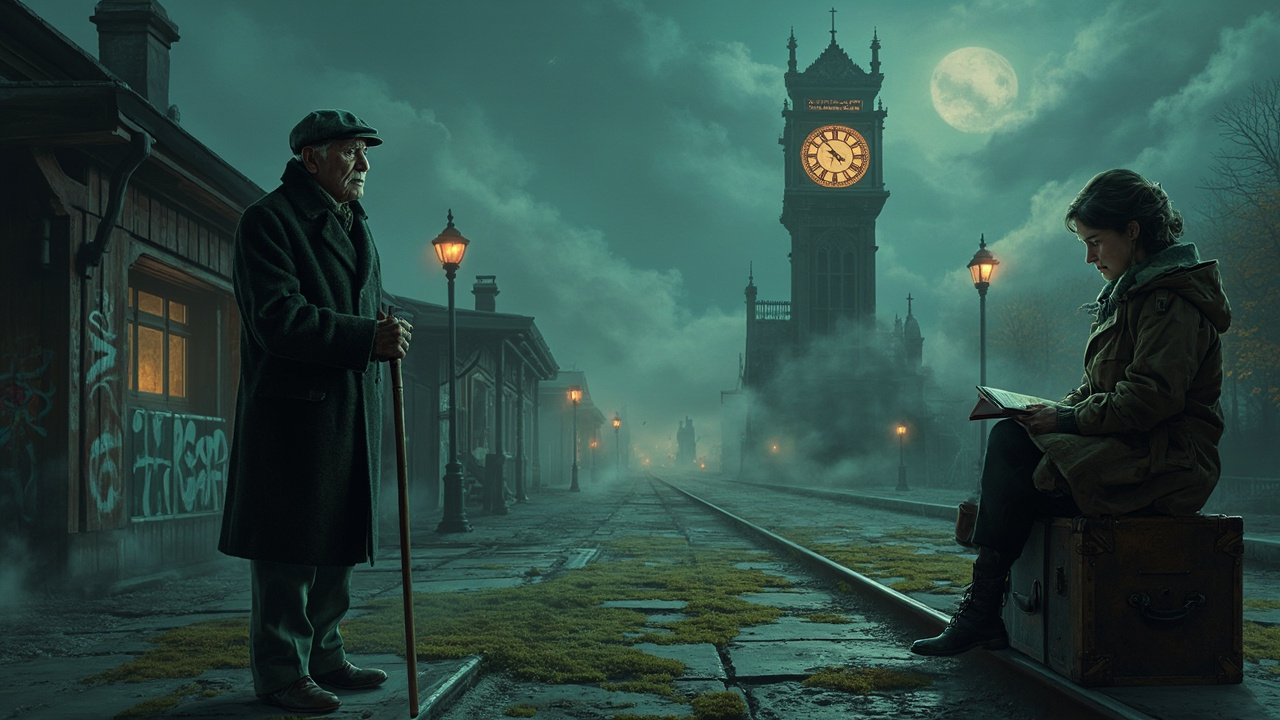
لم يطأ هارولد بيمبرتون رصيف المحطة رقم ثلاثة في محطة آشفورد الصغيرة منذ سبعة وثلاثين عاماً. لكنه وقف هناك الآن، عصاه الخشبية تقرع الحصى المبلل، وأنفاسه تكوّن غيوماً صغيرة في هواء نوفمبر. كانت المحطة قد أُغلقت عام 1987، وأصبح مكتب التذاكر الخشبي وجهاً كاذباً للكتابات على الجدران والإهمال. لكن ساعة البرج هي التي جعلته يقف ميتاً في مكانه.
كانت الساعة القديمة المتزامنة - وجهها المطلبي بالأحمر القاني الخاص بالسكة الحديد الجنوبية - تدور إلى الوراء.
رمش هارولد، متأكداً أن الساد في عينيه يخدعه. استشار ساعته: الثانية والنصف ظهراً. رفع نظره إلى البرج. كانت العقارب تدور بعكس اتجاه الساعة، Secundhand تمر على الأرقام بترتيب عكسي. ارتجف هارولد ارتجافاً لم يكن له علاقة بالبرد.
"مدهش، أليس كذلك؟"
استدار ليجد شابة في السادسة عشرة من عمرها جالسة على حقيبة سفر مقلوبة، دفتر على حضنها وآلة تصوير معلقة حول رقبتها. كانت ترتدي معطفاً واقياً من المطر بضع مقاسات أكبر من مقاسها، وشعرها الداكن مشدود إلى خلف في ذيل حصان مهمل.
"من تكون أنت إذن؟" صرخ هارولد.
"ميا تشن. مستكشفة حضرية. مؤرخة هاوية." قالت هذا دون أن ترفع نظرها، قلمها يخدش الورق. "أوثق المحطات المهجورة على هذا الخط منذ سنتين. أنت أول شخص أراه هنا ينتمي فعلاً." أجلجت إليه إذن، عيناها حادتان وواعيتان. "أنت هارولد بيمبرتون. مدير المحطة. وجدت اسمك في الدفاتر القديمة."
شعر هارولد فجأة أنه عتيق. "كان ذلك منذ عمر بعيد، آنستي تشن. قبل أن تولدِ بزمن."
"هذا يجعلك مثالياً." أغلقت دفترها بحدة. "أحاول فهم هذه الساعة منذ أسابيع. تدور إلى الوراء كل يوم بين الثانية والنصف والثالثة ظهراً. بالضبط. لا يوجد تفسير وجدته منطقياً."
درس هارولد الساعة مجدداً، هذه المرة ملاحظاً ما فاته من قبل: الدقة الميكانيكية المتعمدة لعكسها. لم يكن هذا عطلاً. كان تصميم.
"أعرف لماذا،" قال بهدوء. "أو على الأقل، أظن أنني أعرف."
وجدا مأوى في ما كان ذات يوم مكتب مدير المحطة. أنتجت ميا ترمس شاي وكأسين ميناويين مهترئين، ووجد هارولد نفسه يتحدث كما لم يتحدث منذ عقود - لهذه الفتاة الغريبة الحادة التي كانت تستمع وكأن كل كلمة تهم.
حكى لها عن إليانور آشبي، كاتبة المحطة عام 1943. عن توماس ويتاكر، الرائد في المهندسين الملكيين الذي كان يركب قطار الثانية والنصف إلى دوفر كل خميس بعد الظهر لرؤيتها. عن الوعد الذي قطعاه تحت هذه الساعة بالذات: أنه سيعود، وأنها ستر_WAIT، وأنهما سيبدآن حياتهما معاً في اللحظة التي تنتهي فيها الحرب.
"لم يَعُد أبداً، أليس كذلك؟" سألت ميا.
هز هارولد رأسه ببطء. "قُتل توماس في أرنهيم. لكن إليانور لم تعلم بذلك إلا بعد أشهر من وصول الإشعار الرسمي إلى المحطة. كل يوم في الثانية والنصف، كانت تقف على هذا الرصيف، تراقب قطار لندن وهو يصل، متأكدة أنه سيخطو منه."
في النهاية، أوضح هارولد، كانت إليانور هي من أوكلت آلية الساعة - تعديل خاص على المحرك المتزامن القياسي. كانت الساعة ستدور إلى الوراء خلال الدقائق الأربع المحددة التي استغرقها رحلة توماس الأخيرة، تسجل كل لحظة بالترتيب العكسي كأن الزمن نفسه يمكن فكه. تمرداً صغيراً على قسوة الغياب. طريقة للتمسك.
"لم تتزوج أبداً،" تابع هارولد. "كرست حياتها للمحطة. عندما أُغلقت أخيراً، كتبت إلى مجلس السكة الحديدية تطلب الحفاظ على الساعة. استسلم لها، أفترض. حُفظت منذ ذلك الحين بواسطة صندوق محلي - رغم أنني أشك أن كثيرين منهم يعرفون قصتها."
صمتت ميا لحظة طويلة. ثم قالت: "هذا مؤلم الجمال بشكل لا يُحتمل."
"إنه مؤلم الحزن بشكل لا يُحتمل،" رد هارولد. "لكن ربما هذان نفس الشيء."
جلسا معاً بينما تلاشى ضوء ما بعد الظهر، الساعة تكمّل طقوسها الغريبة فوقهما. عندما دقت الثالثة، clicking بلطف، واستأنفت العقارب دورانها الطبيعي - كأن الكون سامح هذا الانحراف القصير وعاد إلى ترتيبه الصحيح.
"هل ستعود؟" سألت ميا وهما.prepareing للمغادرة.
تأمل هارولد السؤال. فكر في إليانور، في توماس، في الوعود التي قُطعت وكُسرت وقُطعت ثانية بالطريقة الوحيدة المتبقية. فكر في زوجته التي رحلت الآن منذ خمس سنوات، وفي الطريقة التي يرتدي بها الحزن أحياناً وجه ساعة ترفض اتباع القواعد.
"أظن أنني قد أفعل،" قال. "شكراً لأنكِ escuchaste، الآنسة تشن."
"ميا،" صححت له. "وشكراً لأنك تتذكر."
تركها بين أشباح المحطة، قلمها يتحرك على الورق مرة أخرى. الساعة فوقهما tick steadily forward, then backward, then forward again - بالطريقة التي تفعل بها كل الساعات، افترض هارولد، عندما تتوقف عن محاولة فهمها وتتركها فقط تكون.
Harold Pemberton hatte seit siebenunddreißig Jahren keinen Fuß mehr auf den Bahnsteig drei des Haltepunkts Ashford gesetzt. Und doch stand er jetzt hier, sein Spazierstock klopfte gegen die abgetretenen Fliesen, sein Atem bildete kleine Wolken in der Novemberluft. Der Bahnhof war 1987 stillgelegt worden, sein hölzernes Fahrkartenhäuschen nur noch eine Fassade aus Graffiti und Verwahrlosung. Aber es war der Uhrturm, der ihn abrupt stoppen ließ.
Die alte Synchronuhr - ihr Zifferblatt in dem tiefen Karmesinrot der Southern Railway gestrichen - tickte rückwärts.
Harold blinzelte, sicher, dass seine Katarakte ihm Streiche spielte. Er konsultierte seine Armbanduhr: 14:47 Uhr. Er schaute zum Turm hinauf. Die Zeiger bewegten sich gegen den Uhrzeigersinn, der Sekundenzeiger strich in umgekehrter Reihenfolge über die Zahlen. Ein Schauer durchlief ihn, der nichts mit der Kälte zu tun hatte.
"Faszinierend, nicht wahr?"
Er drehte sich um und fand ein junges Mädchen von vielleicht sechzehn Jahren, das auf einem umgedrehten Koffer saß, ein Notizbuch auf dem Schoß und eine Kamera um den Hals. Sie trug eine abgetragene Regenjacke, die mehrere Nummern zu groß war, und ihr dunkles Haar war zu einem unordentlichen Pferdeschwanz zurückgebunden.
"Wer zum Teufel sind Sie?" verlangte Harold zu wissen.
"Mia Chen. Urbane Entdeckerin. Hobbyhistorikerin." Sie sagte dies, ohne aufzublicken, während ihr Bleistift über das Papier kratzte. "Ich dokumentiere seit zwei Jahren aufgegebene Bahnhöfe entlang dieser Strecke. Sie sind die erste Person, die ich hier sehe, die wirklich hierher gehört." Sie blickte ihn dann an, ihre Augen scharf und wissend. "Sie sind Harold Pemberton. Der Bahnhofsvorsteher. Ich habe Ihren Namen in den alten Ledgern gefunden."
Harold fühlte sich plötzlich uralt. "Das war ein ganzes Leben her, Fräulein Chen. Lang bevor Sie geboren wurden."
"Was Sie perfekt macht." Sie klappte ihr Notizbuch zu. "Ich versuche seit Wochen, diese Uhr zu verstehen. Sie läuft jeden Tag zwischen 14:40 und 15:00 Uhr rückwärts. Exakt. Keine Erklärung, die ich gefunden habe, ergibt einen Sinn."
Harold studierte die Uhr erneut, diesmal bemerkte er, was er zuvor übersehen hatte: die absichtsvolle, mechanische Präzision ihrer Umkehrung. Das war keine Fehlfunktion. Das war Design.
"Ich weiß warum," sagte er leise. "Oder zumindest glaube ich, es zu wissen."
Sie fanden Unterschlupf in dem, was einmal das Büro des Bahnhofsvorstehers gewesen war. Mia brachte einen Thermobehälter mit Tee und zwei abgenutzte Emaillebecher zum Vorschein, und Harold fand sich dabei wieder, wie er seit Jahrzehnten nicht mehr gesprochen hatte - zu diesem seltsamen, scharfsinnigen Mädchen, das zuhörte, als ob jedes Wort wichtig wäre.
Er erzählte ihr von Eleanor Ashby, der Schalterbeamten im Jahr 1943. Von Thomas Whitaker, einem Feldwebel der Pioniere, der jeden Donnerstagnachmittag den 14:40-Uhr-Zug nach Dover nahm, um sie zu sehen. Von dem Versprechen, das sie unter dieser selben Uhr gemacht hatten: dass er zurückkehren würde, und sie warten würde, und sie ihr gemeinsames Leben beginnen würden, sobald der Krieg endete.
"Er ist nie zurückgekommen, oder?" fragte Mia.
Harold schüttelte langsam den Kopf. "Thomas wurde bei Arnheim getötet. Aber Eleanor erfuhr davon erst Monate, nachdem die offizielle Benachrichtigung im Bahnhof eingegangen war. Jeden Tag um 14:40 Uhr stand sie auf diesem Bahnsteig, beobachtete die ankommenden Züge aus London, sicher, dass er aus einem von ihnen aussteigen würde."
Schließlich, erklärte Harold, hatte Eleanor den Uhrmechanismus selbst in Auftrag gegeben - eine maßgeschneiderte Änderung am standardmäßigen Synchronmotor. Die Uhr würde während der genauen vier Minuten von Thomas' letzter Reise rückwärts laufen, jeden Moment in umgekehrter Reihenfolge markieren, als ob die Zeit selbst zurückgespult werden könnte. Eine kleine Rebellion gegen die Grausamkeit der Abwesenheit. Eine Art des Festhaltens.
"Sie hat nie geheiratet," fuhr Harold fort. "Sie hat ihr Leben dem Bahnhof gewidmet. Als er schließlich geschlossen wurde, schrieb sie an den Eisenbahnvorstand und bat darum, die Uhr zu erhalten. Sie haben ihr nachgegeben, nehme ich an. Sie wird seitdem von einem lokalen Verein gepflegt - obwohl ich bezweifle, dass viele von ihnen ihre Geschichte kennen."
Mia war lange Zeit still. Dann: "Das ist unerträglich schön."
"Es ist unerträglich traurig," erwiderte Harold. "Aber vielleicht ist das dasselbe."
Sie saßen zusammen, während das Nachmittagslicht verblasste, die Uhr ihr seltsames Ritual über ihnen vollendete. Als 15:00 Uhr schlug, klickte der Mechanismus leise, und die Zeiger nahmen ihre normale Drehung im Uhrzeigersinn wieder auf - als ob das Universum die kurze Ausnahme vergeben hätte und zu seiner eigentlichen Ordnung zurückgekehrt wäre.
"Werden Sie wiederkommen?" fragte Mia, als sie sich zum Gehen anschickten.
Harold dachte über die Frage nach. Er dachte an Eleanor, an Thomas, an Versprechen, die gehalten, gebrochen und immer noch gehalten wurden, auf die einzige Weise, die blieb. Er dachte an seine eigene Frau, die nun seit fünf Jahren fort war, und daran, wie Trauer manchmal das Gesicht einer Uhr trägt, die sich weigert, den Regeln zu folgen.
"Ich glaube, das könnte ich," sagte er. "Danke fürs Zuhören, Fräulein Chen."
"Mia," korrigierte sie ihn. "Und danke, dass Sie sich erinnern."
Er ließ sie dort bei den Geistern des Bahnhofs, ihr Bleistift bewegte sich erneut über das Papier. Die Uhr über ihnen tickte beständig vorwärts, dann rückwärts, dann wieder vorwärts - so wie alle Uhren es tun, nahm Harold an, wenn man aufhört, Sinn in ihnen zu suchen, und sie einfach sein lässt.
Harold Pemberton n'avait pas posé le pied sur le Quai Trois de la Halte d'Ashford depuis trente-sept ans. Et pourtant, il se tenait là, sa canne tapant contre les dalles usées, son souffle formant de petits nuages dans l'air de novembre. La gare avait été désaffectée en 1987, son bureau de vente en bois réduit à une façade de graffitis et de négligence. Mais c'était l'horloge de la tour qui l'avait stoppé net.
La vieille horloge synchrone - son cadran peint du rouge profond de la Southern Railway - avançait à l'envers.
Harold cligna des yeux, certain que ses cataractes lui jouaient des tours. Il consulta sa montre : 14h47. Il leva les yeux vers la tour. Les aiguilles se mouvaient dans le sens inverse des aiguilles d'une montre, la trotteuse balayant les chiffres en ordre inverse. Un frisson le parcourut qui n'avait rien à voir avec le froid.
"Fascinant, n'est-ce pas ?"
Il se retourna pour trouver une jeune femme d'une seizaine d'années perchée sur une valise renversée, un cahier sur les genoux et un appareil photo en bandoulière. Elle portait une anorak élimée de plusieurs tailles trop grandes, et ses cheveux sombres étaient tirés en une queue-de-cheval négligée.
"Qui diable êtes-vous ?" demanda Harold.
"Mia Chen. Exploratrice urbaine. Historienne amateur." Dit-elle sans lever les yeux, son crayon grattant le papier. "Je documente les gares abandonnées de cette ligne depuis deux ans. Vous êtes la première personne que je vois ici qui y appartient vraiment." Elle le regarda alors, ses yeux vifs et perspicaces. "Vous êtes Harold Pemberton. Le chef de gare. J'ai trouvé votre nom dans les vieux registres."
Harold se sentit soudain terriblement vieux. "C'était il y a une vie entière, Mademoiselle Chen. Bien avant votre naissance."
"Ce qui fait de vous la personne parfaite." Elle claqua son cahier fermé. "J'essaie de comprendre cette horloge depuis des semaines. Elle recule chaque jour entre 14h40 et 15h00. Précisément. Aucune explication que j'ai trouvée n'a de sens."
Harold étudia l'horloge à nouveau, remarquant cette fois ce qu'il avait manqué avant : la précision mécanique et délibérée de son revers. Ce n'était pas une panne. C'était un design.
"Je sais pourquoi," dit-il doucement. "Ou du moins, je crois savoir."
Ils trouvèrent refuge dans ce qui avait été le bureau du chef de gare. Mia sortit un thermos de thé et deux tasses en émail cabossées, et Harold se mit à parler comme il ne l'avait pas fait depuis des décennies - à cette étrange et vive jeune fille qui écoutait comme si chaque mot importait.
Il lui parla d'Eleanor Ashby, l'employée de gare en 1943. De Thomas Whitaker, un caporal du Génie royal qui prenait le train de 14h40 pour Douvres chaque jeudi après-midi pour la voir. De la promesse qu'ils avaient faite sous cette même horloge : qu'il reviendrait, qu'elle attendrait, et qu'ils commenceraient leur vie ensemble au moment où la guerre prendrait fin.
"Il n'est jamais revenu, n'est-ce pas ?" demanda Mia.
Harold secoua lentement la tête. "Thomas a été tué à Arnhem. Mais Eleanor ne l'a appris que des mois après que la gare ait reçu la notification officielle. Chaque jour à 14h40, elle se tenait sur ce quai, regardant arriver le train de Londres, certaine qu'il en descendrait."
Finalement, expliqua Harold, Eleanor avait elle-même commandé le mécanisme de l'horloge - une modification sur mesure du moteur synchrone standard. L'horloge fonctionnerait à l'envers pendant les quatre minutes exactes du dernier voyage de Thomas, marquant chaque moment à l'envers comme si le temps lui-même pouvait être rembobiné. Une petite rébellion contre la cruauté de l'absence. Une façon de s'accrocher.
"Elle ne s'est jamais mariée," continua Harold. "Elle a dédié sa vie à la gare. Quand elle a finalement fermé, elle a écrit au conseil des chemins de fer pour demander que l'horloge soit préservée. Ils ont cédé à sa demande, je suppose. Elle est entretenue depuis par une association locale - bien que je doute que beaucoup d'entre eux connaissent son histoire."
Mia resta silencieuse un long moment. Puis : "C'est d'une beauté insupportable."
"C'est d'une tristesse insupportable," répondit Harold. "Mais peut-être que c'est la même chose."
Ils restèrent assis ensemble tandis que la lumière de l'après-midi s'estompait, l'horloge accomplissant son étrange rituel au-dessus d'eux. Quand 15h00 sonna, le mécanisme cliqueta doucement, et les aiguilles reprirent leur rotation normale dans le sens des aiguilles d'une montre - comme si l'univers avait pardonné ce bref écart et était revenu à son ordre propre.
"Reviendrez-vous ?" demanda Mia alors qu'ils se préparaient à partir.
Harold réfléchit à la question. Il pensa à Eleanor, à Thomas, aux promesses tenues, brisées et tenues encore de la seule façon qui restait. Il pensa à sa propre femme, disparue depuis cinq ans, et à la façon dont le chagrin portait parfois le visage d'une horloge qui refusait de suivre les règles.
"Je crois que oui," dit-il. "Merci de m'avoir écouté, Mademoiselle Chen."
"Mia," le corrigea-t-elle. "Et merci de vous souvenir."
Il la laissa là parmi les fantômes de la gare, son crayon se déplaçant à nouveau sur le papier. L'horloge au-dessus d'eux marquait le temps vers l'avant, puis vers l'arrière, puis à nouveau vers l'avant - comme le font toutes les horloges, supposa Harold, quand on cesse d'essayer de leur donner sens et qu'on les laisse simplement être.
Гарольд Пембертон не ступал на Третий путь станции Эшфорд Холт тридцать семь лет. И всё же он стоял здесь, его трость постукивала по истёртым плитам, дыхание образовывало маленькие облачка в ноябрьском воздухе. Станция была закрыта в 1987 году, её деревянная касса теперь превратилась в фасад граффити и запустения. Но часы на башне заставили его остановиться как вкопанного.
Старые синхронные часы — их циферблат, выкрашенный в глубокий алый цвет Южной железной дороги — шли в обратном направлении.
Гарольд моргнул, будучи уверен, что его катаракта играет с ним шутки. Он посмотрел на свои часы: 14:47. Поднял взгляд на башню. Стрелки двигались против часовой стрелки, секундная стрелка проходила цифры в обратном порядке. Дрожь пробежала по нему, не имевшая никакого отношения к холоду.
"Завораживает, не правда ли?"
Он обернулся и увидел молодую женщину лет шестнадцати, сидевшую на опрокинутом чемодане, с блокнотом на коленях и фотоаппаратом на шее. На ней была потёртая куртка на несколько размеров больше, а тёмные волосы были стянуты в небрежный хвост.
"Кто вы, чёрт возьми, такая?" — потребовал Гарольд.
"Миа Чен. Исследовательница городских пространств. Любитель-историк." Сказала она, не поднимая глаз, карандаш скрежетал по бумаге. "Я документирую заброшенные станции этой линии уже два года. Вы первый человек, которого я вижу здесь, кто действительно принадлежит этому месту." Она взглянула на него тогда, её глаза были острыми и знающими. "Вы Гарольд Пембертон. Начальник станции. Я нашла ваше имя в старых журналах."
Гарольд вдруг почувствовал себя древним. "Это было целую жизнь назад, мисс Чен. Задолго до вашего рождения."
"Что и делает вас идеальным." Она захлопнула блокнот. "Я уже несколько недель пытаюсь понять эти часы. Они идут назад каждый день между 14:40 и 15:00. Точно. Ни одно объяснение, которое я находила, не имеет смысла."
Гарольд снова изучил часы, на этот раз заметив то, что пропустил раньше: преднамеренную, механическую точность их разворота. Это была не неисправность. Это был замысел.
"Я знаю почему," — сказал он тихо. "Или, по крайней мере, думаю, что знаю."
Они нашли укрытие в том, что когда-то было кабинетом начальника станции. Миа достала термос с чаем и две помятые эмалированные кружки, и Гарольд обнаружил, что говорит так, как не говорил десятилетиями — с этой странной, проницательной девушкой, которая слушала так, будто каждое слово имело значение.
Он рассказал ей об Элеоноре Эшби, кассирше станции в 1943 году. О Томасе Уитакере, капрале Королевских инженерных войск, который каждую четверг после обеда садился на поезд 14:40 до Дувра, чтобы увидеть её. О клятве, которую они дали под этими самыми часами: что он вернётся, она будет ждать, и они начнут совместную жизнь в тот момент, когда закончится война.
"Он так и не вернулся, ведь так?" — спросила Миа.
Гарольд медленно покачал головой. "Томас погиб под Арнемом. Но Элеонора узнала об этом лишь через месяцы после того, как станция получила официальное уведомление. Каждый день в 14:40 она стояла на этой платформе, наблюдая за прибытием лондонского поезда, будучи уверена, что он сойдёт с него."
В конце концов, объяснил Гарольд, Элеонора сама заказала механизм часов — особую модификацию стандартного синхронного двигателя. Часы должны были идти назад точно четыре минуты — время последнего путешествия Томаса, отмечая каждый момент в обратном порядке, словно само время можно перемотать. Маленький бунт против жестокости разлуки. Способ удержать.
"Она так и не вышла замуж," — продолжил Гарольд. "Посвятила свою жизнь станции. Когда она наконец закрылась, она написала в правление железной дороги с просьбой сохранить часы. Они ей угодили, надо полагать. С тех пор их поддерживает местный фонд — хотя я сомневаюсь, что многие из них знают их историю."
Миа долго молчала. Потом: "Это невыносимо красиво."
"Это невыносимо печально," — возразил Гарольд. "Но, возможно, это одно и то же."
Они сидели вместе, пока дневной свет угасал, часы над ними завершали свой странный ритуал. Когда пробило три, механизм тихо щёлкнул, и стрелки возобновили своё обычное движение по часовой стрелке — словно вселенная простила эту краткую уступку и вернулась к надлежащему порядку.
"Вы вернётесь?" — спросила Миа, когда они собрались уходить.
Гарольд обдумал вопрос. Он думал об Элеоноре, о Томасе, о клятвах, которые были сдержаны, нарушены и всё ещё сдерживаются единственным оставшимся способом. Он думал о своей жене, ушедшей пять лет назад, и о том, как горе порой надевает лицо часов, отказывающихся следовать правилам.
"Думаю, что да," — сказал он. "Спасибо, что выслушали, мисс Чен."
"Миа," — поправила она. "И спасибо, что помните."
Он оставил её там, среди призраков станции, её карандаш снова скользил по бумаге. Часы над ними мерно тикали вперёд, потом назад, потом снова вперёд — так, как делают все часы, как предполагал Гарольд, когда перестаёшь пытаться найти в них смысл и просто позволяешь им быть.